Saint Stephen the Martyr Catholic Church was dedicated in Novemeber 1991 as the church for a non-territorial parish serving Birmigham’s university and college community. Later, it became a chapel within the parish of the Cathedral of St. Paul. Thus it is now known as St. Stephen’s Chapel, rather than church. It continues to serve as a campus ministry center.
The church was dedicated in 1991 under the leadership of Fr. Frank Muscolino. Like, Yeilding Chapel at Birmingham-Southern College, the altar is located in the center of the church and originally, worshipers surrounded it on all sides. Thus, in every act of prayer and worship in the church, all worshipers saw not only the altar, the priest, and images of Christ, but also faces of their fellow worshipers. The congregation itself was an important centring focus and symbol. Like many churches, especially innovative ones, this church has seen alterations over the years.
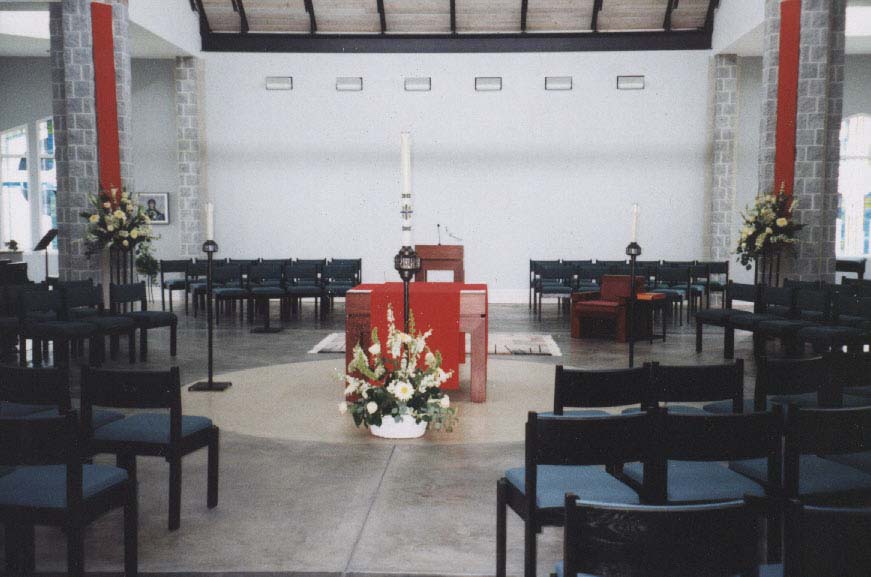
As was then the practice at the Cathedral of St. Paul, the tabernacle where the Blessed Sacrament was reserved was placed in a side chapel. In this case, it was the corner of the church to the right (liturgically south) of the ambo. As in many new Catholic worship spaces of the time, no kneelers were provided for the congregation. Following the custom of the ancient church and many Eastern Orthodox Christians, worshipers stood for all prayers.
Due to both an evolving vision and the fact that full funding was not available when the church opened, decoration of the church evolved under Muscolino’s leadership. Initially there were various art installations around or behind the altar. Then before 1999, a unique crucifix, know as the Christ of the Nations, was suspended above the square free standing altar. It depicted Christ as more than one race. Click here to learn more about this cross. It remained in place throughout the church’s time as a parish.
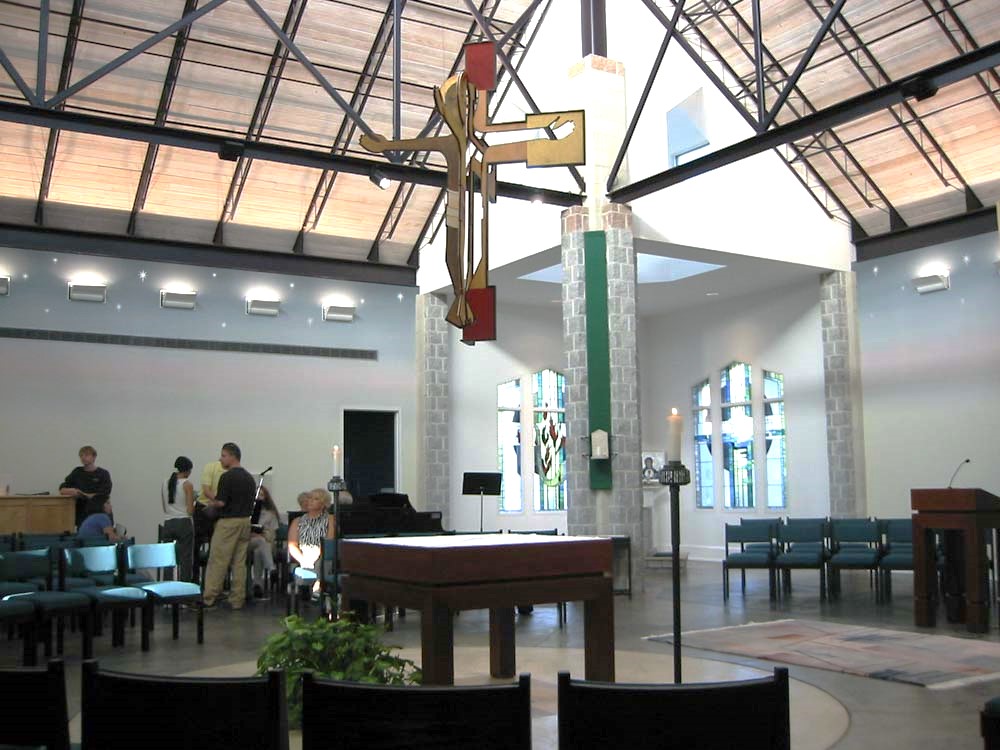
Later a pipe organ was installed behind the ambo. Acoustically, this was the natural space for the instrument, but prior to its installation, this quadrant of the church did not look very different from those to its left and right. The organ began to change a space focused on the center to one with an axis.
Next, the original wooden altar and ambo were covered in marble and the simple concrete circle around the altar covered with beautiful hand made tiles reflecting a rainbow of colors. These changes made the altar and ambo less mobile, fixing them in their positions. Their new aesthetics also suggested a greater degree of importance. It gave them more weight not only physcially, but visually.
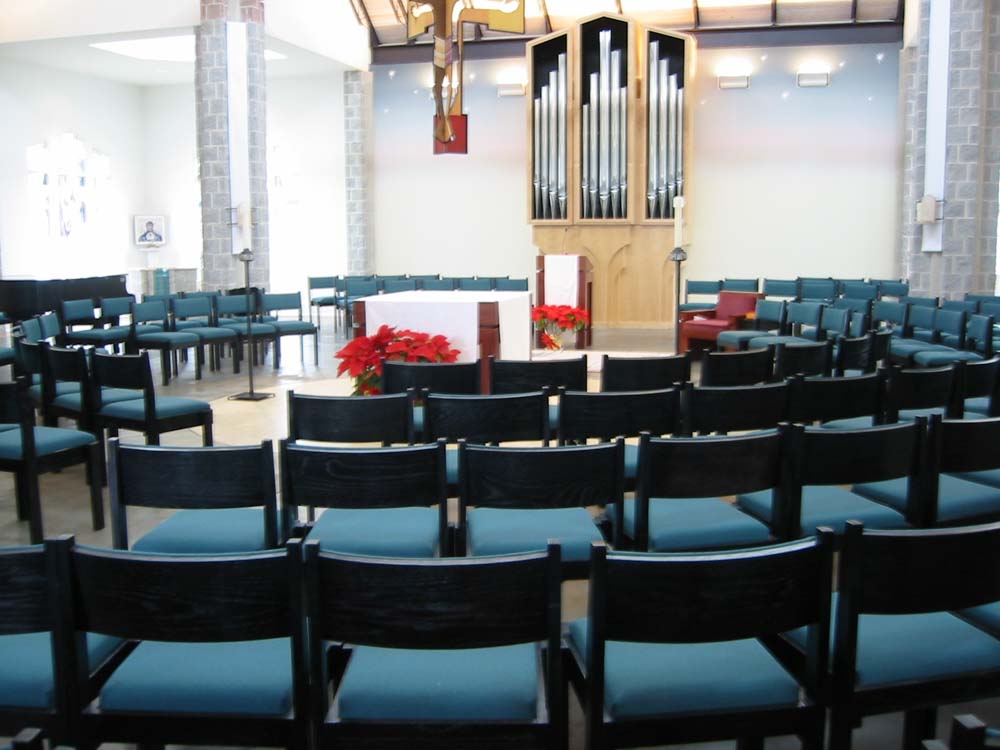

The tile circle also increased a sense of division between a sanctuary around the altar, and a nave, or congregational space surounding it, though they were all still on the same level. The church was still a distinctive space, like a some other Catholic churches in the United States, but unlike most of the Catholic churches in which students coming to Birmingham for college were coming raised. The congregaton remained a strong visual symbol of God’s presence.
After the church became a chapel of the cathedral parish, a number of changes were made that made the chapel more like a “typical” Catholic Church. Most importantly, the tabernacle was moved to in front of the organ, and the ambo moved to the side opposite the presider’s chair and a low screen placed around it.
Additionally the Christ of the Nations was removed. In its innovative artistry it seemed to depict Christ as both dead and alive. While there would be no theological problem with this if it were a series of images, as arguably it is a single image it could be seen as theologically misleading. A more traditional crucifix was installed over the tabernacles’s new location. Soon, a more traditionally styled and golden tabernacle replaced the original silver-colored one.
The altar did not move. The congregation still assembles on three sides of it, though no longer on the side with the ambo and organ. Whereas the chairs were originally arranged in curved rows, they were made straight. Thus there was perhaps less a sense of gathering and more a sense of a focus on the altar. Kneelers were provided for the congregation and regularly used. The instagram posts from the chapel below depict church after these alterations.
In short, an altar-centered space that strongly reflected the innovative work at recovering early Chrsitian practices was brought more in line with spatial arrangements and practices in place before Vatican II. Most importantly, the tabernacle is now on the church’s central axis, opposite the main entrance. The unusualness of the space was reduced. Importantly, this made it a more familiar space for college students coming to Birmingham. But the spatial dynamics of the altar in the round were not eliminated. The altar still remains at the center with the congregation surrounding it on multiple sides.
Click here to return to Yeilding Chapel.
Disclosure: From 2000 into 2007, the author worshiped weekly at St. Stephen where his wife was a parishioner and a eucharistic minister (a title officially changed to extraordinary minister of holy communion at the beginning of this period).
This page is part of “Spaces for Worship: A Birmingham-Based Introduction,” a section of Magic City Religion, written by the editor and funded by Samford University’s Center for Worship and the Arts.
 Magic City Religion