The 1960s were an age of architectural and liturgical innovation. In architecture, the tenets of modernism encouraged freedom, especially if it confirmed to functionality. In liturgy, the project of ressourcement that fueled the Liturgical Movement emphasized that the Lord’s supper was the central event of Christian worship and that it was a communal meal around a table. Together, these encouraged many to build “round churches.” That is, churches in which the altar or communion table was dead center in the space surrounded by worshipers on all sides.
The altar in the round is a natural configuration for a religion sustained by small groups gathered for a meal. It is a curious, if not challenging, arrangement for a religion that prioritizes preaching: the proclamation of a message by one individual to many others. It is hard to talk to a circle, inevitably someone is behind you. Therefore in round churches, often a pulpit, or other preaching desk, was established at one point in the circle. Whether or not this was done, the ideas of equality, unity, and community that the round altar-centered church expressed fueled its appeal. In the mid twentieth century, it was considered idea by many Roman Catholics and by Protestants, such as the famous theologian Karl Barth (1965). It is a very important variety of liturgical space and one embraced by at least three worship spaces in Birmingham.
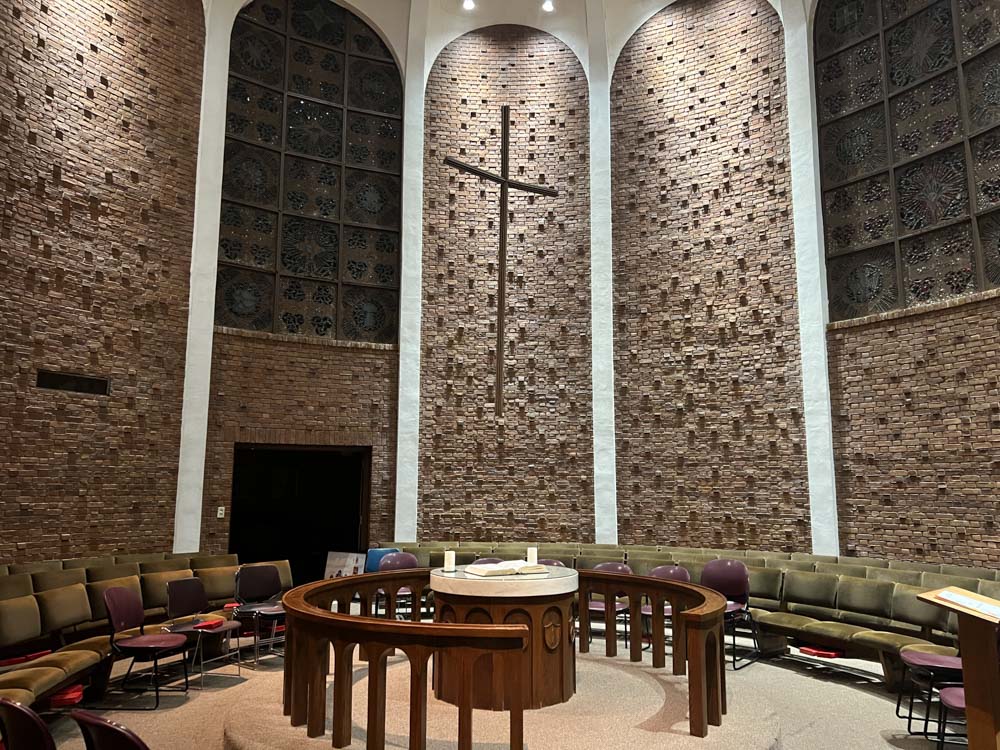
Yeilding Chapel at Birmingham-Southern College is the oldest of these. It opened in 1967. It is a tall brick cylinder with four large stained-glass windows, each keyed to a color of the church year. In the middle is a circular altar inside a circular communion rail above it is suspended a cross a silver mobile above suggests the decent of the Holy Spirit and is lit by a stained-glass oculus in the center of the space (Jackson 2024). Pews circle the altar, constraining the freedom of movement in this innovative space. Originally a pulpit stood opposite the main entrance to the circle.

The pioneering cylindrical college chapel in the United States was the designed by Eero Saarinen for the Massachusetts Institute of Technology. It opened in 1955. While the space was circular, the arrangement was conventionally linear: from the entrance a central aisle led to an altar near the wall of the circle (Kilde 2024). By contrast, Yeilding Chapel is like the much larger Liverpool Metropolitan Cathedral which, like Yeilding, opened in 1967, the same year as the chapel. Both are thoroughly round churches with the altar in the center. This arrangement was not without ancient precedent, but had become very rare. It began being used in a few churches, more in Europe than in America, in the 1930s.
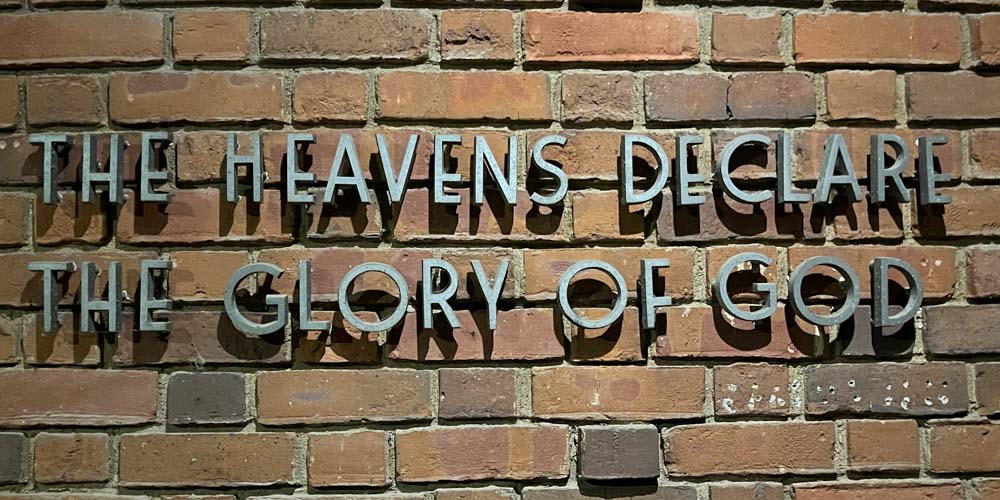
The chapel at Birmingham-Southern is best understood as part of a widespread movement in from the 1930s to 1970s to build small innovative chapels on American college campuses. These were designed for meditation or relatively small services, rather than assemblies of the whole student body (Grubiak 2012, Kilde 2024). Amid the Cold War these chapels sought to show that religion was relevant to the scientific space age. Thus Yeidling Chapel was designed as a complement to the adjoining Robert R. Meyer Planetarium. In the chapel’s entrance, an inscription proclaims “The Heavens Declare the Glory of God” (Psalm 19:1).
It can be useful to evaluate the chapel according to the various frameworks presented on this website.
In plan, the chapel might be considered thoroughly a meetinghouse. It is a space that is entirely focused on the gathering of God’s people for worship.
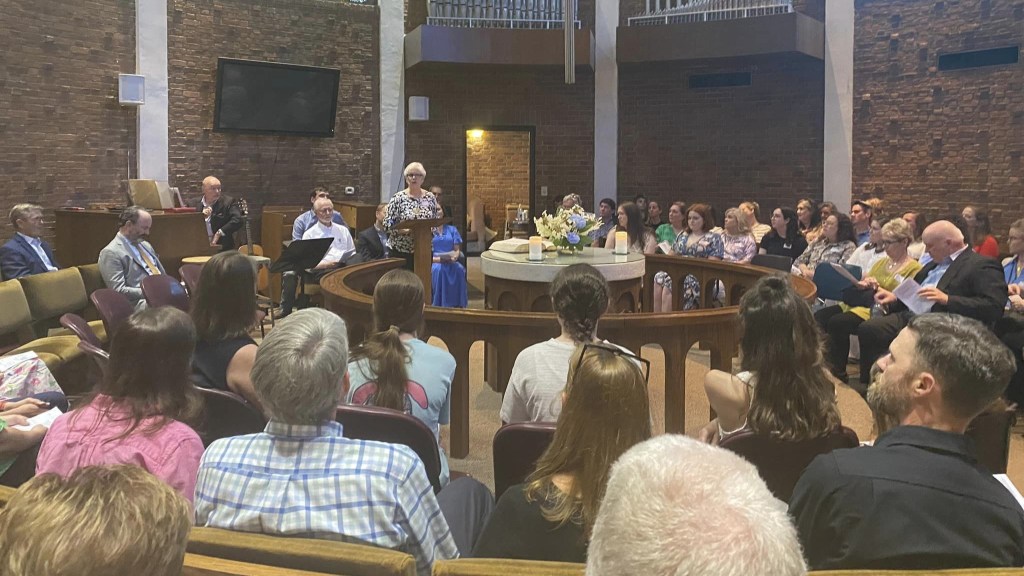
But it also has strong temple characteristics. The object in the middle of the room is called an altar. The ceiling is quite high for the space and the suspended cross directs the worshiper’s eye upward. Light comes down from the stained-glass windows in the wall and ceiling from above, suggesting that the centering focus is really above the worshipers. It is definitely crafted as a meditative space that encourages people to be at peace and look up (Jackson 2024).
The chapel’s aesthetic impact is shaped by its low entrances and tall interior. Light comes down from above. It clearly signals itself as a different, meaningful, space, inviting stillness and peace. In a useful essay worship designer Marcia McFee explores the role of four basic ways of movement (“kinestic styles”) in worship: “swing,” “shape,” “hang,” and “thrust” (2009). Yeilding Chapel clearly encourages “hang:” being still and experiencing the presence of God and others. Though the atmosphere can be very different “swing”-like when filled with a lively community of close-knit college students.
The centering focus is clearly the altar with the supended cross above it. The dominance of this focus at the expense of all others is shown in that the pulpit which had once been located opposite the main entrance was abandoned, replaced by a screen for projection.
When one considers the spatial dynamics of the chapel, the presence of the fixed rows of pews and the communion rail before the table jump to the fore. These limit movement in the space and make it more static than it would be otherwise. But the communion rail was necessary for Methodist communion practice at the time. The placement of the altar as the only elevated site in the current space and as the place where all the key actions occur: scripture reading, prayer, preaching, the Lord’s supper, baptisms, weddings, further emphasizes the dynamics of gathering around it and being present in a single unified egalitarian community (Jackson 2024).


Through its decoration, the chapel invites symbolic resonance with a large number of biblical ideas and events. The post-war period were a time when Methodists and other mainline Protestants often explored traditional Christian symbolism. For example, the first Chrismon Tree (a Christmas tree decorated with “Christ monograms,” symbols of Jesus) was created in 1957 at Ascension Lutheran Church in Danville, Virginia. Yeilding Chapel is full of symbols like this of God and the apostles. The four windows represent God the Father, God the Son, God the Holy Ghost, and the Holy Trinity. Each contains nine symbols related to its subject. Unlike pictorial stained-glass windows, such as those in Third Presbyterian Church, the symbols in these windows might need to be explained. Indeed they invite detailed explanation such as offered on the chapel’s website. They are also subordinated to the windows primary goal of modulating the light that enters the chapel.
The twelve panels of the altar display the shields of the twelve apostles, including one for Judas who betrayed Christ (not Matthais who was selected to replace Judas, or Paul who often appears in place of both of them).


Dr. Stewart Jackson served as chaplian or dean of the chapel at Birmingham Southern from 1979 to 2007. When Birmingham-Southern College closed in May 2024, he provided his interpretation of the architecture, aesthetics, and liturgical function of the chapel In his sermon at a Service of Gratitude and Leave-Taking. The video below begins at the place in the sermon where Jackson begins to discuss the architecture of the chapel. To watch the entire service on YouTube click here. (This page continues below the video.)
The appeal of the central altar is demonstrated in that decades after Yeilding Chapel opened, the worship spaces in two campus ministry centers near the University of Alabama at Birmingham were also designed in this way: St. Stephen the Martyr Catholic Church and the chapel of Trinity Commons: Episcopal Student Center. The history of those spaces also express the difficulty sustaining that design. Click here to learn more, or to continue to the last of our eight varieties of worship spaces click here.
Note: Birmingham-Southern ceased operations at the end of May 2024. At this writing the future of the campus is unknown. If an academic institution purchases it, Yeilding may again serve as a college chapel. As part of the campus’s closing a leavetaking service was held in the chapel. It can be watched on Facebook here.
This page is part of “Spaces for Worship: A Birmingham-Based Introduction,” a section of Magic City Religion, written by the editor, David R. Bains, and funded by Samford University’s Center for Worship and the Arts.
 Magic City Religion