The auditorium church type of worship space represented by Sixteenth Street Baptist Church has now been evolved by technology into something substantially different: the modern auditorium church, represented by Birmingham’s largest church: The Church of the Highlands. Specfically, our focus here is on the Church of the HIghlands’s Grants Mill campus, it is the oldest of its twenty-four campuses in Alabama and Georgia. The other spaces are smaller and often simpler, but conceptualy the same.
Like classic auditorium churches, the modern auditorium church directs worshipers toward the leaders and musicans and provides comfortable setting for listening to oratory and both choral and instrumental music. Spatially, however, the focus of attention is significantly different. There is no permanent furniture at the front of the church. Specifically, at Highlands there is no large pulpit, no chairs where leaders sit facing the congregation, no rows of fixed tiered seating for the choir, no pipe organ, no stained glass windows, no communion table, no baptismal pool. Instead there is a stage that thrusts out into the congregation, elaborate sound and lighting systems, large projection screens, and a flexible environment that can be used for many purposes. The modern auditorium church leverages twentieth-century technology to serve more people in similar ways to the classic auditorium church, but it also creates a substantially different experience in important ways.
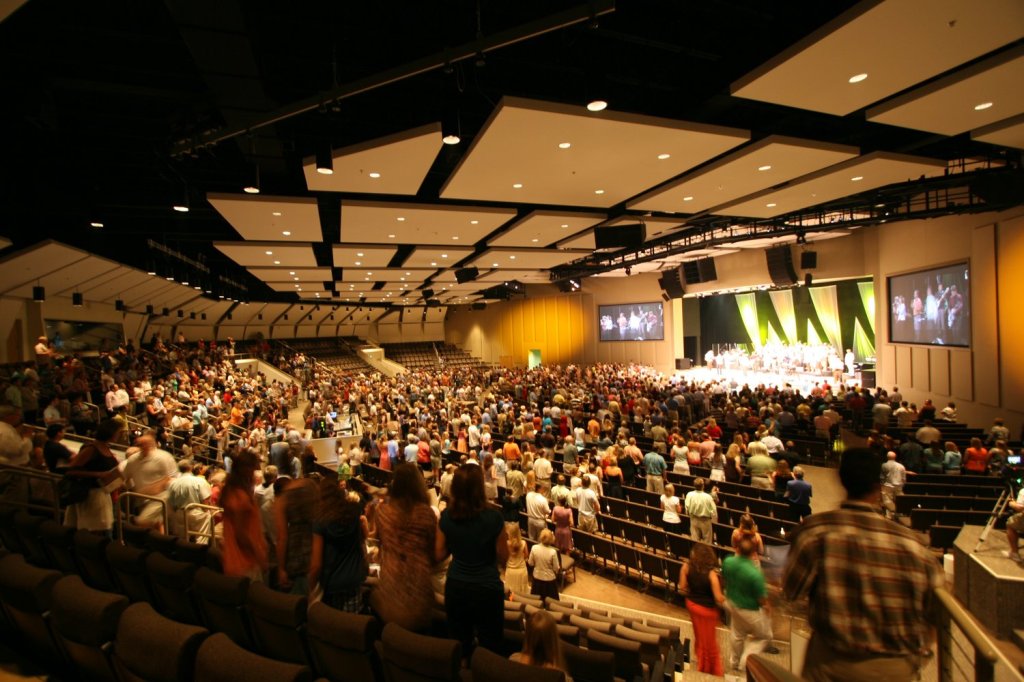
In High on God: How Megachurches Won the Heart of America, James Wellman and his colleagues emphasize that worship in churches like Highlands succeeds because it creates a strong sense of joy and wonder in part by creating an “atmosphere that marked human bodies with expectation and home that this is a place where something was and is happening” (Wellman 2020, 102). At the same time, churches like Highlands seek to create demands upon individuals entering the worship space low. It operates Kevin McElmurry explained in a “relatively passive, potentially anonymous, potentially temporary, low stakes, low obligation mode” that makes newcomers feel safe (Wellman 2020, 107). For this reason, the size and lighting of these modern church auditoriums allow anonymity. One can be anonymous in the crowd, but begin to feel part of the crowd participating in joyous, high energy music.
Modern church auditoriums like Highlands employ little or no traditional Christian symbolism and sometimes rather simple clean furnishings to create a large worship environment with sophisticated electronic sound, lighting, and projection.
Several earlier student-written essays on Magic City Religion discuss worship in Highlands and similar churches. They include:
- Duck, Kellum, Knauff, and Carr, “Church of the Highlands, Grants Mill Campus” (a general introduction that stresses the church’s emphasis on a high production value).
- Brady, “Church of the Highlands: Passionate about God.”
- Flint and Marsh, “Church of the Highlands, Woodlawn Campus.”
- Smith, “Auburn Community Church, Birmingham: Relentless Pursuit“
- Kellum, “Shades Mountain Baptist Church: Like You Never Left Home“
- Queen, “Church at Brook Hills’s Easter Worship Service“
To explore explore the next variety of worship space and learn about the chief rival to the auditorium church click here.
This page is part of “Spaces for Worship: A Birmingham-Based Introduction,” a section of Magic City Religion, written by the editor and funded by Samford University’s Center for Worship and the Arts.
 Magic City Religion