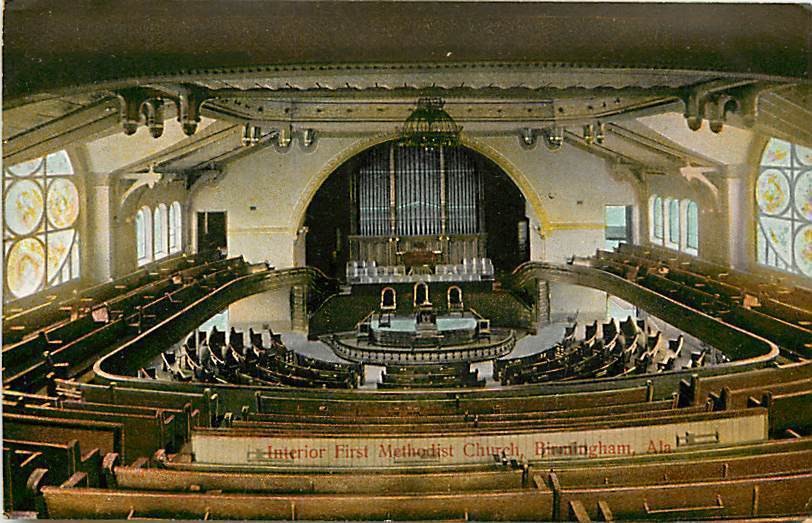
In his 1897 text The What, How, and Why of Church Building, George Washington Kramer celebrated the auditorium church. His firm, Weary & Kramer designed hundreds of them throughout the country, especially for Methodists. First United Methodist in Birmingham (1891) was typical of what designed when a large church was requested. It is Birmingham’s largest classic auditorium church.
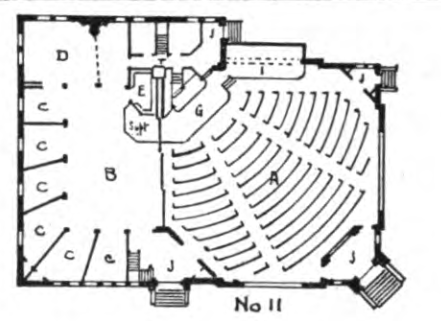
But what about smaller neighborhood churches? For them Kramer advised a “combination church.” In such churches, the Sunday school was not a housed in a separate space below the auditorium (as was common and the case at Sixteenth Street Baptist), rather it was placed next to or behind the auditorum and moveable partitions enabled these spaces to be combined with the auditorium to accomodate large crowds. Kramer particularly recommended the “Pulpit in the Corner Church,” where the pulpit was placed in the corner of a square with the congregation arrayed in curved pews about the platform. The Sunday school space adjoined the main auditorium along a side of the square adjacent to the pulpit platform. This allowed for “doubling the audience without increasing the distance of any, or changing the location of the speaker materially” (Kramer 1897, 222).
Third Presbyterian Church
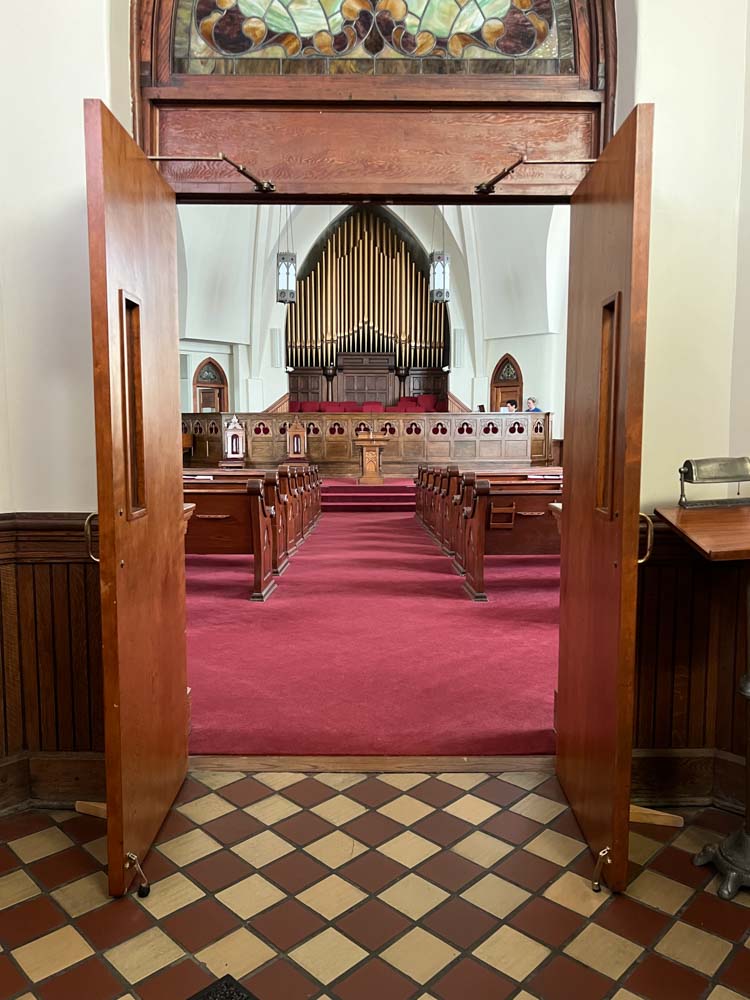
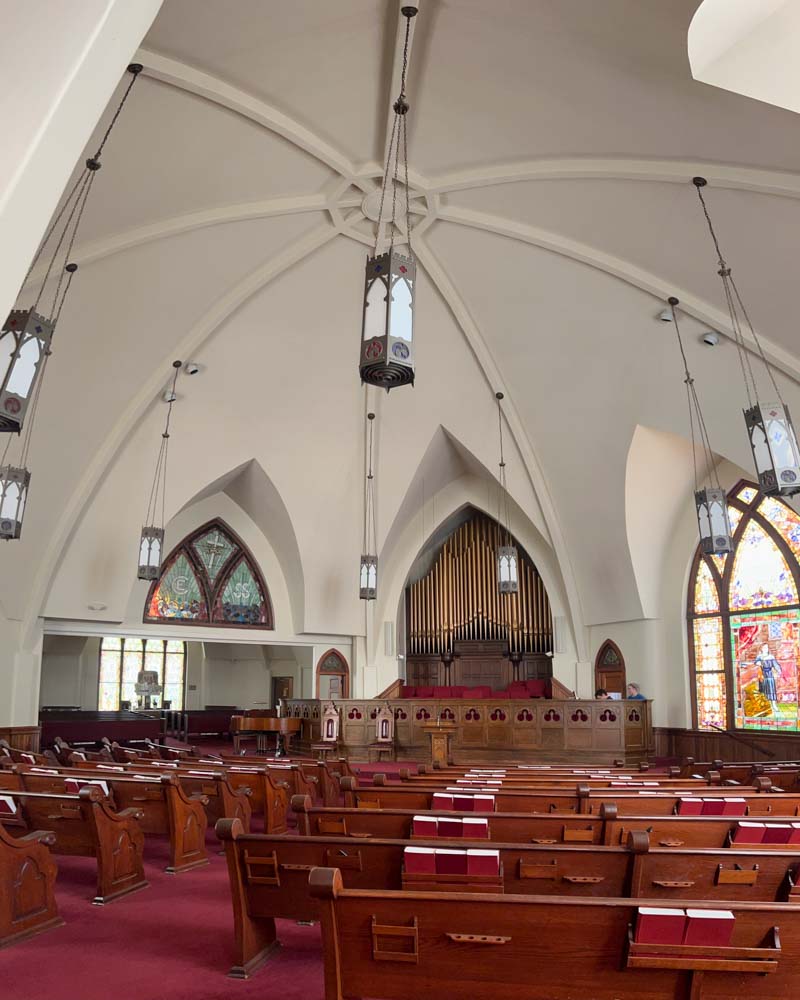
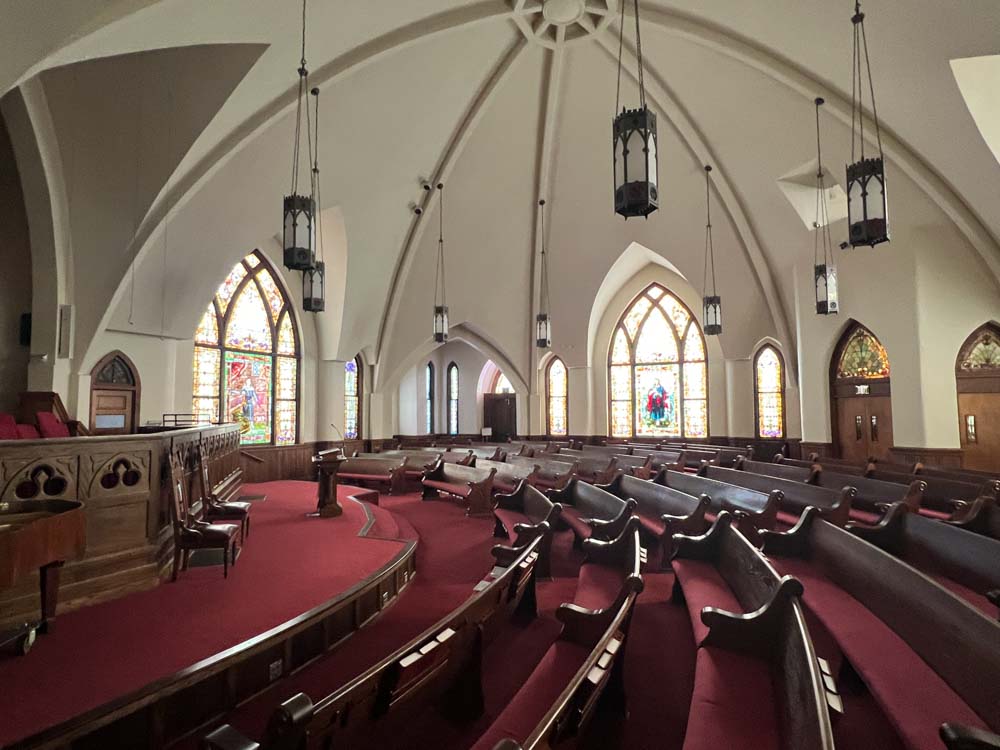
In 1901, Birmingham’s Third Presbyterian Church was destroyed by fire and the congregation resolved to erect a pulpit-in-the-corner combination church like Kramer suggested. The architect is unknown, but it is a classic example of the type. As is now common in such churches, the former Sunday school area has been integrated into the worship space after additional buildings for Christian education were constructed. In otherwords, the overflow seating was made permanent.
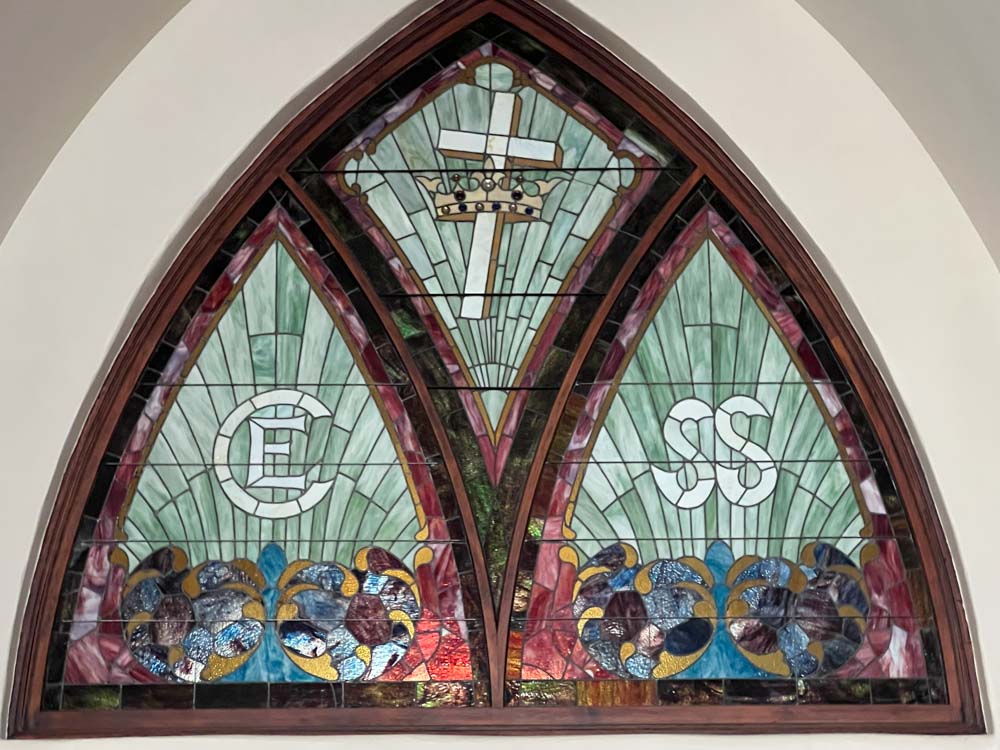
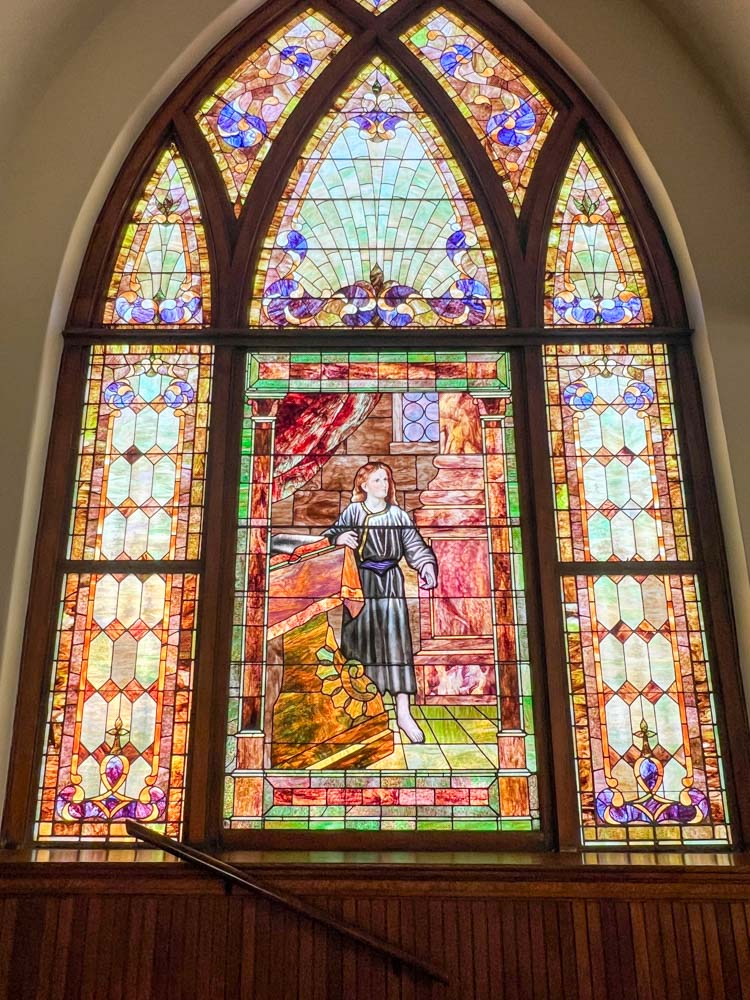
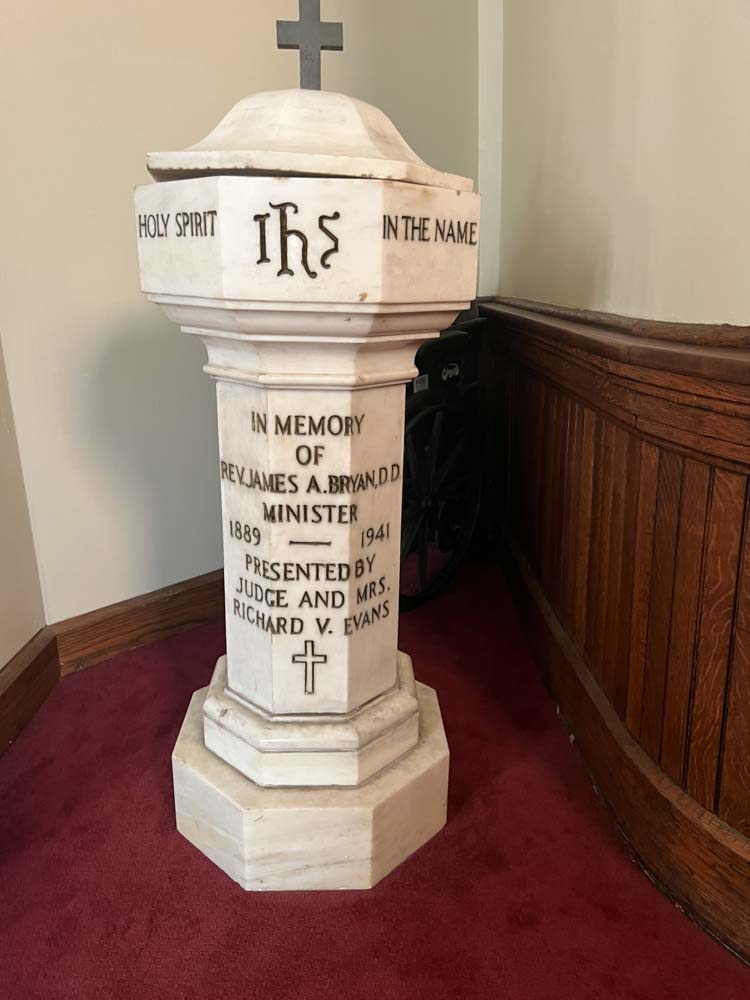
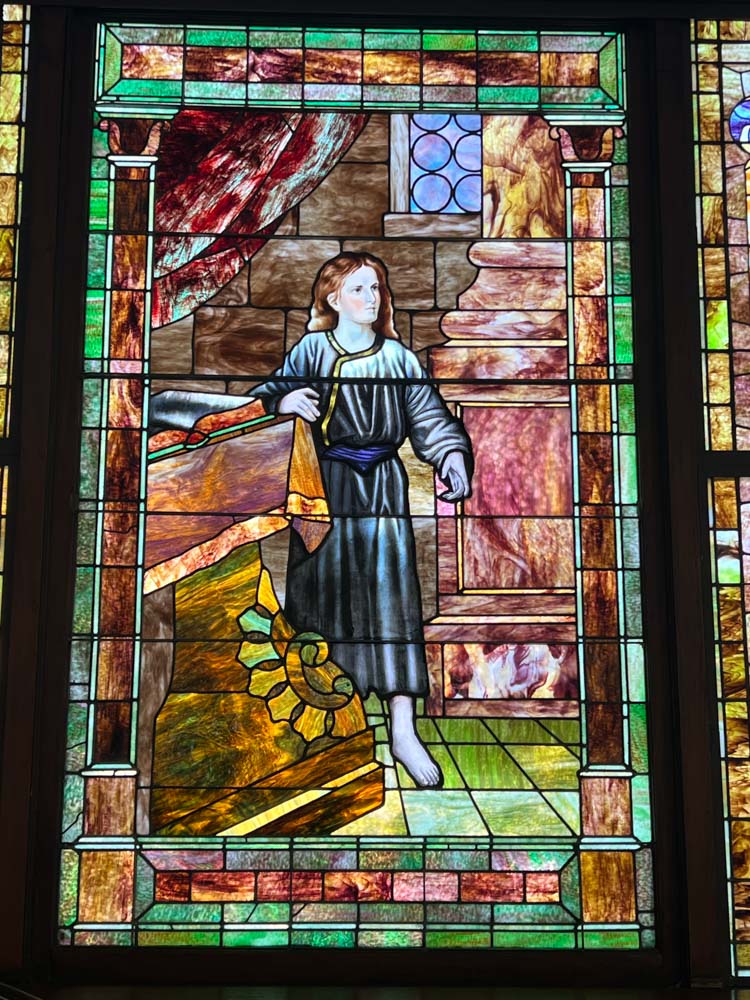
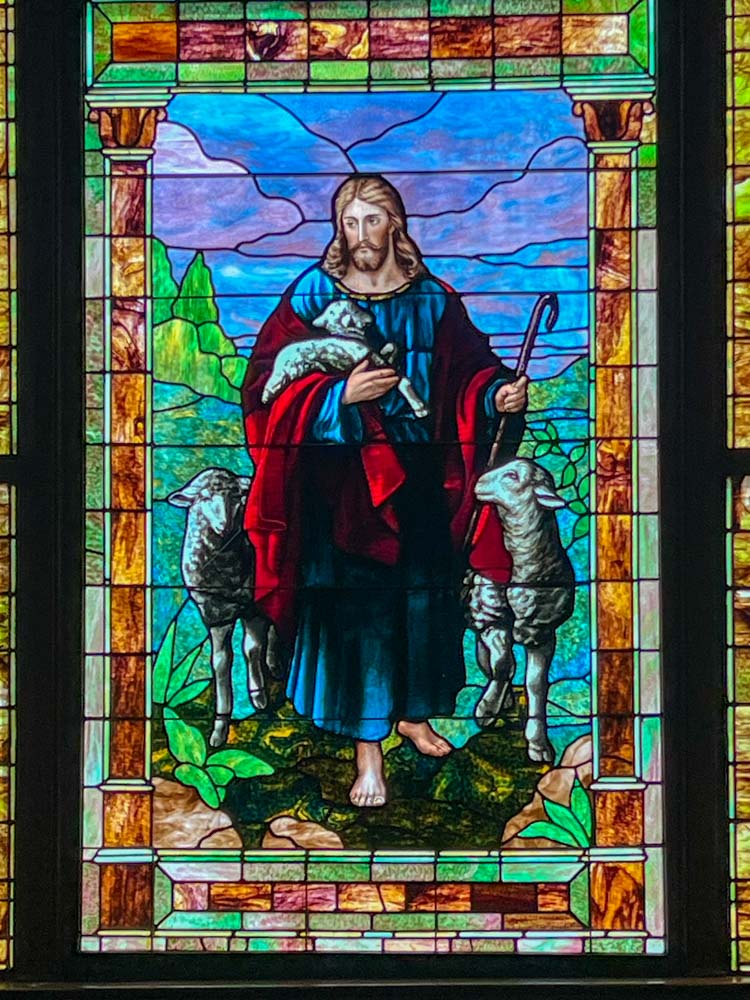
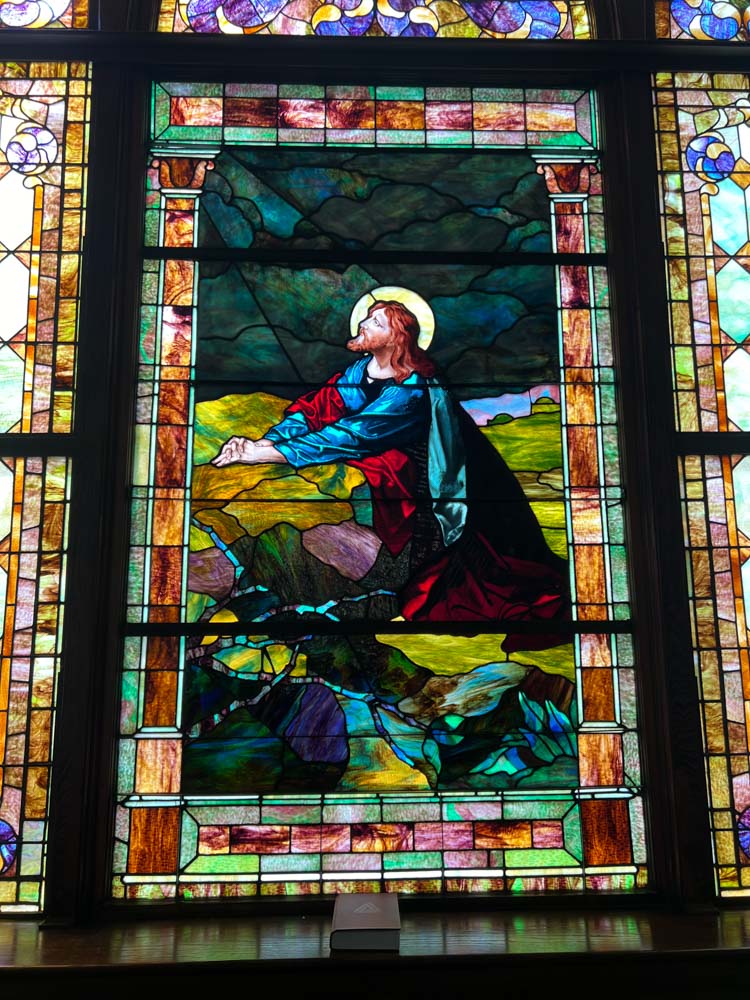
Also here the original pulpit platform has been expanded to accomodiate an enlarged choir. (In 1901 choirs were often quite small: four or eight voices.) But in many other respects Third Presbyterian is a remarkably well preserved example of a once very popular form of church building. Its windows include three of the five most popular scenes from the life of Christ included in such churches. The building has had the great fortune to be continuously owned by the same congregation. Click on the photos in the gallery below to enlarge them and explore the worship space.
South Avondale Baptist Church (now Redeemer Community Church)
Another combination church was erected for Baptists in Avondale a decade later. Designed by James E. Green, it was somewhat similar to the plan below from Kramer’s book in that it had two levels, and arranged classrooms around the back of the auditorium, not on the side.

But Green’s design (which he also adapted for Baptists in Sylacauga, Alabama, and Florala, Florida) hid this asymetrical plan behind a neo-classical facade, such as Southern Baptists generally preferred by the 1920s.

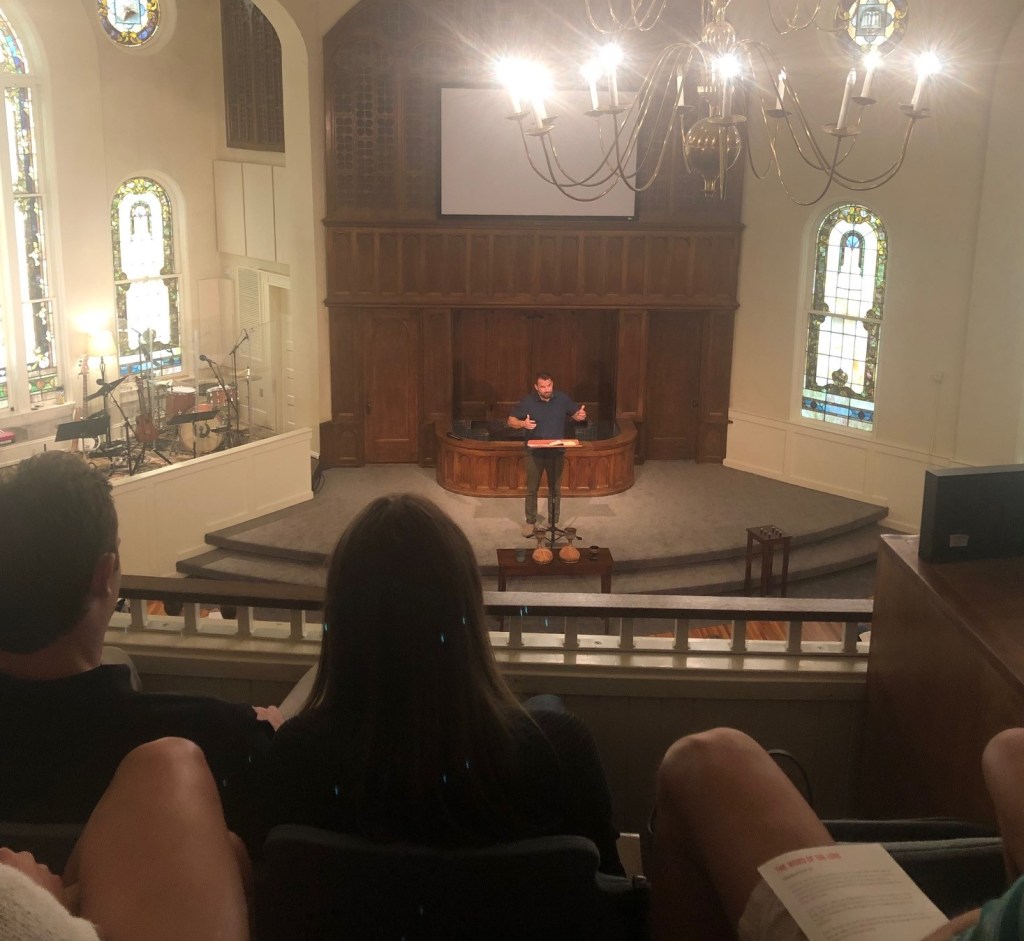
The pictures above were taken during the services of Redeemer Community Church, the current owners of the building. They show (1) the curved wall in the back of the auditorium (there are doors to small classrooms here, but they are hard to see), (2) the position of the choir (now worship team) underneath a side window (they are not the focus of attention), and (3) the pulpit platform in the corner and, since this was built as a Baptist church, a baptismal pool behind the preacher.
Harmony Street Baptist Church
Across the railroad tracks in North Avondale, Harmony Street Baptist Church was erected a decade later, in 1924. Like the previous two churches it is a pulpit-in-the-corner church, but it is not a combination church. Designed by the pioneering African American architect, Wallace Rayfield. It utilized a small square location to focus a congregation on the pulpit platform with the choir to the side in support. (Rayfield was also the architect of Sixteenth Street Baptist Church.) The building was measured and photographed for the Historic American Building Survey in 1994.

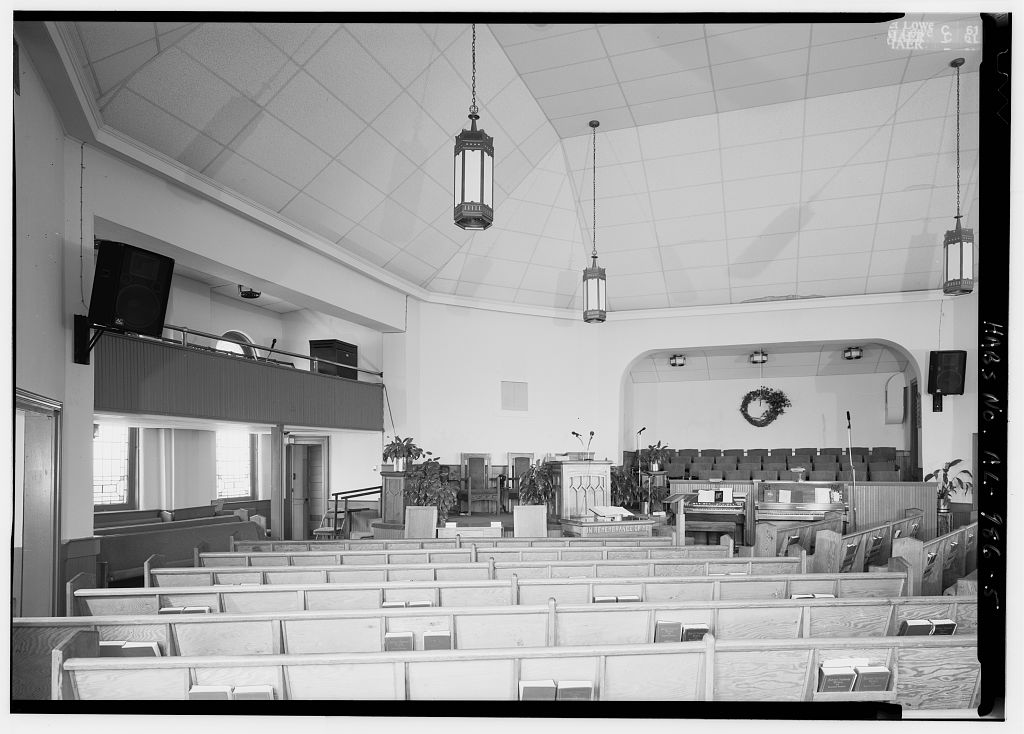
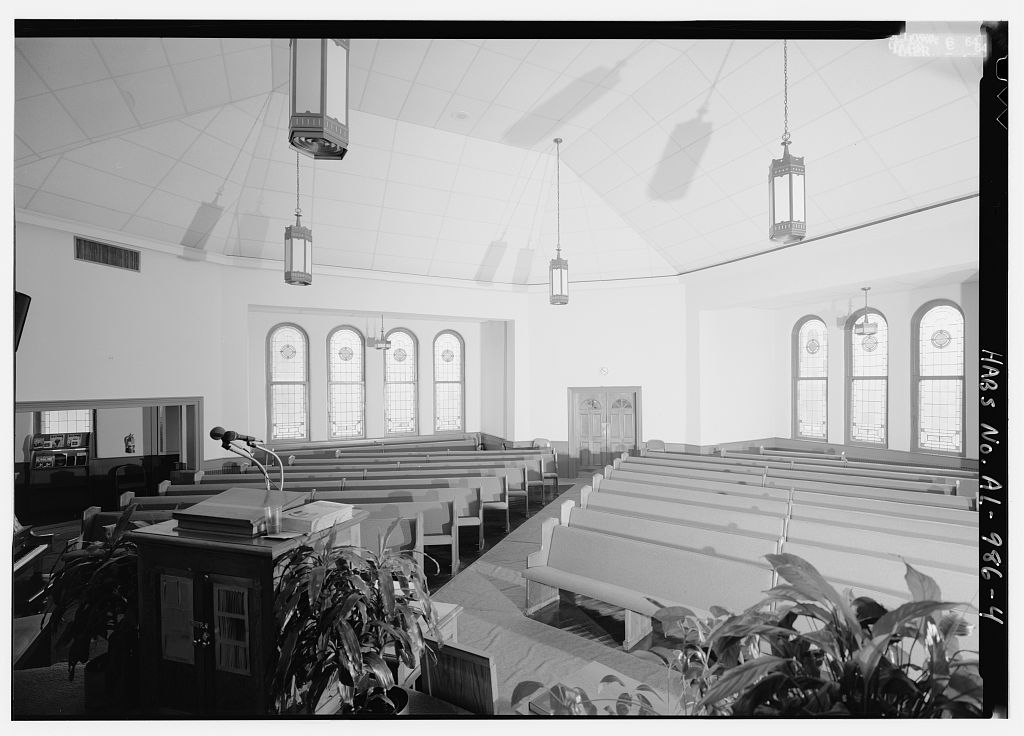
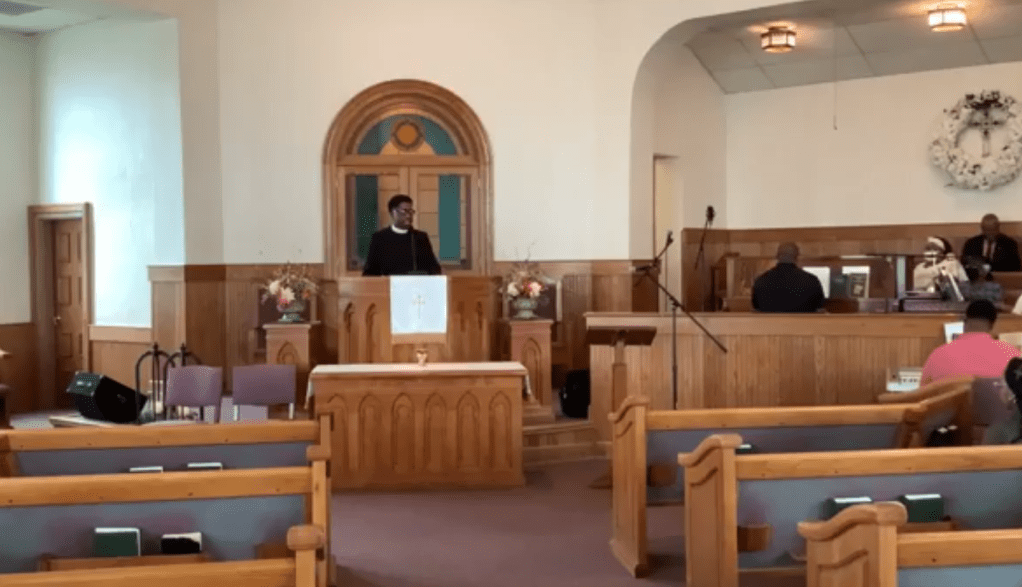
Notice in the floor plan above that the baptismal pool is located beneath the platform. Part of the floor would be lifted to access it. Since the 1994 survey, the church has been renovated and a baptismal pool has been added in what was originally the pastor’s study behind the pulpit. As the screen shot below from a recent worship service shows. (The church added an additional building with classrooms and offices adjoining this building in 1966.)
Together, Third Presbyterian, South Avondale Baptist, and Harmony Street Baptist show how the principles of the classic auditorium churches were adapted smaller neighborhood churches in the first three decades of the twentieth century.
A few essays by students on South Avondale Baptist and Redeemer Community Church have been previously published on Magic City Religion.
- Thompson, “South Avondale Baptist Church“
- Hamilton, “Redeemer Community Church“
- Dreher, “Redeemer Community Church’s Easter Worship Service“
Additionally, a major multi-part study of religion in Avondale was published on Magic City Religion in 2019. Click here to read the introduction to it.
Click here to return to Sixteenth Street Baptist Church.
This page is part of “Spaces for Worship: A Birmingham-Based Introduction,” a section of Magic City Religion, written by the editor and funded by Samford University’s Center for Worship and the Arts.
 Magic City Religion