Sixteenth Street Baptist Church is Birmingham’s most famous church builidng and an excellent example of an auditorium church from the turn of the nineteenth century, or what we are calling “a classic auditorium church.” Until the twenty-first century, this was the most common type of worship space in Birmingham.
This type of worship space focuses worshipers’ attention on the preacher and the choir. There is a table for communion, but is placed below the pulpit. Worshipers are aranged in comfortable seats for listening to oratory and both choral and intrumental music. The curved seating gathers worshipers together around the leaders. Thus it creates a strong sense of a community in which all can participate. In auditorium churches such as this, worshipers are visible to the leaders and to each other. There is no place to hide. It is intensely a congregational space, a meetinghouse.

Auditorium churches began to become popular in America in the 1880s. From 1890 to World War I, almost all Baptist, Methodist, and Presbyterian churches were erected in some version of this format, and it remained popular for decades there after. Birmingham’s largest classic auditorium church, First United Methodist Church, was erected twenty years before Sixteenth Street, just three blocks to the east.
Key to the spatial dynamics of these churches is the act of assembly, coming together to be led by the preacher and being dismissed to go into the world. Many of these evangelical churches also practiced altar calls, where the penitent and those seeking prayer came down to “the altar,” the steps in front of the platform, to be prayed for. In Methodist churches a communion rail is here since the practice in that tradition has been to receive communion kneeling, in Black Baptist churches the celebration of communion was often strongly ritualized as deacons assembled at the table to take it to people in the pews. These churches frequently included stained glass windows based on popular paintings of Jesus. The two older windows in Sixteenth Street are typical in that regard.
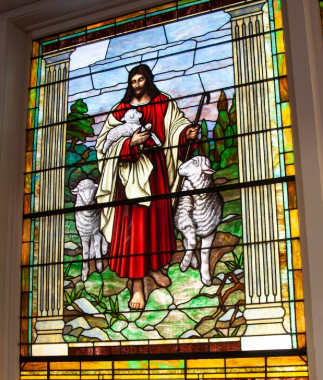

These images suggest the personality of Jesus and important scriptural themes. They strongly echoed many messages that were preached and so were rich in symbolic resonance. Large auditorium churches like this were grand spaces whose organs and choirs offered a rich musical experience. Most of Birmingham’s auditorium churches were much smaller, often rectangular in form, but here too the positioning of the choir is important. It faces the congregation to variously sing to them, perform for them, and encourage them in worship.
The architects of these churches were often inventive in the ways they arranged worship spaces and education spaces inside these buildings so that they could be combined and the way they placed unconventional spaces behind traditional facades. To learn about how these things were done at Third Presbyterian, South Avondale Baptist, and Harmony Street Baptist click here.
Previous Magic City Religion essays by student authors on Sixteenth Street include on its famous window of Black Christ figure and another on its worship during the Covid restrictions of spring 2021.
To explore explore the next variety of worship space and learn how the auditorium church was reimagined in the twenty-first century click here.
This page is part of “Spaces for Worship: A Birmingham-Based Introduction,” a section of Magic City Religion, written by the editor and funded by Samford University’s Center for Worship and the Arts.
 Magic City Religion