When you enter St. Symeon Orthodox Church you find images of saints and Christ on every wall, the smell of incense, a solid partition separating the nave (the people’s area) from the area around the altar (the sanctuary), and no pews or chairs facing the altar for the congregation to sit in. These are all distinctive elements of the Byzantine tradition of worship space.
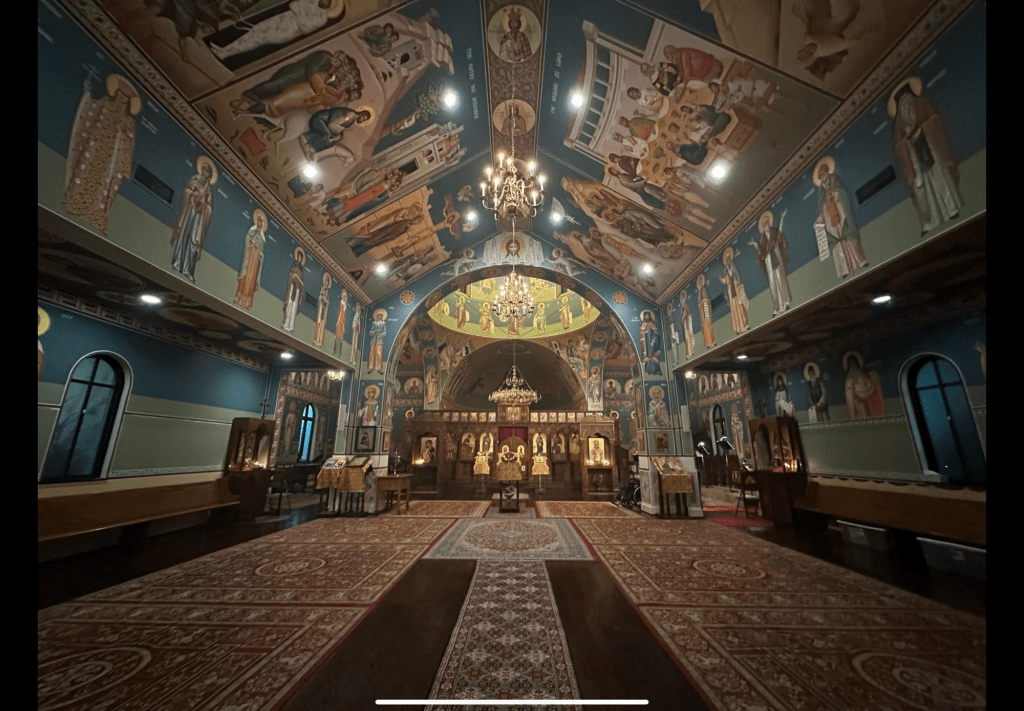
Byzantine refers to former capital of the Eastern Roman (or Byzantine) Empire: Constantinople, now known as Istanbul, and previously known as Byzantium. The Byzantine liturgical tradition is one of a number of traditions of worship that emerged in Christianty’s first six centuries. The one that claims the most Christians is the Roman tradition, it shapes Birmingham’s Roman Catholic churches, discussed on the previous page. The Byzantine is the second-most popular. It is the tradition of all Eastern Orthodox churches (including many nationalities such as the Greek, Serbian, Russian, Ukrainian, and Romanian). It is also the tradition of Eastern churches that are in union with pope in Rome. These are known as Byzantine-rite Catholics.
There are three churches in the Southside area of Birmingham, Alabama, erected for worship in the Byzantine tradition. Two are Eastern Orthodox, one is Byzantine-rite Catholic, also known as Greek Catholic. From west to east the three churches are: St. George Melkite Greek Catholic Church, Holy Trinity – Holy Cross Greek Orthodox Cathedral, and St. Symeon Orthodox Church. (There is one other building erected for Byzantine worship in the area: St. Nicholas Russian Orthodox Church in Brookside. In Bessemer St. John Cassian Orthodox Chapel worships in a former Church of God building.)
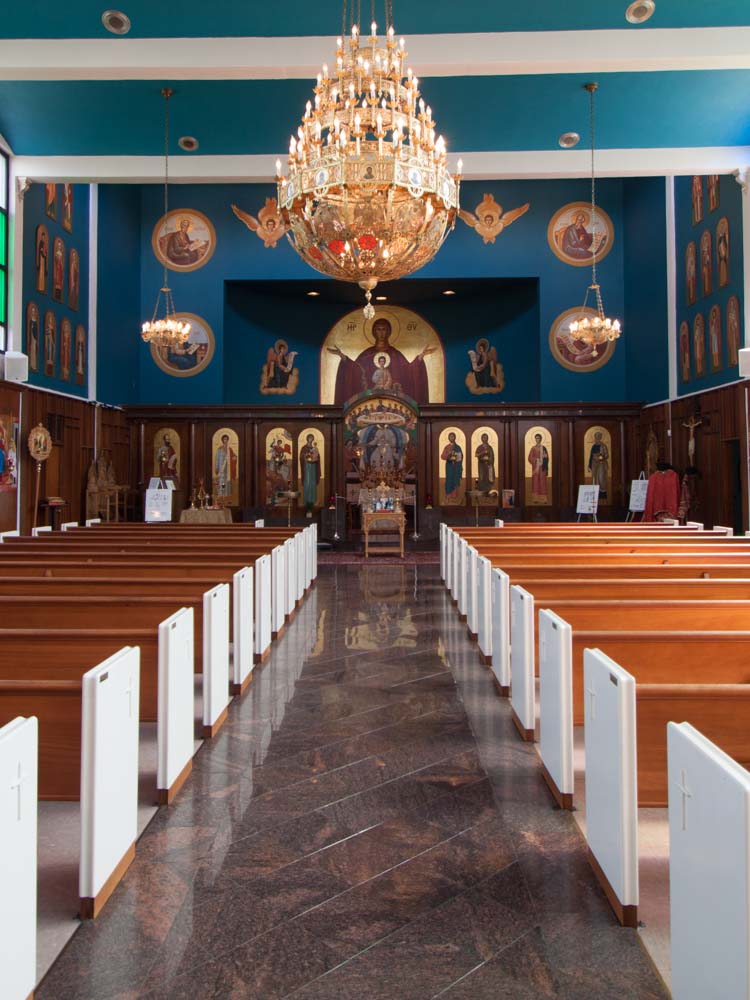

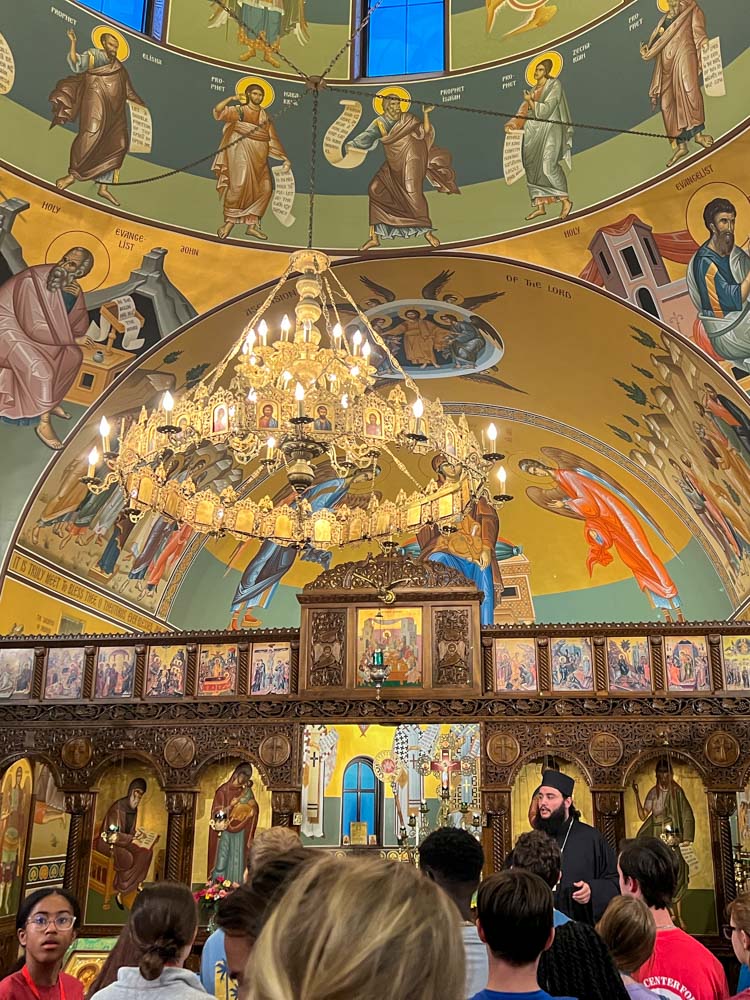
St. Symeon is the newest of the three Southside congregations. It was established in 1977. It also has the newest building (opened in 2015). Additionally, it is the one that strives most to depart from common American (i.e., Western) Christian traditions and recover distinctive practices of the Christian East. This is evident in its lack of rows of pews or chairs (there are benches along the wall should worshipers need to sit). The ancient postures for worship and prayer are standing, bowing, and, in certain Lenten services, prostration. You can see this in Orthodox churches with pews, but St. Symeon is crafted to make this the norm.
The most universal and distinctive characteristic of a Byzantine church is an icon-screen (Greek: iconostasis) separating the nave from the sanctuary. In a few churches this is an open grill or fence with just a few icons that mark the division between the sanctuary and the nave. Most commonly, however, it is like the one in St. Symeon: a wall that extends above the height of any worshiper, but not reaching the ceiling. There are three doors or gates in the screen. The center one, often called the royal doors, composed of two doors and an a curtain, and ones on either side, known as deacon doors, which often just look like other panels in the screen.

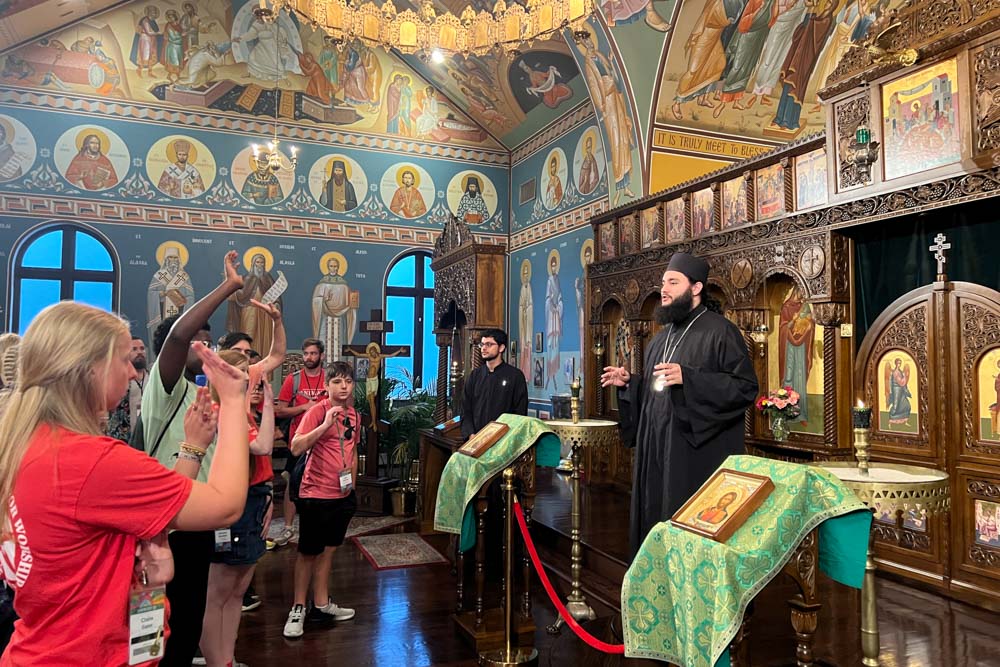
There are a variety of traditions and practices concerning when the doors are opened and when they are closed. In all cases, however, the icon screen limits the visual access of worshippers to the sanctuary and offers them instead image of Christ and his saints. Orthodox Christians commonly explain that their temples (for that is what they often call their church buildings) are directly shaped by the ancient temple in Jerusalem prescribed by God in the Bible. The sanctuary corresponds to the Holy of Holies. The icon-screen communicates its holiness.
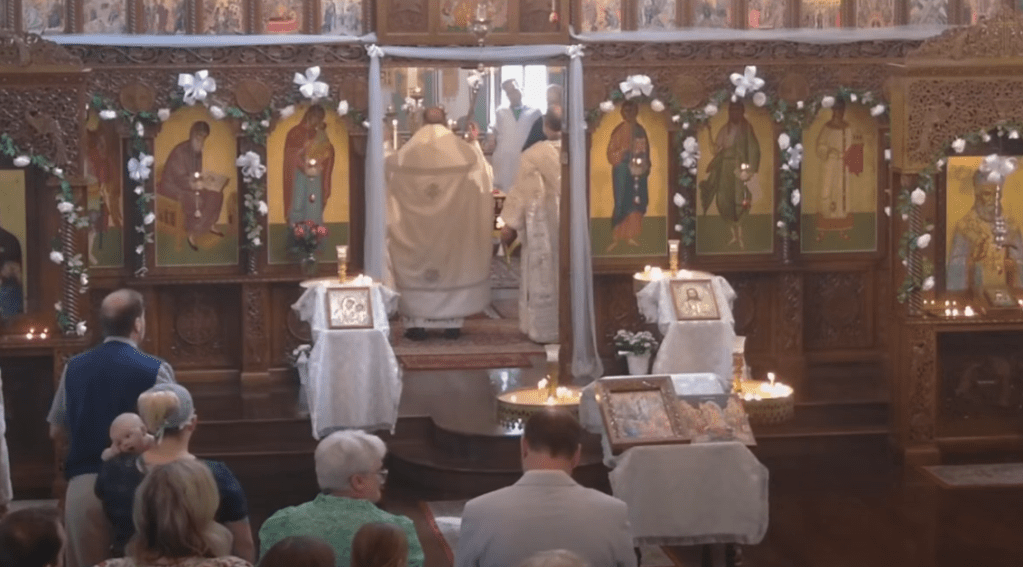
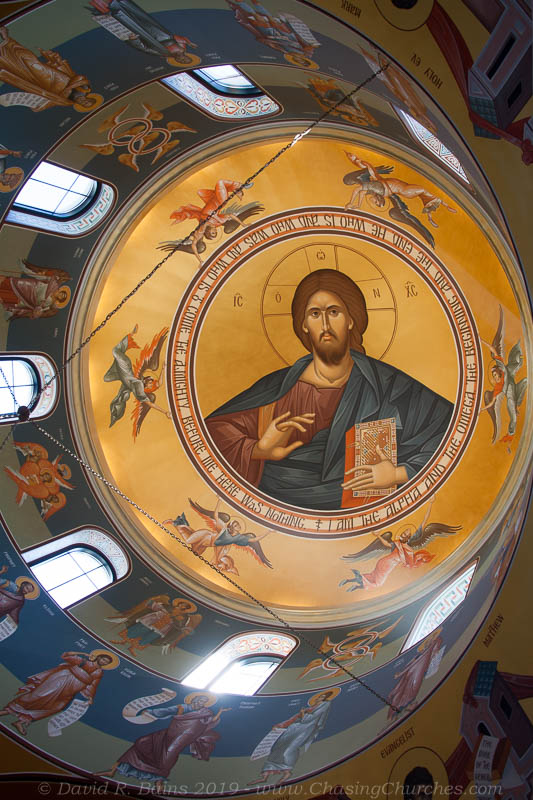
In practice the partition of the sanctuary from the nave does not simply signal the exclusion of most worshipers from the sanctuary. Instead it defines a holy place from which the holy things can come to the holy people. Whereas in a traditional Roman Catholic Church the communion was served to the people kneeling at the chancel rail, thus the sacrament did not leave the sanctuary, in the Orthodox Church, “the holy for the holy” (the holy [food] for the holy [people]) is brought out from the icon-screen into the nave and the people receive it while standing. In Saint Symeon and many other churches this takes place beneath an icon of Christ the Almighty (Christos Pantokrator) that visible signals the reign of Christ in the church.
It is helpful to contrast this to the the altar and tabernacle arrangement of Birmingham’s Roman Catholic churches. That arrangement reflects the emphasis of the Western church on the material presence of Christ in the eucharist and the importance of the laity seeing the consecrated host at the elevation in the mass. The fact that the material presence of Christ (defined in the doctrine of transsubtantiation) was rejected by Protestants only intensified the Catholic focus on it, contributing to the abandonment of the screens that had once visually separated Western Christians from the sanctuary in a manner quite similar to Eastern Christians.
Byzantine churches retain the icon-screen and thus resist the visual location of God’s presence to one place and extends it to the whole sanctuary, and more broadly to the whole church where many icons of saints are present.
“We who mystically represent the cherubim”
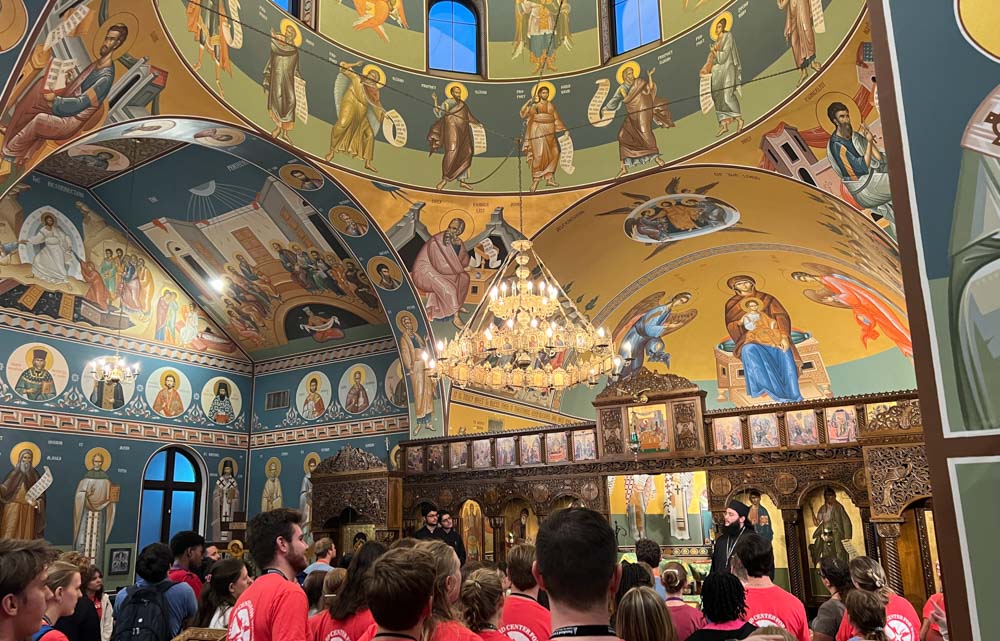
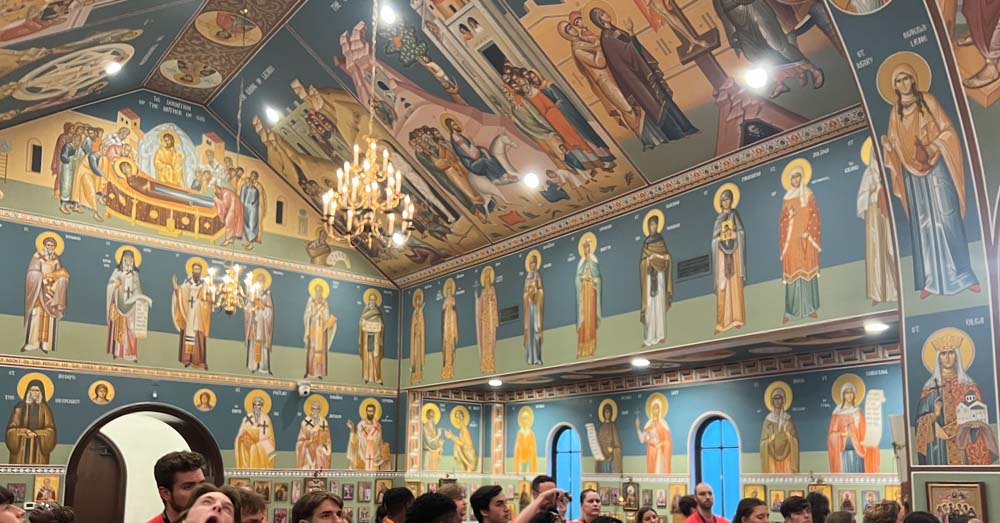
Most Orthodox writers on worship emphasize the fact that the worship in a church on earth participates in the worship of the church (the redeemed and the angels) in heaven. This is a good way of understanding why there are so many images of saints in Orthodox churches. The walls of St. Symeon are covered with them. These include not only the icons commissioned by the parish from its Romanian iconographers, but also the many small icons from many sources that line the lower walls of the nave.
The total environment of St. Symeon, and other Orthodox churches, is crafted to convey to worshipers that the worship they offer here is part of the worship in heaven. As hymn that is sung before the prayers of the eucharistic rite states:
Let us, who mystically represent the cherubim and sing the thrice-holy hymn to the life-giving Trinity, lay aside all worldly cares, that we may receive the King of all, invisibly escorted by the angelic hosts. Alleluia, alleluia, alleluia.
Through all four factors that shape worship spaces (centering focus, aesthetic impact, spatial dynamics, and symbolic resonance) St. Symeon and other Byzantine churches embrace the use of visual art to communicate the fact that worship in this earthly temple is a participation in the worship by the saints in heaven.
To emphasize that worship involves the active participation of everyone present in the worship space a few churches have employed our next variety: the central altar.
Essays by students on Byzantine-Rite Catholic churches and Eastern Orthodox churches previously published on Magic City Religion include:
- Beall, Bagatin Lopes, Loftus, Fraser, and White, “Portraying Eastern Christian Beliefs: The Power of St. George’s Iconography“
- Howard, “St. George Melkite Church’s Liturgies“
- Shinholster, Pawlick, Dunn, Hall, and Hebert, “Holy Trinity – Holy Cross Greek Orthodox Cathedral“
- Bullock, “Basil of Caesarea in Holy Trinity – Holy Cross Greek Orthodox Cathedral: More Than ‘Just Another Saint‘”
- Foncea, “St. Symeon Orthodox Church“
- Buckles and Vines, “Jesus and the Theotokos of St. Theodore“
- Adams, “Mark of Ephesus in St. Symeon Orthodox Church: Faithful Orthodox Christian Behind Bars“
- Maxey, “Raphael of Brooklyn: First Eastern Orthodox Bishop Consecrated in America“
This page is part of “Spaces for Worship: A Birmingham-Based Introduction,” a section of Magic City Religion, written by the editor in 2024 and funded by Samford University’s Center for Worship and the Arts.
 Magic City Religion