In Roman Catholic churches in Birmingham, the focus of church buildings is on two things that are intrincically joined. Every church has a central aisle at the end of which is the altar where the priest celebrates the eucharist (also known as the mass). Behind it is a tabernacle: an ornamented safe box in which the reserved Blessed Sacrament is kept. That is it contains unleavened bread (typically small wafers) which because it has been consecrated is Christ’s body. Tabernacles on or behind the altar have been the traditional place for reserving the sacrament in most Catholic churches since the sixteenth century.
In keeping with my focus on major churches, this page focuses on Birmingham’s Catholic cathedral, but to grasp the essentials, I suggest you begin with a small church that is also Birmingham’s oldest Catholic Church building: Holy Rosary Catholic Church. (Click here to do that and then you can return to this page.)
Spatial Dynamics and the Centering Focus in a Catholic Church
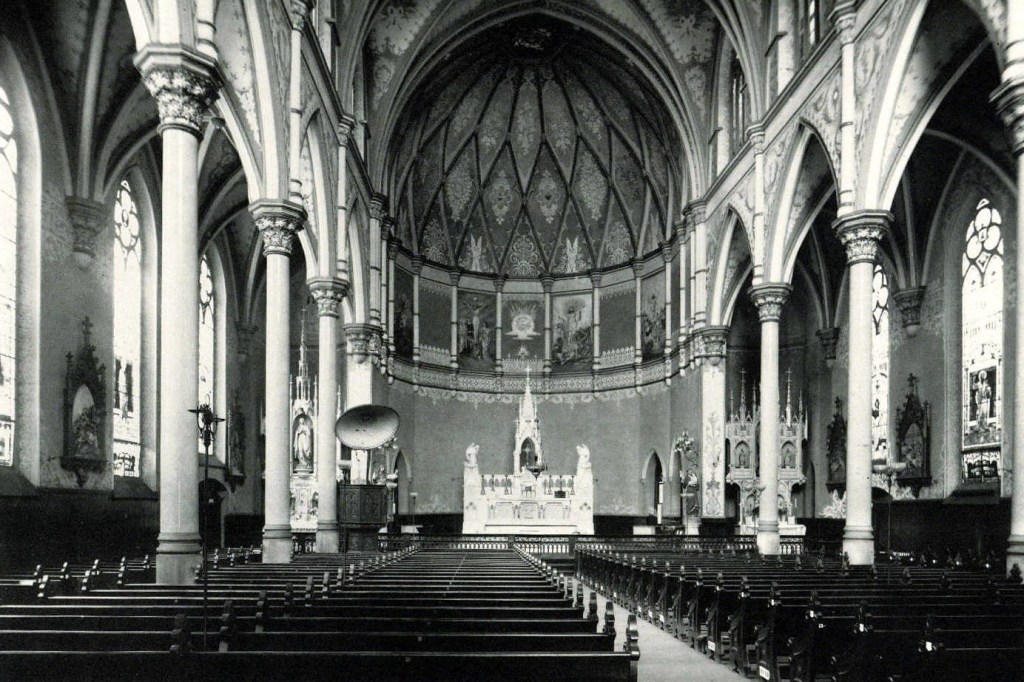
In the image of the cathedral above, the altar is the long white table (or counter) behind the carpet. The tabernacle is under the canopy behind it, below the crucifix. In front of the altar on the right is the ambo (or pulpit) where scripture is read and the sermon preached. To the right of it is a smaller lectern for the cantor (song leader). In many churches, you might find this lectern for the cantor on the opposite side of the church from the ambo. Here, however, they are together so that nothing obstructs the congregation’s view of the bishop’s chair (or cathedra, from which the word cathedral is derived). The chair faces the altar encouraging worshipers to see God, not the bishop, as the focus of attention. Thus the chair escapes notice when the bishop is not in it (as in the photo above), but you can clearly see the two steps on which it elevated. When the bishop preaches he often stands or sits here, not at the ambo.
At the same time, the placement of the chair enables the bishop to preside and preach from his chair and be clearly seen by the congregation. The cathedral’s liturgical plan has been altered a few times over the years. A 1982 photo shows that at that time the bishop’s chair was located at the back of the sanctuary, where the tabernacle is now. This was the place for a bishop’s chair in many early Chrsitian cathedrals and placing it here when the altar was moved forward was part of a general movement to restore early Christian practices after the Second Vatican Council (1962-65).

This current arrangement entails a certain degree of minimalism. The focus of the church is on the worship led by the clergy and their assistants. The choir and organ do not have a place in the chancel (or what Catholics would call the sanctuary). In many traditional Catholic Churches, such as this one, the choir and organ are in the balcony at the back of the church from which this the first photo above was taken. It is a central place from which they can be clearly heard. But it also means they cannot be seen. Their leadership of the congregation’s song does not involve them being seen by the congregation. In some Catholic churches, the musicans are to side where they can still be seen by the congregation. And here at the cathedral, the cantor does face the congregation from the small lectern to the side of the ambo. Also often times some portions of the liturgy are sung and the celebrant or deacon is effectively the leader of the congregation’s song.
- Is it important that musicans and congregations see one another? Why?
- What do you think is the ideal position for musicans in your church?
It is also important to note that the altar’s proximity to the congregation makes the movement of worshipers (the spatial dynamics) significantly different here, than at many churches with a divided chancel, such as the Cathedral Church of the Advent. Whereas at the Advent, worshipers can process up through the choir to the high altar to receive communion, here the ministers bring the sacrament down the steps to the level of the people for communion. The people still come forward, but not as far.
- In what ways is the movement of the congregation (or the ministers) an important part of worship in your church?
On the other hand, aside from the steps, there are no physical barriers separating the altar-area from the congregation. This is unlike St. Symeon Orthodox Church. Here, everything the clergy do is clearly visible.
Originally, the altar was against the far wall of the sanctuary, backed by a tall altarpiece (also known as a reredos). This meant that the clergy celebrating the eucharist at the altar were facing the same direction as the people, but also that the people could not see what they are doing.
- Do you think it is important for everyone to see what happens at the Lord’s table?
The tabernacle was in the center of this original reredos. It provided a devotional focal point for worshipers even when services were not taking place. Because Christ is truly present in the Blessed Sacrament, every church in which the sacrament is reserved is a house of God, a temple.
As part of the post-Vatican II restoration of early Christian practices, the tabernacle was removed from the main part of the cathedral to a side chapel. Supporters of this change felt that it emphasized that the cathedral was for communal worship, the celebration of the eucharist, not the adoration of the Blessed Sacrament by individuals. This could occur elswhere. Others did not approve of this change. Near the beginning of twenty-first century the cathedral’s sanctuary was remodled and a tabernacle placed again on the central axis of the church, though the altar remained free standing.
As mentioned in the discussion of the Advent, the baptismal font here at St. Paul is near the entrance of the church at the far end of the central aisle from the altar. This serves a vivid reminder that Christians are incorporated into the church through baptism, and also makes clear the connection between the holy water sumps at each entrance of many Catholic churches and the water of baptism. To blessing oneself with holy water is a reminder of baptism.
- Why does baptism occur where it does in your church?
A few previously written student essays on Magic City Religion discuss other aspects of the cathedral.
- Beall, Hansen, Mulder, and Criswell, “The Cathedral of St. Paul: Enriching Faith and Community through Music“
- Pease, “The Good Shepherd Window“
- Thorley, “St. Patrick in the Cathedral of St. Paul: The Irish Savior“
 Magic City Religion