Symbolic Resonance
One of four factors shaping the experience of worship spaces.
What symbolic associations does the structure, decoration, and furnishings of the space invite the worshiper to make? What stories or ideas does it bring to mind? How does its repeated use inscribe the space with different meanings in worshipers’ experiences? These questions help us understand the symbolic resonance of a worship space. Of the four factors shaping experiences of worship spaces that Richard Kieckhefer offers us, symbolic resonance is the one that is most dependent on what the worshiper brings to the space: their knowledge of symbolism, their understanding of the Christian story depicted in art works, their experience of previous worship services in the same or similar spaces.
Architecture
Birmingham churches are built many different ways, and embrace many different architectural styles. For some people these styles carry significant meanings. For example, my office at Samford University is in Chapman Hall, one of the wings of the building whose central unit is Reid Chapel.
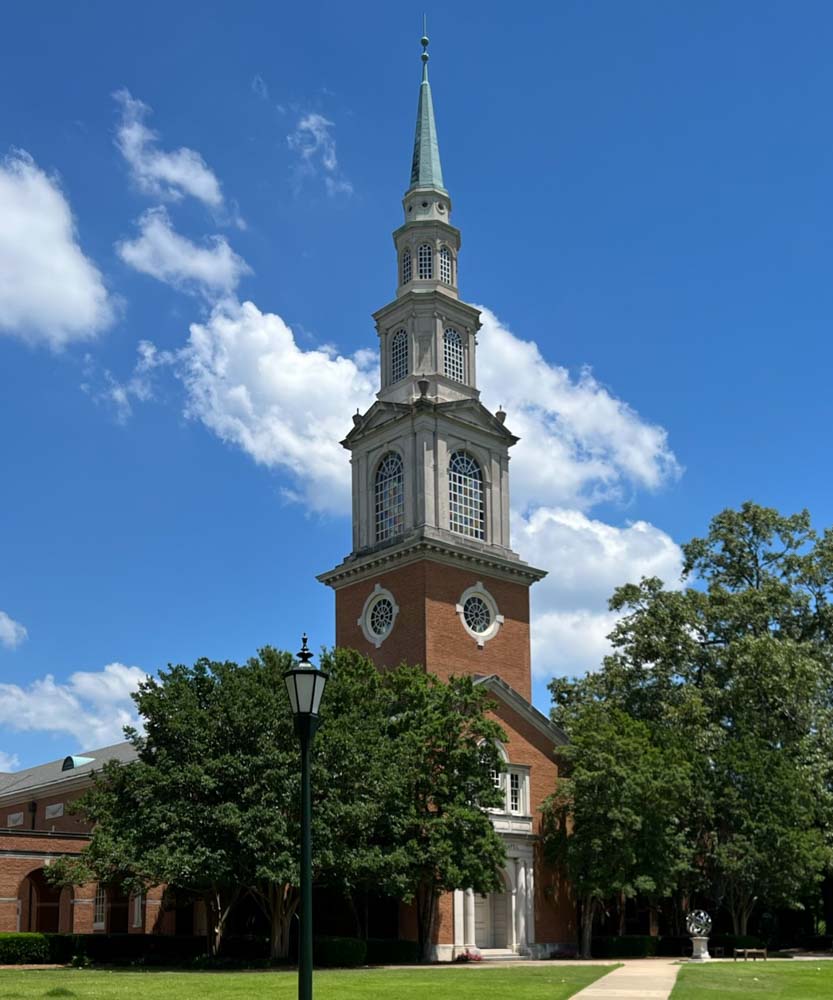
It was built in 1960 in the initial phase of development of Samford’s campus in Shades Valley. The entire campus was designed in the then-popular Georgian Colonial Revival style. At the time, this style evoked tradition, democracy, and Americanness. In the South, it also usually evoked an society in which Whites were in charge. And while some Catholic churches embraced the style (perhaps most notably Mundelein Seminary outside of Chicago, Illinois), most people saw it as Protestant. As a member of Generation X, who grew up in eastern Virginia, this is all self evident to me. As a child, I could not escape it. The architecture tells me to be an English-speaking Christian who values reason, democracy, America, and the Enlightenment. To my eighteen-year old students, it just looks “classic” and “collegiate.” The symbolic resonance of the building to me sits within theirs, but the meaning to me is much more specific and expansive in its meanings.
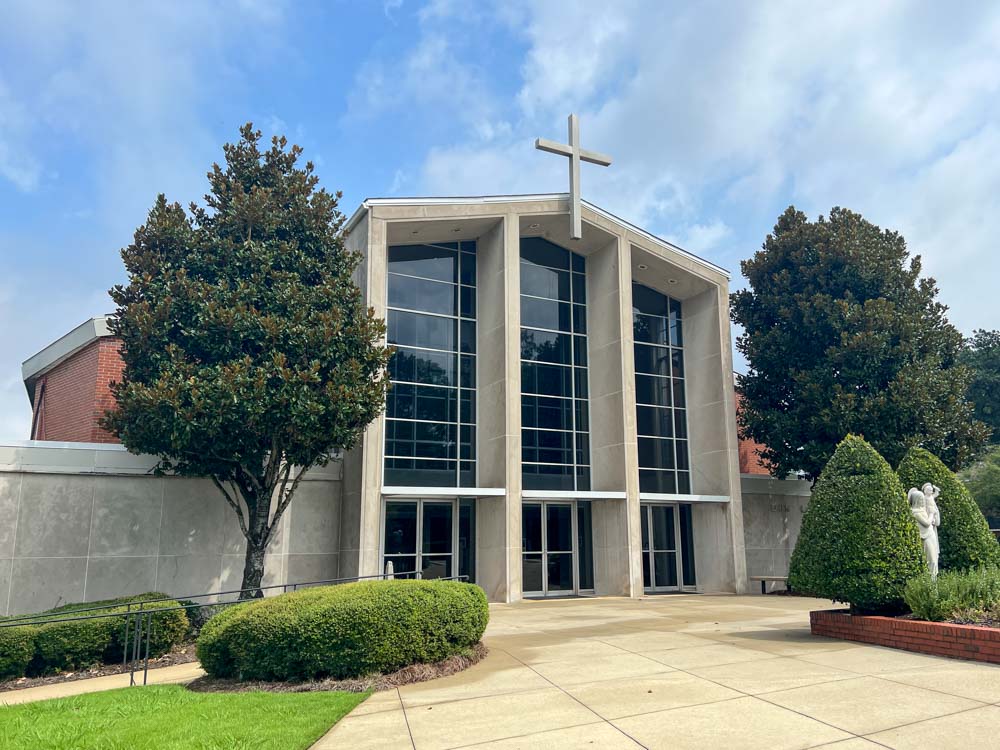
Another example: some people look at the facade of Our Lady of Sorrows Catholic Church and see an unfortunate piece of modernist architecture that barely looks like a church. I see a building that proclaims that Christainity is at home in the space age and is relevant to present day concerns. The meaning depends on what the physcial form resonantes with in the experience of the individual.
Art and Symbolism
Some churches, like Church of the Highlands, are sparsely decorated with permanent art (though projection screens and stage backdrops do change). Others, like St. Symeon Orthodox Church have images on almost every surface. Thus the symbolic resonance generated by images (or decoration) is much more extensive in some spaces than in others.
Earlier this week, I gave a tour of the Cathedral Church of the Advent to about 100 middle school and high school students participating in Animate, the week-long summer program of the Center for Worship & the Arts. I pointed out to them the Chi-Rho emblem in the floor tiles at the base of the chancel steps.
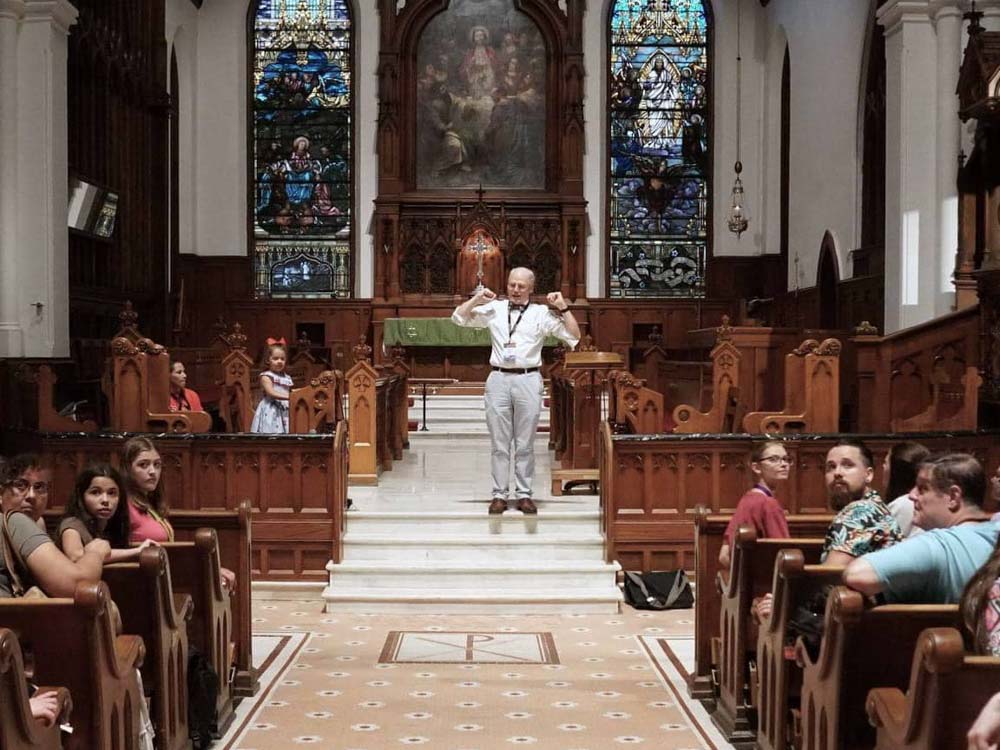
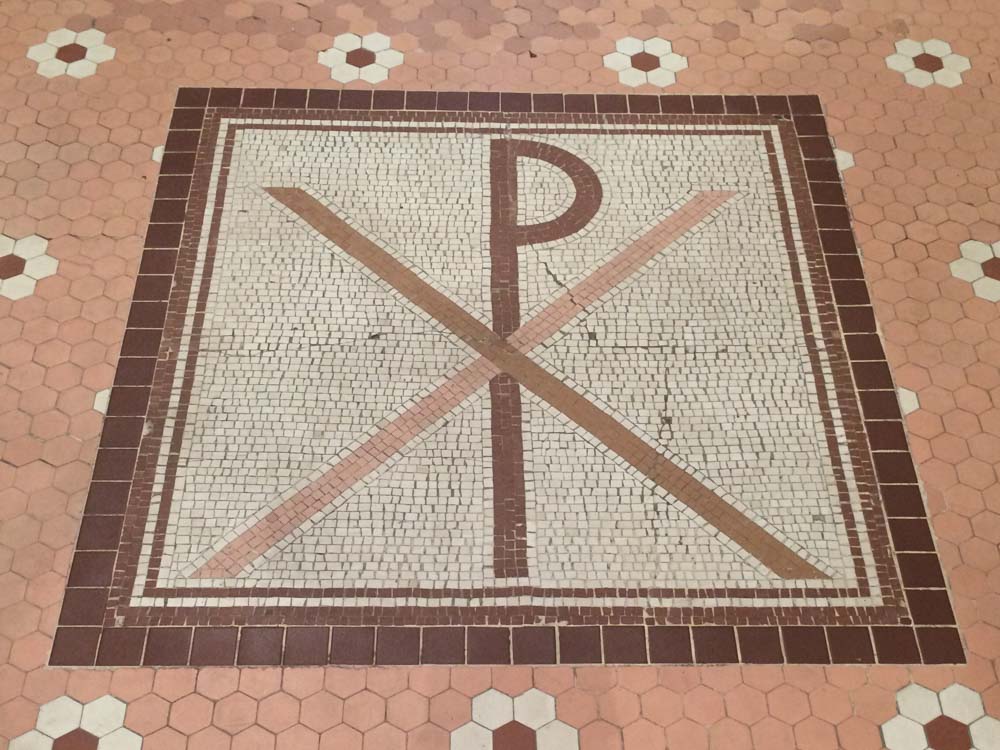
Asked to interpret this emblem the students might, correctly, conclude that if it is in a church it is probably about Jesus, but very few of them recognized it as the Greek abbreviation of Christ and as suggesting that Christ is in the center of the church, with the people, not only in the word read and preached from the lectern and pulpit or in the bread and wine offered at the altar.
Other forms of art are more uniformly legible or clearly relate to scripture. Bernhard Plockhurt’s painting of The Good Shepherd (1887) was one of the most popular religious images at the end of the nineteenth century. Reproductions of it in stained glass are included in at least three Birmingham churches: the Cathedral Church of St. Paul, Third Presbyterian Church, Sixteenth Street Baptist Church.

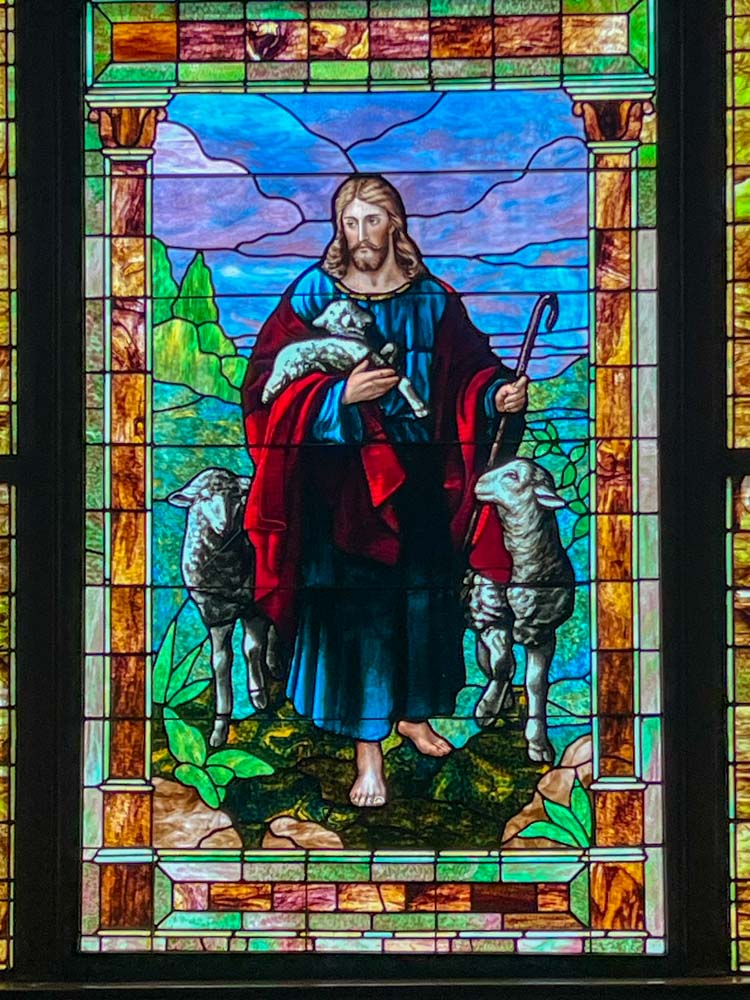
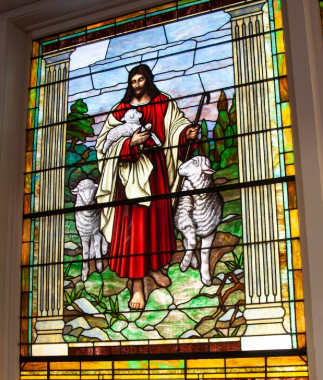
Since these are windows, none of them are devotional objects, as statue of a saint before a prayer desk would be. (That is to say people do not kneel before them or pray to them.) But they are devotional images. The painting presents Jesus as a relational person. It depicts his personality more than his character. He is also presented as a loving agricultural figure in the midst of a fiercely industrial city. The image evokes Psalm 23, but also many other passages of scripture. It is a multivocal image with a wide symbolic resonance.
At the same time, it depicts Jesus as having particular human features: shape, hair style, skin color. In order to expand the symbolic resonance of Jesus beyond this form, some churches, including a more recent window in Sixteenth Street, display images of Jesus as Black, St. Stephen the Martyr Catholic Church used to include an images of him as four different races over the altar, and other churches do not represent him at all or represent him only through symbols. Significantly, evangelical churches in Birmingham today are far less likely to contain visual depictions of Jesus than they were in earlier decades.
Events and Memory
In the first of the eight buidling profiles on this site, I state that Sixteenth Street Baptist Church is Birmingham’s most famous church building. It is possible it could have been so simply because it is perhaps the best work of the pioneering African American architect, Wallace Rayfield, or because it was an important mass meeting site during the spring 1963 civil rights marches led by Martin Luther King, Jr. But its place in the history of Chrisianity and America was elevated by by a terrorist bombing on September 15, 1963, which killed four girls.
Events inscribe worship spaces with meaning. These include not only tragedies and triumphs, but the repeated experience of worship and the events on one’s life cycle. All this is part of the symbolic resonance of a place.
This post is part of “Spaces for Worship: A Birmingham-Based Introduction,” a section of Magic City Religion, written by David R. Bains, published in 2024, and funded by Samford University’s Center for Worship and the Arts.
 Magic City Religion