Places and Items: Components of a Worship Space
The previous page introduced two basic types of worship space: temple and meetinghouse. Each of these contains various places and furnishings that make it up. Identifying these different components and thinking about there relationship is fundmental for understanding how a worship space works.
The Acts of the Apostles describes the communal life of the first Christians saying “they devoted themselves to the apostles’ teaching and fellowship, to the breaking of bread and the prayers” (Acts 2:42). This verse points to at least three components of a worship space: a place for a teacher, a place for the congregation, and a table for the Lord’s supper. The congregation does at least three things be taught, have fellowship, and pray. The congregation could do all these things in one space, or there might be special portions of the worship space designated for each.
Think of worship spaces you know. Do you have all of these? Do you have more than one space for doing some of the things mentioned in Acts 2:42? What other activities do you have special places or furnishings for? We will think about the various components of worship spaces and how they are arranged in each of our discussion of eight varieities of worship spaces, but to get a sense of what is involved, let’s start by looking at simple photographs of one of Birmingham’s historic church buildings.
St. Luke African Methodist Episcopal Zion Church is located at the corner of Cahaba Street and 12th Avenue North in East Birmingham. It faces W. C. Patton Park. If you know where to look, you can see it from Interstate 20-59 or when landing at Birmingham Shuttlesworth International Airport. The brick church was built in 1930. Its pastor, John O. Hart was active in the civil rights movement and the church was damaged by a terrorist bomb on January 16, 1962. In 2005 it was added to the National Register of Historic Places (NRHP).

Here is the photo of the worship space taken for the NRHP. What different spaces do you see in it?

You probably recognize pews for the congregation, a choir loft at the back, a platform with four chairs (of two different kinds) for leaders, and a central lectern or pulpit for the preacher. Maybe you also see the communion rail in front of the platform. This provides a place for people to come up and kneel to receive communion, an important part of Methodist worship. You might also see the lectern in front of the pulpit on the main floor to the right of the pulpit. Why might there be two different places for speakers? Who gets to speak from each place? Which one is more important? These are good questions to think about to understand how worship works in this space.
The next photo provides a clear view of some of the furnishings and spaces.

In this photo we can see the communion table, but also that it has a cross and candlesticks on it making it something of a devotional focal point. We also see a place for the other sacrament Methodists observe: baptism. The baptismal font is to the left of the communion table covered by a lid with a cross.
Christ Fellowsip Church in Homewood meets in a renovated grocery store. Conceptually, its space is not that different than St. Luke AMEZ, but there are important differences.
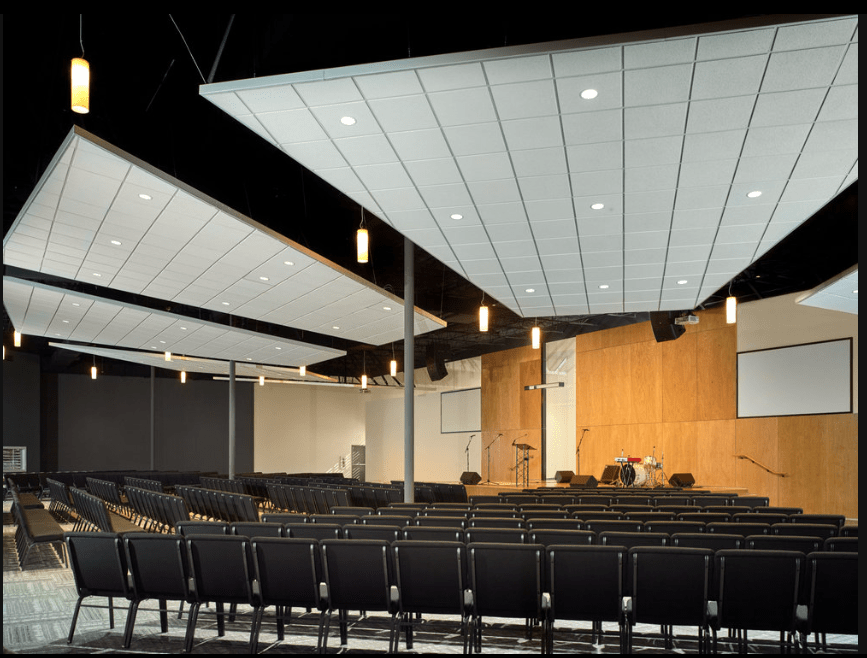
The congregation sits in chairs that can be moved, not wooden pews. There are no racks for hymnals, instead there are screens to project words and images. The platform is very simple. There are no chairs to sit on it, there is only one stand to hold a speaker’s notes. Nothing hides any part of the leaders’ bodies. Futhermore it appears that there is no communion table or baptismal pool in this Baptist church.
Both spaces are designed for Protestants who emphasize singing, reading, praying, and teaching. Both are aranged to focus on preachers and musicans who face the congregation from a raised platform, but clearly these two spaces are designed to shape quite different services. On the next page we will consider how various sub-spaces and furnishing are arranged, but first here are some spaces and furnishings to look for in church buildings. There presence or absence shapes worship in important ways.
Pulpit
Communion Table
Altar
Lectern
Processional aisle
Presider’s chair
Kneelers
Tabernacle
Saint’s shrine
Baptistry
Holy water sumps
Cathedra
Confessional
Communion rail
Choir stalls
Choir loft
Worship team
Sound booth
Pews
Chairs
Icon-screen
- Are there other important spaces and objects in worship spaces you know?
This page is part of “Spaces for Worship: A Birmingham-Based Introduction,” a section of Magic City Religion, written by the editor and funded by Samford University’s Center for Worship and the Arts.
 Magic City Religion