Historic Forms: Christian Spaces for Worship in Birmingham to 1960
Christians first settled permanently in what became the Birmingham metropolitan area after the Muskogee, having been defeated by U.S. forces under Andrew Jackson at the Battle of Horseshoe Bend, ceded the land to the United States in the Treaty of Fort Jackson on August 9, 1814. The first congregations in what would become Jefferson County included Bethlehem Methodist Episcopal Church (1818), Canaan Baptist Church (1818), and Ruhama Baptist Church (1819). Spaces for Worship focuses on existing examples of worship spaces and, unfortunately, the original buildings of these congregations do not survive.
In the antebellum period other churches were founded at other places, particularly at Elyton, the seat of Jefferson County, but the real growth in population and church building waited on the coming of the railroad and the establishment of Birmingham as an industrial city in 1871. Three monumental church buildings from the 1890s survive in downtown Birmingham: First United Methodist Church, the Cathedral of St. Paul (Roman Catholic), and the Cathedral Chruch of the Advent (Episcopal). (Neither of these churches were cathedrals until the second half of the twentieth century, but current names are employed throughout this project.) While there have been important changes, in each of their interiors it is easy to imagine the original liturgical space. First Presbyterian was built in the 1880s. Its interior aesthetics are shaped by the nineteenth century, but its liturgical plan reflects later developments.


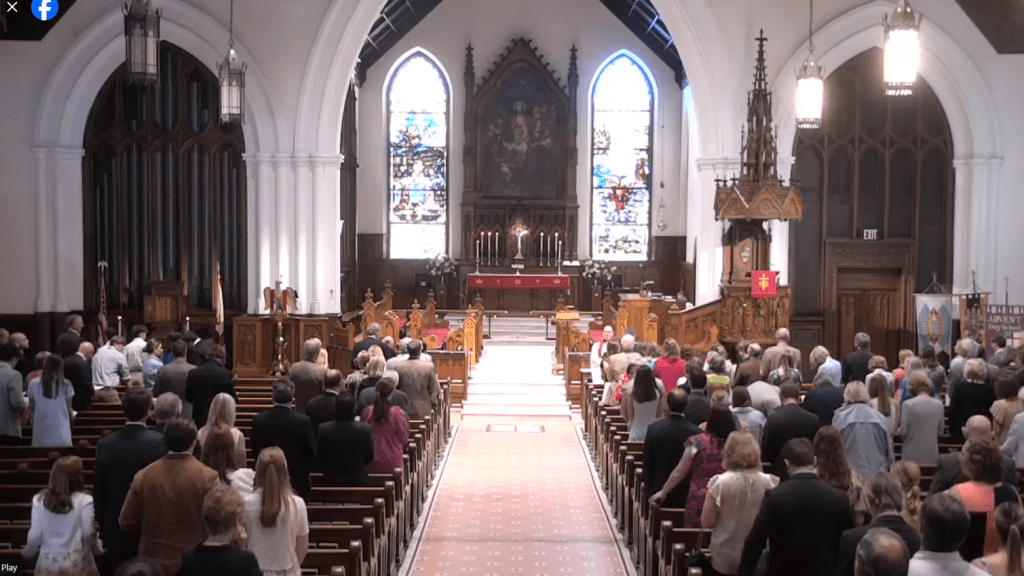
These churches embody three of the four types of worship space that shaped Chrisian worship for decades. First United Methodist was an auditorium church. This was the design favored by almost all Protestants until the 1950s. it was also the original plan of First Presbyterian. The Cathedral Church of the Advent followed the neo-medieval Anglican plan we are calling the divided chancel. This was the principal rival to the auditorium church, and was increasingly embraced by non-Anglican Protestants from the 1920s. The Cathedral of St. Paul, like all Catholic churches of the period, conformed to an altar and tabernacle plan.
In terms or aesthetics and architectural style, all four churches embraced the Victorian revival of medieval Europe. First Presbtyerian, St. Paul, and the Advent embodied forms of the Gothic. First United Methodist was Romanesque in the version known as American Romanesque or Richardsonian Romanesque for its pioneer, the architect H. H. Richardson. More than any other in the 1880s and 1890s, this Romanesque was the style of the current American mainstream. Thus the Methodists, like the Baptists in their now-destroyed building of a decade later identified themselves thoroughly with the culture, while the other denominations may have been signaling a little distance from it.
The central-plan auditorium church with its square form, curved seating and (frequently) side galleries remained the design of choice for Protesants well into the first decade of the twentieth century. Hand-in-hand with this went the Akron Plan of Christian education and Sunday school space. Architecturally, its distinquishing feature was the combination of a large “rotunda” for gatherings of all students with smaller class rooms separated from the main space by sliding partitions. At Birmingham’s First United Methodist as well as at the eponymous First Methodist in Akron, Ohio. This Sunday school space was a fully separate part of the building from the main worship space. Many smaller churches, however, such as Third Presbyterian, South Highland Presbyterian (originally), South Avondale Baptist Church, and Harmony Street Baptist Church, combined the different spaces in a flexible arrangement, usually by placng the pulpit platform in the corner of a square room and placing the Sunday school auditorium on one of the facing walls.
In addition to these three plans favored by Western Christians, Birmingham’s Eastern Christians worshipped in spaces shaped by the Byzantine liturgy. These featured an icon screen (or iconostasis) separating the nave from the sanctuary. Important examples of this form of worship space from this period include Holy Trinity Greek Orthodox Church (later Holy Trinity – Holy Cross Greek Orthodox Cathedral) designed by George Turner and St. George Melkite Greek Catholic Church, designed by Van Keuren and Davis.

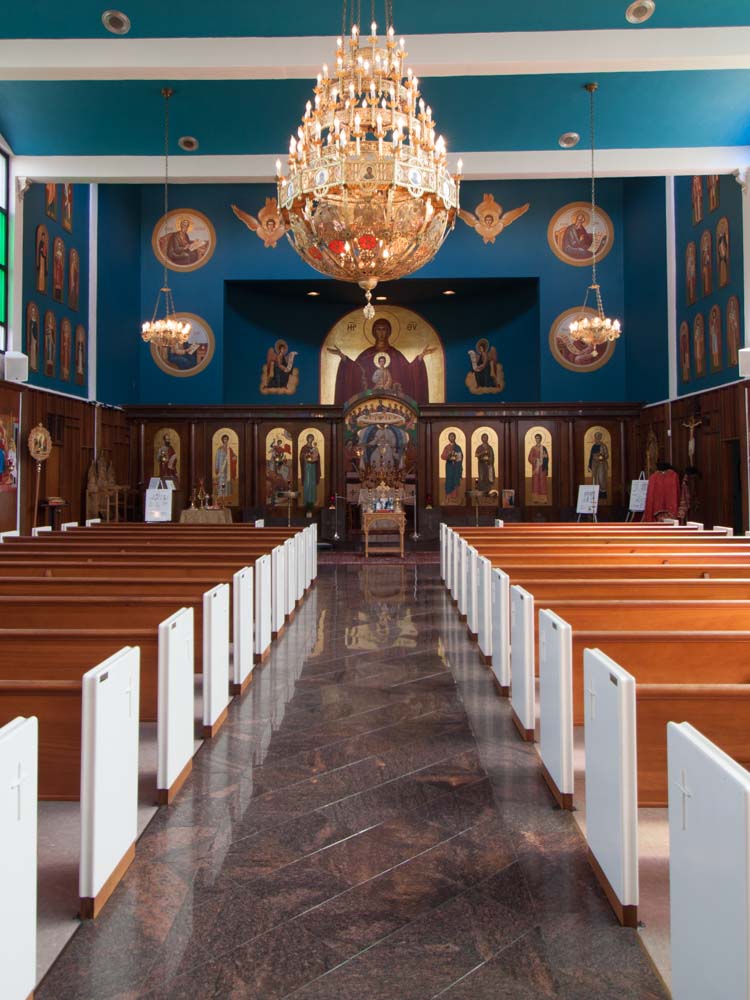
As the contrasting architectural styles of the Greek church (which is Early Christian) and St. George (which is modernist) show, liturgical plan is often independent of architectural style. Thus while in the 1960s, Lutherans employed the parabolic arch for their Trinity Church in West End and Episcopalians for the interior of St. Luke’s Church in Crestline Village, neither of these buildings introduced a significantly different liturgical plan.

Still, the spirit of innovation did lead to some different spaces for worship in late twentieth-century Birmingham. Click here to continue.
This page is part of “Spaces for Worship: A Birmingham-Based Introduction,” a section of Magic City Religion, written by the editor, David R. Bains, and funded by Samford University’s Center for Worship and the Arts.
 Magic City Religion