The most significant change to Birmingham worship spaces in the past thirty years has been the advent of digital projection and online streaming. There has also been an increased interest in evangelicals The year 1995 is not a particularly significant date in the history of Chritian worship, but soon there after the use of digital projectors became common, and over two decades later amid a global pandemic, practically every church starting live streaming there services, some very simply others with great sophistication. Some of the changes in worship spaces from the television to the digital age can be seen in the remodeling of Shades Mountain Baptist Church.
In 1989, the growing congregation opened a new 3,500 seat worship center adjacent to its 1962 1,500 seat church. The new building expressed the form of a classic auditorium church on a grand scale. It included the traditional elements of a pipe organ, a large platform which in this case could host an orchestra, and tiered seating for a choir with a fixed parapet separating the choir from the pulpit and orchestra platform. The congregation was seated in curved pews. By the 2010s, if not originally, a large projection screen was over the baptistry.
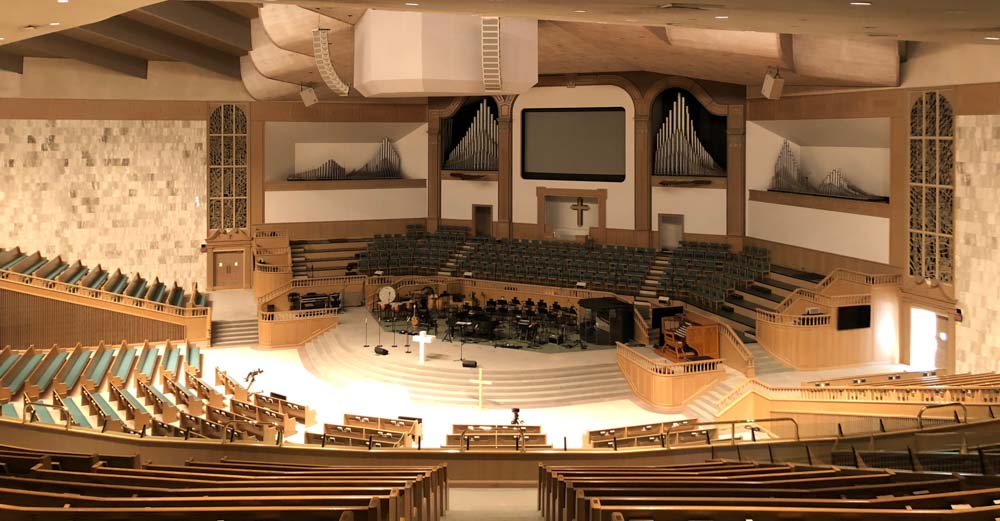
In the 2018-19 renovation, the organ was removed, the choir loft made more flexible, and thus the platform reduced in size allowing for more seating on the main floor enabling the seating under the balcony to be removed while still only reducing the worship center’s capacity from 3,500 to 3,000. Most importantly two large screens were added. In the digital age, lighting and projection are central means of creating the liturgical environment.

Online streaming and digital projection have also made possible multi-site churches that are united by the same sermon delivered from the home church. This is a model that Church of the Highlands has extensively used and that has also led to a congregation of Auburn Community Church being formed in Birmingham.
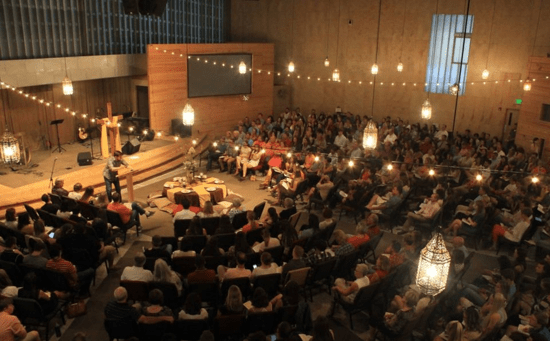
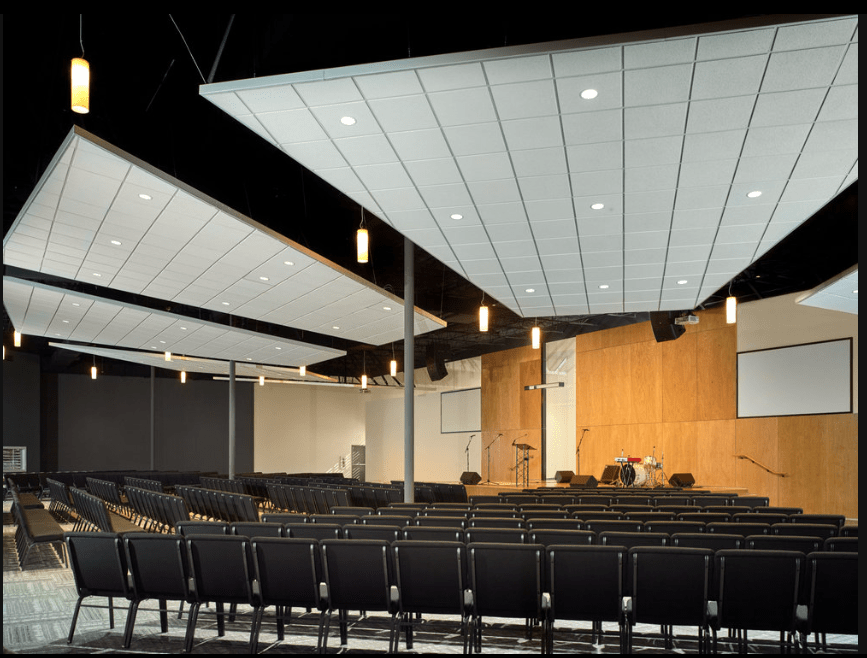
The lack of interest in a “traditional” space for worship among many Birmingham evangelicals has led many to freely adapt former commercial spaces as churches. In Homewood, Shades Valley Community Church has met in a former ice skating rink since 2006 and Christ Fellowship Church in a former grocery store since 2018. Both churches focus the congregation around a platform for the musicans and preachers, but there are important differences. While both observe the Lord’s supper every Sunday, a table is an important devotional focus at Shades Valley and is absent at Christ Fellowship.
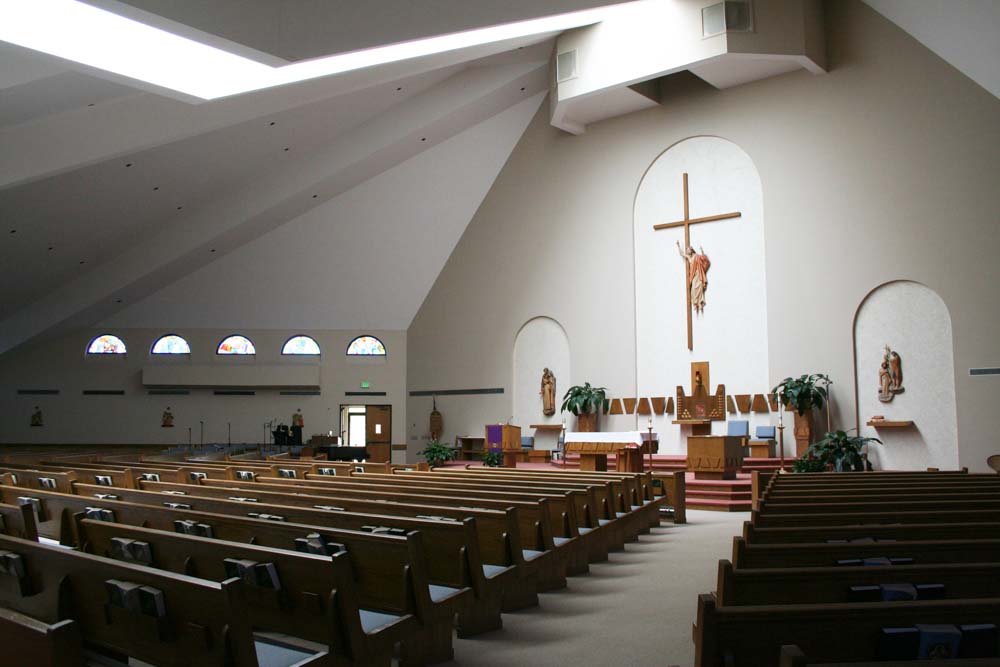
While there is a considerable movement toward informality and secular appearing spaces among evangelicals, this is not the case among Birmingham’s Roman Catholic church builders. In the late twentieth century, suburban churches such as St. Francis Xavier, Our Lady of the Valleyand St. Peter the Apostle were built in modern styles. More recent churches such as Prince of Peace, St. Mark the Evangelist, and the replacement of the fire damaged St. Francis Xavier, have all embraced traditional stained glass windows and interior furnishings. Prince of Peace and St. Francis Xavier retained a wide seating plan popular in many post-Vatican II Catholic churches and used at Our Lady of the Valley. St. Mark, however, has a more traditional basilican plan.
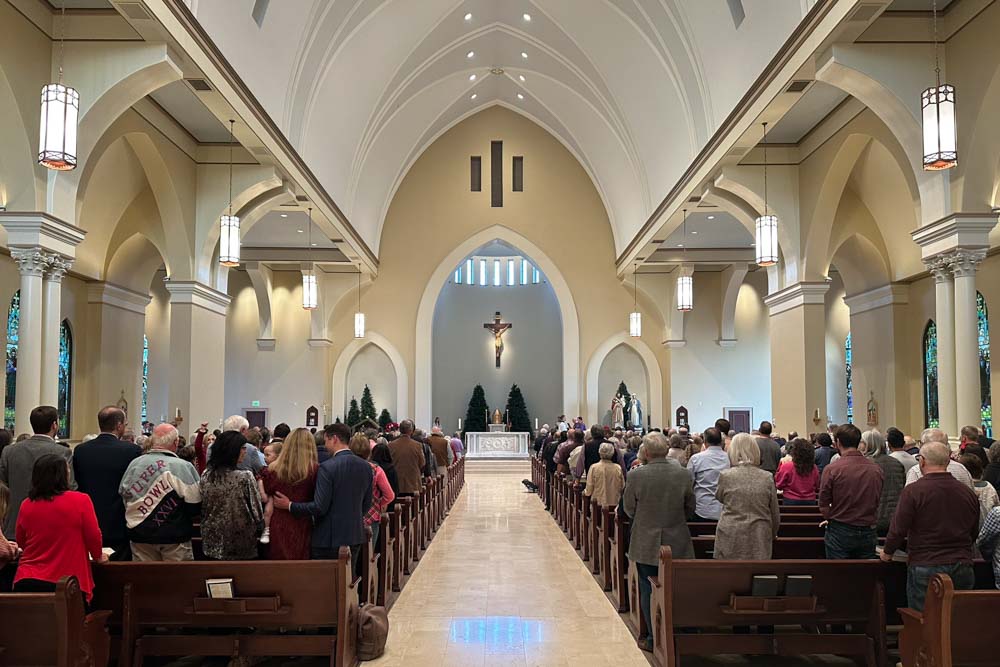
The last recent development to note is that several wealthy congregations have invested in new spaces for their more contemporary-style worship services while retaining their traditional sanctuary for their still-popular traditional services. These include Trinity and Canterbury United Methodist churches. Elsewhere, such as at the Cathedral Church of the Advent, St. Luke’s Episcopal Church, and First United Methodist Church existing spaces have received significant attention to adapt them to contemporary worship.
Thank you for reading visiting Spaces for Worship. Click here to return to the main page.
This page is part of “Spaces for Worship: A Birmingham-Based Introduction,” a section of Magic City Religion, written by the editor, David R. Bains, and funded by Samford University’s Center for Worship and the Arts.
 Magic City Religion