This semester (spring 2024) Magic City Religion published fifteen essays by first-year undergraduates on memorials in Birmingham. (Read this post for a general orientation to the project and a list of essays.) The students were enrolled in “Core Seminar,” a freshman writing course. Given the course’s general focus, students did not have to choose religious memorials, but most are, and I would argue that all acts of memory are in some sense religious. We defined “memorials” broadly to include not only statues, paintings, and the like, but also historical markers and works of public art. The subjects of their essays range chronologically from the fifteenth-century Byzantine bishop and theologian, Mark of Ephesus, to the still-living baseball legend Willie Mays.
Carved in Stone and Painted on Walls
The chosen memorials take many forms. Humans’ oldest enduring monuments are stone carvings and wall paintings, and both the oldest and newest memorials in our collection take these forms. Our one stone carving is the marble statue of the Reverend Dr. James Alexander Bryan was carved in 1934 by Georges Bridges. “Brother Bryan” was a Presbyterian minister well known for his concern for the downtrodden.
Our wall paitings are icons installed on the walls of St. Symeon Orthodox Church just last fall. This congregation of the Orthodox Church in America opened its new building in 2015 and over the past nine years its interior walls have been completely covered with icons by Romanian iconographers, Alin and Smaranda Trifa, The latest installation in the nave includes many lesser known Orthodox saints including two bishops discussed here Mark of Ephesus and Raphael of Brooklyn.
Cast in Bronze
In the ancient development of technology, bronze succeeded stone as a medium of choice. Our collection includes three bronze statues, all crafted within the past forty years to honor pivotal figures from the twentieth century. Two have direct connections to Samford University.
The oldest bronze statue in our collection, and probably the best known, is Glenn Acree’s of Ralph Waldo Beeson or “Mr. Beeson,” as Samford students celebrate him. The popularity of this statue is witnessed by the fact that two students chose to write about it. He is featured in so many student photographs. They wanted to know his story.
In 2015, a statue of Nina Miglionico was installed in Linn Park, Birmingham’s most prestigious memorial landscape. “Miss Nina,” as she was known to everyone, graduated from Samford (then known as Howard College) in 1933, long before Ralph Waldo Beeson gave it millions. As a woman, she was a pioneering attorney in Alabama and served on the Birmingham City Council for two decades from the council’s inception in 1963.

One year after Miss Nina’s statue debuted, Willie Mays, the Alabama-native and celebrated baseball player was honored with his own bronze statue outside Regions Field, Birmingham’s new minor league ball park. Mays did not play at this park, but instead at Rickwood Field a few miles west. Rickwood Field is America’s oldest baseball park and is currently receiving much attention because on June 20, 2024, the San Francisco Giants and the St. Louis Cardinals will play Major League Baseball’s ”Tribute to the Negro Leagues” game there. It is hoped that Mays will be able to attend.
Written in Iron
Birmingham was founded in 1871 as an ideal place to produce iron, the strong metal that overtook bronze three thousand years earlier. Not surprisingly, the city’s largest memorial is made of cast iron: the fifty-six foot tall statue of Vulcan, god of the Forge that Guiseppe Moretti designed it to celebrate the city at the 1904 world’s fair in St. Louis. Standing on a pedestal at the top of Red Mountain, Vulcan is well known, but what does he mean? In her essay, Johanna VanPelt highlights the environmental pollution caused by Birmingham’s iron industry as a cautionary tale for future advancements.
In the United States, the most common iron monument is the highway historical marker, In the early days of the automobile, cast iron historical markers became the norm throughout America. They are lovingly catalogued in the Historical Markers Database. Three such markers are included here.
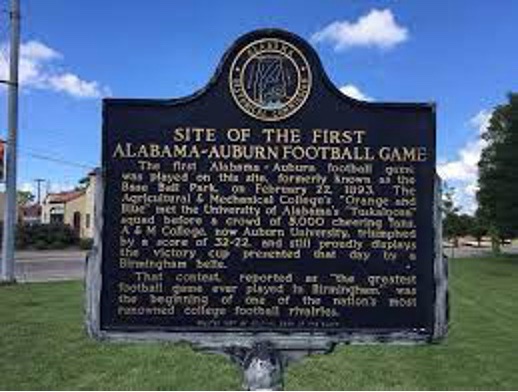


The markers commemorate the two things for which Alabama is best known: college football and the struggle for civil rights. It is perhaps no surprise that oldest, erected in 1985, celebrates a football game: the first “Iron Bowl” between Auburn and Alabama. It is just across the street from St. Symeon Orthodox Church. A decade later, Birmingham erected a historical marker remembering the Freedom Riders who in 1961 heroically attempted to get Alabama to abide by U.S. Supreme Court decisions supporting civil rights and were met with violent beatings. The final historical marker is just two-years old. It remembers the attempted bombing of Temple Beth-El in 1958.. This Conservative Jewish synagogue now offers a civil rights experience to groups from across the nation.
Inside Buildings
Many memorials are placed inside of churches. I’ve already mentioned the icons of the saintly bishops Mark and Raphael at St. Symeon. In Western tradition, it is not uncommon for pulpits to be decorated with statues of preachers. The pulpit of Hodges Chapel is no exception. Last semester, Magic City Religion, featured an essay on John Knox. This semester we follow with the man to his left: George Whitefield.
Libraries are also often memorial spaces. The main library at Samford is filled with painting of past presidents and a few others. In 2000 Magic City Religion featured one of those other paintings. This semester we include another which is of two figures separated by centuries: Johann Sebastian Bach and Albert Schweitzer.
On the Cities’ Walls
Perhaps the most popular, if transitory, memorial form in contemporary urban America is the mural. Last semester, Magic City Religion featured two recent murals painted on the outside of buildings in downtown Birmingham. One honors Fred Shuttlesworth, the other John Lewis. This semester students chose two slightly older murals.
Both state their message forthrightly in words, not just in images. One on a YWCA building downtown proclaims “Unity” and “Strong Youth Strong City” and depicts all these sentiments in a compelling compostion. In terms of message communication, it may be the best work of art featured here.

Another in Avondale encapsulates the messages of all memorials with its admonition, “Know Your History.” Of the four Birmingham residents it celebrates, Erin Elliott chose the one who said he was from the planet Saturn, Sun Ra.

Invitations for Conversation
In a faculty development meeting, a facilitator appealed to the fourth chapter of the Book of Joshua, where Joshua tells the Israelites that when they walk through the Jordan River on dry ground they should remove twelve stones and set them up as a memorial at Gilgal so that future generations will know that “Israel crossed over the Jordan here on dry ground” and thus “that the hand of the LORD is mighty” and “so that you may “fear the LORD your God'” (Joshua 4:22-24 NRSVue).
As the text makes clear, the stack of twelve stones were a discussion prompt. When the saw the stones, future generations were to ask, “‘what do these stones mean?’” In composing these essays, these fifteen students have shared their reflections on what these sculptures, paintings, and castings mean. Doubtless over time they may come to discover additional meanings of these memorials. But for now, we hope these essays are useful starting points for your own reflections.
Published May 3, 2024.
 Magic City Religion
1 Comment