Built to Endure: A Church Rooted in Resilience
By Alonte Hill
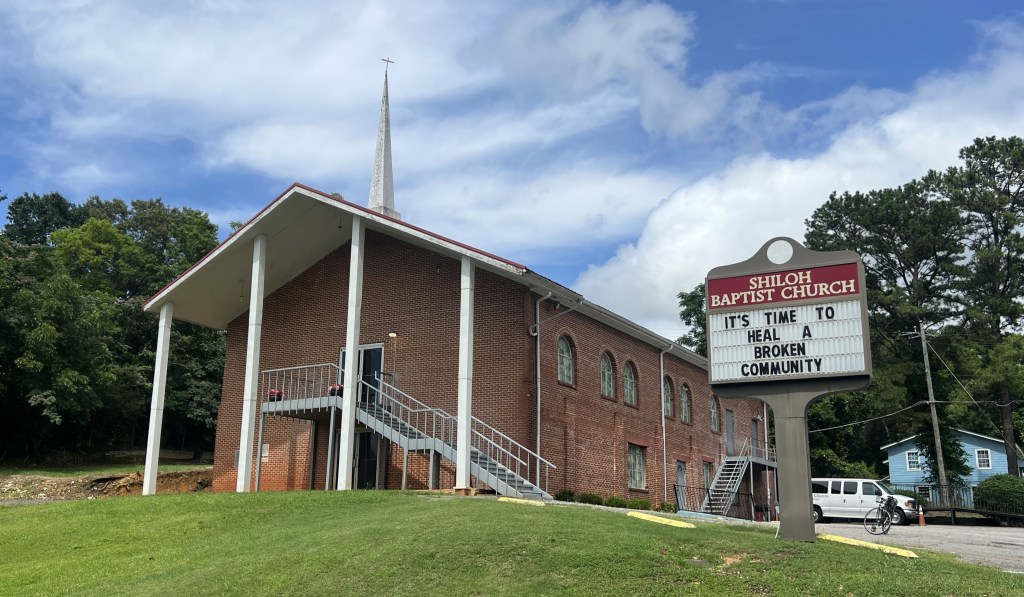
Shiloh Baptist Church was founded in 1912 following a revival led by the Reverend B.R. Jackson, and it has served as a pillar in the city of Brighton for over 113 years. Its first pastor was S.G. Guinn. Brighton, Alabama, is a small city in Jefferson County. According to the 2020 census, the population was 2,337 people. Throughout its history, Shiloh has played an important role in the Civil Rights Movement, serving as a pivotal meeting site during that era. The church is affiliated with the Jefferson County District Missionary Baptist Association, which is currently under the moderatorship of the Reverend Dr. Victor L. Harkins, pastor of Shady Grove Missionary Baptist Church in Bessemer, as well as the National Baptist Convention, USA, where Reverend Dr. Boise Kimber serves as president.
Currently, Shiloh is without a full-time pastor and is in a season of rebuilding following the impact of the COVID-19 pandemic, which delayed the completion of the last pastoral search. Other challenges have also slowed the congregation down in certain ways. However, things are gradually getting back in motion, and the church continues to strive forward despite struggles and strains. Shiloh is a predominantly African American church. Most of the congregation is comprised of older members, many of whom have been connected to the church for decades.
Description of Worship Service
The current building, completed in 1959, is the church’s third. There are two levels. Downstairs are the kitchen, restrooms, and a fellowship hall, which hosts meals and celebrations such as Friends and Family Day and church anniversaries. The upstairs sanctuary is the primary space for worship, featuring a red carpet, padded pews, and stained glass windows. Though showing signs of aging, the space is functional and creates a reverent atmosphere. Within the sanctuary, the lighting is soft but sufficient. At the front of the sanctuary, the pulpit and communion table serve as the centering focus. On it, there is a large Bible on top. In the right and left corners of the sanctuary, the American and Christian flags, each holding symbolic meaning related to national identity and faith.
The service opened at 11:00 a.m., with devotion led by the deacons. In the Black church tradition, devotion is a time of worship led by the deacons before the formal service begins, typically including a scripture reading, a hymn or spiritual in call-and-response style, and prayer. It sets a spiritual tone and invites the congregation to engage in communal praise and reflection. Devotionals at Shiloh follow the traditional “call and response” style found in many African American Baptist churches. For example, deacons may sing a line like “Come & Go To That Land,” with the congregation repeating the verse.
Though there was no choir on the Sunday being discused, the minister of music served as the worship leader and was accompanied by a drummer. They help the worship service flow by singing hymns, such as “Just a Little Talk with Jesus,” which creates a spiritual atmosphere. While singing, the congregation incorporated clapping, vocal responses, and affirmations.
As we transitioned to the announcements, the church secretary led them with community updates and church events. This included updates on local events, such as a Brighton City Council meeting, community concerns, and church-specific events like revivals and local pastor anniversaries. A highlight during this time is when the secretary asks if any members are celebrating a birthday or wedding anniversary. Those who are will stand, and the congregation will sing the birthday song. As opposed to the traditional version of the song, they often use the chorus from Stevie Wonder’s version of “Happy Birthday.”

Finally, the sermon came from Luke 18:35-43, which was the most important part of the service. It sermon was titled, “I Won’t Hold Back!” and was introduced by referring to a moment in a joint session of Congress, which took place on March 4, 2025, when Representative Al Green interrupted the proceedings to address President Trump, saying, “You have no mandate to cut Medicaid.” Even though Speaker Mike Johnson urged him to stop, Green refused to be silenced. By setting the stage in this way, it served as an attention grabber to illustrate Bartimaeus, who also refused to be quiet to get the change he needed.
As the sermon progressed through the passage, the following points were highlighted. First, (1) Request with Sincerity: Bartimaeus cried out with a genuine need, demonstrating both humility and faith. Next, (2) Refuse to Surrender: despite opposition from the crowd, Bartimaeus was determined and refused to be silenced. Finally, (3) Rejoice in the Savior: after receiving his sight, Bartimaeus responded by following Jesus and praising God.
Following the sermon, the Invitation to Discipleship was extended. The preacher invited individuals to come forward to accept Jesus Christ or join the church. Although metaphorical, the phrase “the doors of the church are open” shows a welcoming space for spiritual commitment. As this sacred moment took place, a congregational hymn was sung, and the invitation was extended. This moment was crucial because certain individuals in the congregation were urged to accept Jesus Christ while the opportunity was before them.
Telos, Ethos, and Key Practices at Shiloh
In observing the worship service, L. Edward Phillips’s study of worship can be implemented. As I watched, the focus turned to the telos at Shiloh Baptist Church, which emphasizes that worship always aims toward something, or a purposeful end. While glorifying God is the broad and ultimate aim of Christian worship, the telos at Shiloh Baptist Church reveals a more particular focus. Based on the structure of the service, the sermon content, and the participatory ethos of the congregation, the telos of worship at Shiloh can be broken into two parts, and their goal is to proclaim God’s word and to strengthen the faithful believers in the spiritual walk with God.
Shiloh Baptist Church exhibits a strong call-and-response tradition during both preaching and singing. Members openly express their engagement with the service through verbal responses such as “Amen,” “Preach, preacher!” and “Take your time!” They often stand, clap, or raise their hands as visible signs of how the message is impacting them personally. This responsive environment reflects a deeply participatory worship culture.
Another key expression of Shiloh’s ethos is seen in the practice of giving. Tithes and offerings are not treated as routine or obligatory. Instead, giving is seen as an intentional act of worship. This means that it is an expression of obedience, gratitude, and trust in God’s provision. As a result, members are encouraged to participate in the church’s mission and ministry, and not under pressure.
In addition to this, the strong sense of fellowship has a major impact on the worship ethos at Shiloh. Before, during, and after the service, members greet one another with hugs, handshakes, and conversation. These interactions are more than social gestures. They reflect the communal identity and bond of the congregation. At Shiloh, being together as the body of Christ is just as meaningful as the structured elements of the worship service.
In the Baptist tradition, worship is not typically described using sacramental language. At Shiloh Baptist Church, practices such as baptism and the Lord’s supper are not viewed as sacraments in the same way as they are in some other Christian traditions. Instead, they are viewed as ordinances, which are symbolic acts representing a believer’s faith and obedience to Christ. These ordinances are important, but they are not believed to mediate divine grace in and of themselves. Even though the congregation did not observe baptism or communion during the service on March 23, 2025, their absence does not exclude the sense of God’s presence. In Baptist worship, encountering God is most often experienced through the faithful preaching of the Word, prayer, singing hymns and praise, and the movement of the Holy Spirit within the congregation.
Built to Endure
Shiloh Baptist Church truly lives up to the title Built to Endure. Despite facing seasons of transition and the lasting impact of the pandemic, the church continues to stand strong. The members remain committed to God, to one another, and to the legacy of faith they have inherited. What is clear throughout every part of the service is that worship is not taken lightly at Shiloh. From the devotion to the preaching, and from the music to the fellowship, the congregation engages with sincerity, reverence, and passion. This clearly reflects the congregation’s shared commitment, which points to their resilience.
Shiloh Baptist Church
Address: 4401 West Street, Brighton, AL 35020
Services Observed: Sunday Morning Worship 11:00 A.M., March 23, March 30, and April 6, 2025 (In-Person)
Website: https://shilohbaptistbrighton.org/?page_id=5
Congregation established: 1912
Affiliation: National Baptist Convention, Inc.
References
“Welcome to the City of Brighton.” Accessed April 17, 2025. https://brightonal.org/.
Phillips, L. Edward. 2020. The Purpose, Pattern, & Character of Worship. Nashville, TN: Abingdon Press.
Ruth, Lester. 2002. “A Rose by Any Other Name: Attempts at Classifying North American Protestant Worship.” In The Conviction of Things Not Seen: Worship and Ministry in the Twenty-First Century, edited by Todd E. Johnson, 33-51. Grand Rapids: Brazos Press.
Alonte Hill ‘26 was a student in Christian Worship: History & Theology in Samford University’s Department of Biblical and Religious Studies in spring 2025.
Published June 16, 2025.
 Magic City Religion
Outstanding‼️TGBTG ❤️🙏🏽
LikeLike
This is very professional. Very Very Good. I am so proud of you!!
LikeLike
Awesome and very informative. This was very detailed , well said, and very professional. I’m very proud of u!!
LikeLike
Outstanding
LikeLike