By Katherine Williams
On April 6, 2025, Dawson Memorial Baptist Church in Birmingham, Alabama, marked its centennial with Sunday morning services that celebrated past, present, tradition, and innovation in worship. Through Scripture, song, space, and community, Dawson offered services that did more than honor a milestone. They enacted a theological vision of covenantal remembrance and called worshippers to renewed faithfulness. With three Sunday morning services (8:30, 9:45, and 11am) the congregation filled the pews of the sanctuary and joyously celebrated together. Though each service was the same order and content, each hour brought new worshippers with the same excitement for the occasion. I really enjoyed getting to evaluate these services and observe how people interacted with all the different elements that were a part of the centennial service. There were former staff members that travelled from out of state to be there, former Sanctuary Choir members that sang in the loft to help support the celebration through music, and countless others I didn’t see that all wanted to share in commemorating this anniversary. Dawson’s April 6 morning services exemplified a distinctive ethos that balances reverent continuity with meaningful celebration, inviting us to see God’s faithfulness not only behind but also ahead.
Worship Rooted in Covenant and Continuity
The telos of these services was covenantal remembrance. Rather than a celebration of nostalgia, Dawson’s leadership effectively crafted a service designed to guide their congregation into reflection on God’s enduring love. Former senior pastor Dr. Gary Fenton, who returned to preach the centennial sermon, centered his message on Psalm 136 entitled: “What Are We Celebrating?” The well known line of this psalm guided the focus, “His steadfast love endures forever.” This refrain, repeated throughout the psalm and the service, provided a theological anchor for the day’s worship celebrating God’s steadfast faithfulness. Just prior to Dr. Fenton’s message, the current senior pastor, Dr. David Eldridge, offered a brief, heartfelt introduction. Dr. Eldridge expressed very deep and personal gratitude for Dr. Fenton’s leadership and acknowledged the significance of his return. His introduction emphasized the unity and legacy of leadership that has shaped the church’s identity for a century. Every element of the liturgy, from the organ prelude, “O God, Our Help in Ages Past” to the closing hymn “Great Is Thy Faithfulness,” reiterated the church vision: “To Be Found Faithful As God’s People.” This theme was not only printed in the commemorative materials and etched above the stained glass baptistry window, but it was embodied in the service structure itself. In a tradition not formally sacramental, the services still bore what Lester Ruth has described as a “non-ritual sacramentality,” with music, testimony, and space serving as visible signs of invisible grace (Ruth 2002).

Music as Centering Focus
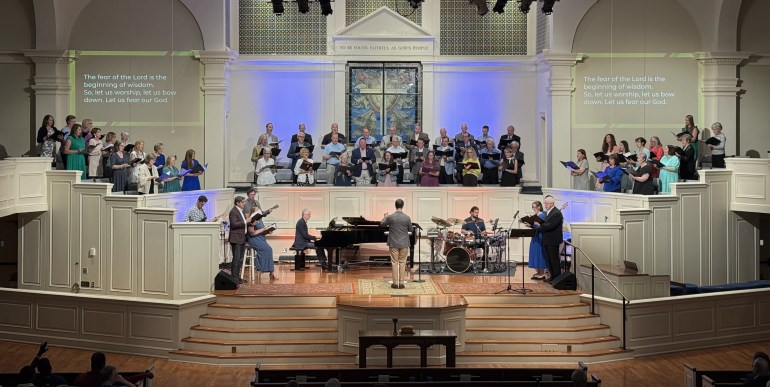
The musical elements of the service were particularly significant in expressing the church’s theological and liturgical identity. The church’s musical legacy is an important part of its identity and the many congregants leading music on April 6 were a testament to that. There were hundreds leading music for these special services, including choir singers, orchestra players, a full rhythm section, front-line vocalists, and returning members. Led by John Woods, music & worship pastor, and Dan Mullis, associate music & worship minister, the Sanctuary Choir & Orchestra were joined by alumni, forming an ensemble that visually and audibly testified to the congregation’s intergenerational continuity. The anthem “The Majesty and Glory of Your Name” stood out as a musical sacrament, a piece that invited God’s presence through harmony, orchestration, and communal memory. Paired with modern hymns like “Hymn of Heaven” and a full orchestral arrangement of Psalm 150 , the music ministry demonstrated Dawson’s commitment to blending tradition with contemporary expression without compromising theological depth. The congregational singing was participatory and robust, involving people of all ages and backgrounds. This was no performance for spectators but a gathering of worshippers drawn into the shared story of God’s faithfulness across a century.
Aesthetic Impact of Sacred Space
The physical space of Dawson Memorial Baptist Church shaped the liturgy in silent but impactful ways. Unlike the dark, introspective architecture of many Gothic churches, Dawson’s sanctuary is intentionally bright and outward-facing. The sanctuary’s massive windows filled the space with natural light, exemplifying the church’s commitment to openness, hospitality, and warmth. The space showcases a blend of warm wood, green-blue textiles, white columns, and a wide platform that directs attention both upward in praise and outward in fellowship. Above the baptistry hangs a stained-glass window featuring the cross, backed by radiant light, and framed with the words “To Be Found Faithful As God’s People.” This visual focal point served as a theological reminder that the church’s ultimate goal is not institutional success but spiritual steadfastness. The sanctuary fostered a sense of sacred celebration that was accessible to longtime members and first-time guests alike.

What Others Can Learn from Dawson
Dawson’s centennial celebration offers a strong example of how worship services can be both reverent and relational, grounded in tradition but open to innovation. The services highlighted “receptive ecumenism”: a posture of learning from one another across traditions while remaining rooted in one’s own. Leadership at Dawson utilized music, space, and theological depth to create a centennial celebration that is not simply commemorative but spiritually formative. While Dawson’s services are intentionally planned and executed with excellence, they do not sacrifice warmth or accessibility. The 100th Anniversary Sunday services were a reminder that churches are living traditions. When structured with care and vision, worship can both recall God’s past faithfulness and call forth fresh commitment for the future. It was deeply meaningful for me to witness how many hands and feet were working together for the common goal of joy and celebration. It was evident in my observation that Dawson has such a rich history because of the care the congregation has in supporting leadership, and the care that leadership takes to support the congregation. It is a sign of a special place, with a lot of special people, all working together To Be Found Faithful As God’s People.

Dawson Memorial Baptist Church
Address: 1114 Oxmoor Road, Birmingham, AL 35209
Services Observed: 100th Anniversary Sunday Worship, 8:30, 9:45, and 11:00 a.m., April 6, 2025
Website: https://www.dawsonchurch.org
Video Archives: https://www.youtube.com/@dawsonchurch
Affiliation: Southern Baptist Convention
Congregation established: 1925
References
Phillips, L. Edward. 2020. The Purpose, Pattern, and Character of Worship. Abingdon Press.
Ruth, Lester. 2002. “A Rose by Any Other Name: Attempts at Classifying North American Protestant Worship.” In The Conviction of Things Not Seen: Worship and Ministry in the Twenty-First Century, edited by Todd E. Johnson, 33–51. Brazos Press.
White, James F. Introduction to Christian Worship. 4th ed. Edited by L. Edward Phillips. Abingdon, 2023.
Katherine Williams ‘26 was a student in Christian Worship: History & Theology in Samford University’s Department of Biblical and Religious Studies in spring 2025.
Published June 15, 2025.
 Magic City Religion
1 Comment