Worshipping with All of Heaven
By Katie E. Schansberg
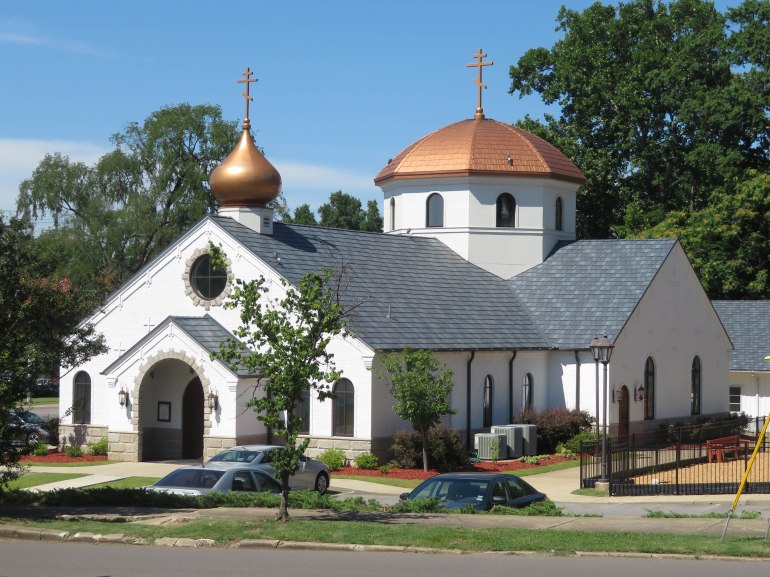
St. Symeon Orthodox Church was established in 1977 and is part of the Diocese of the South of the Orthodox Church in America (OCA). It is the only OCA church in Birmingham and has a “multi-ethnic emphasis and history” (Foncea). This parish is named after St. Symeon the Theologian, whom the Orthodox Church has the title “theologian” because he knew God (“Our Community”). St. Symeon the Theologian’s passionate conviction was that we should be living out of a personal, transformative experience with Christ instead of just going through the motions (“Our Community”).
Orthodoxy
There are three major branches of Christianity: Protestantism, Roman Catholicism, and Orthodoxy. According to the website for St. Symeon Orthodox Church, the Orthodox Church characterizes itself as staying faithful to the fullness of the traditional ancient church and the apostolic tradition, and as having a “rich liturgical life” (“About Orthodoxy”). Orthodox emphasize Christ as the head of the church and that the Orthodox Church operates as his body (“About Orthodoxy”). An estimated 300 million practicing Orthodox Christians are in America today (“About Orthodoxy”).
Key components of worship in the Orthodox Church include an entirely sung liturgy, frequently celebrating the eucharist, the veneration of images, or “icons,” praying to saints, lighting candles, and the belief that as they worship together, they are joining the angels, the saints, and all of heaven in worship. A choir sings the liturgy on behalf of the congregation. While the congregation can join in, they don’t do so loudly. Congregants listen and meditate on the words being chanted and sung and frequently cross themselves in reference to what is being said. The priest also circles the room at least once to honor the saints who are depicted in the images on the walls of the church. It is also common for congregants to arrive late and move and walk around freely during the service, often moving to different icons to venerate them or light candles.
In every service, Orthodox will kiss, cross themselves, bow to, and prostrate before icons. This is part of their theology of showing honor to or “venerating” the great saints of the faith. They believe that the honor and reverence they show to the saint in that moment passes on to God. It is because his spirit is present in the saint that the saint is worthy of honor. Additionally, congregants often cross themselves and bow their heads, facing the sanctuary, when they enter and exit the nave, to show reverence.
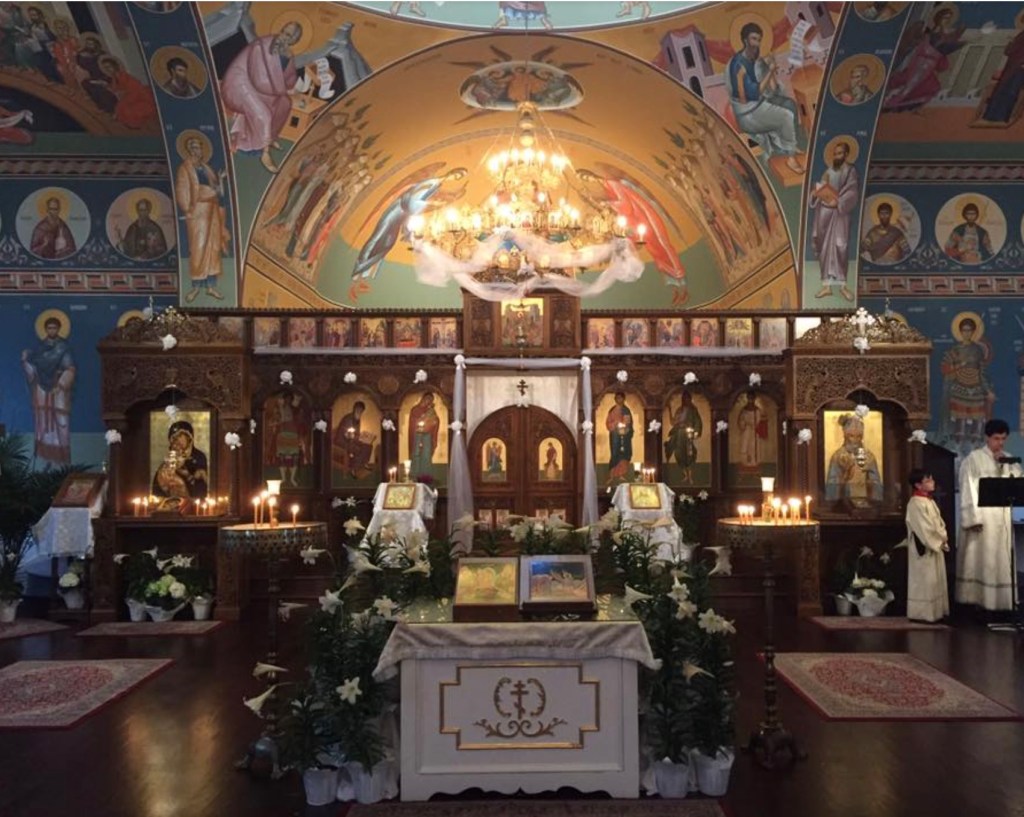
Orthodox call their church buildings temples. They are comprised of the narthex (a kind of foyer), the nave (the main area where people stand or sit during the service), and the sanctuary, which is separated from the rest of the nave by a wall, which is called an iconostasis or icon screen. This icon screen has three sets of doors, the royal doors in the center, and the deacons’ doors on the left and right. At St. Symeon, the choir is stationed on the right-hand side of the nave, in the transept, off to the side of the icon screen. (See this earlier essay for more on the architecture of St. Symeon.)
Space
Orthodox Churches create beautifully grand and ornate temples which are covered in images. The purpose of the beauty and magnificence of their sung liturgy, images, and temples is to “make the presence of heaven on earth live and intensive” (“About Orthodoxy”). The goal is to help the believer sense, experience, and feel the weight and grandeur of God’s presence with us (“About Orthodoxy”). This is in line with Orthodox theology, which teaches that when Christians gather together in worship, they are worshipping alongside all of heaven. They believe they are worshipping God with all the saints who have gone before them and all the angels in heaven. This is made evident through the worship space at St. Symeon. It depicts saints and biblical scenes while directing people’s eyes upward and toward the grandeur of the space.
I attended I visited a vespers service at St. Symeon Orthodox Church on Monday, March 24, 2025, the eve of the Annunication. Vespers is an evening service focused on prayer and reciting of psalms. When visiting St. Symeon, due to the depictions of saints and biblical figures all over the walls and ceilings, I found myself looking up and around at the various images. The ceiling has a beautiful dome with little windows at the top and images all in the dome. I constantly found myself looking upward and admiring the dome, its images, and the natural light streaming down. The design of this space and the artwork in it inspire you to look toward heaven and to the saints you are worshipping alongside. It also gives the space a grand and majestic feeling, reminding you of God’s majesty and glory.

To employer the terms Marcia McFee defines in “Primal Patterns: Towards a Kinesthetic Hermeneutic,” the worship space at St. Symeon inspires one to just “hang,” admiring God’s grandeur in awe while “residing in the moment” (McFee 2009). Furthermore, the beautiful music and the fact that during the service, most people stand in the center of the room inspires one to simply exist in the space in worshipful reverence.
L. Edward Phillips writes in The Purpose, Pattern, and Character of Worship, about the goal and character of a worship service (Phillips 2020). Phillips uses these two data points to analyze and differentiate worship styles. The goal of a worship service at St. Symeon Orthodox Church is to join in with heavenly worship, and the goal of the service is reinforced, taught, and embodied by the space containing the worship. Another goal for their services is to honor the saints that have gone before us, which is also encouraged through the many beautiful images of saints throughout the building. Even the outside of the church and the website have images of saints depicted there. Furthermore, the character of worship is one of reverence, which is also reinforced by the grandeur and ornate design of the architecture and art of St. Symeon church.
The Orthodox Church emphasizes venerating saints through images, participating in heavenly worship, and reverential awe in worship. These characteristics and beliefs held by the Orthodox Church are upheld, encouraged, and embodied through the beautiful temple of St. Symeon. In that temple, you cannot help but be still and reflect upon the great men and women of faith who have gone before us, what Jesus and other biblical figures did, and look heavenward in awe as you participate in worship with all of heaven.
St. Symeon Orthodox Church
Address: 3101 Clairmont Ave, Birmingham, AL 35205
Services Observed: Vespers 6:30 PM, March 24th (in person) and Great Vespers October 12th, 2024 (online).
Website: https://www.stsymeon.com.
Video Archives: https://www.youtube.com/@StSymeon
Affiliation: Orthodox Church in America
Congregation established: 1977
References:
“About Orthodoxy.” n.d. St. Symeon Orthodox Church. https://www.stsymeon.com/about_orthodoxy.
“About Our Community.” n.d. St. Symeon Orthodox Church. https://www.stsymeon.com/about.
Foncea, Jane. “St. Symeon Orthodox Church.” Magic City Religion. November 7, 2019. https://magiccityreligion.org/2019/11/07/st-symeon-orthodox-church/.
McFee, Marcia. 2009. “Primal Patterns: Towards a Kinesthetic Hermeneutic.” Proceedings of the North American Academy of Liturgy: 136-157.
Phillips, L. Edward. 2020. The Purpose, Pattern, and Character of Worship. Abingdon Press.
Katie E. Schansberg ‘25 was a student in Christian Worship: History & Theology in Samford University’s Department of Biblical and Religious Studies in spring 2025.
Published June 13, 2025.
 Magic City Religion
1 Comment