By Sydnie Ferrant
At the Episcopal Church of the Ascension in Vestavia Hills, everything in the liturgy leads to one main moment which is the eucharist. Whether it’s a regular Sunday or a major celebration such as the Easter Vigil, the congregation gathers around the table to receive what they believe is the true presence of Christ. It is far more than a significant ritual. The eucharist stands at the core of the church’s worship service.
Many aspects give Episcopal worship its depth such as scripture, prayer, music, and sacred space, but it is the eucharist that holds it all together. It is the moment when the community gathers in anticipation of encountering God. It is a key experience in shaping parishoners’ views on grace and unity as well as remembrance. As the 1979 Book of Common Prayer puts it, the eucharist is “the principal act of Christian worship on the Lord’s Day,” and Ascension clearly lives by that rhythm.
Episcopal Church of the Ascension was established by the Diocese of Alabama as a mission in 1953. Its mission was initially to serve the growning communities in the south of Birmingham. At first, the congregation was small and would gather in homes, local schools, and Vestavia Hills’ town hall. The mission continued and in 1960 it became a full parish. Subsequently, the congregation built its own church building with wooden beams, a center aisle, brick floors, and a pulpit and table that clearly set the tone for reverent, liturgical worship. Over the years, Ascension became known for its services, musical tradition, and genuine hospitality.
A typical Sunday service at Ascension follows Rite II from the 1979 Book of Common Prayer, with the holy eucharist celebrated every Sunday. The liturgy moves steadily and after the readings, sermon, and prayers of the people, the congregation shares the peace and then prepares for communion.
When the eucharistic prayer starts, the tone and feeling of the service change. The celebrant speaks more slowly and deliberately while the music becomes more reflective and the gestures of lifting the bread and wine stand out. These movements are not just symbolic as they help the community slow down and pay attention.
The words of the Great Thanksgiving (eucharistic prayer) are drawn from Christian tradition. The celebrant prays them aloud from the altar while the congregation joins with responses, the Sanctus, and the Lord’s Prayer. Then follows the invitation: “The Gifts of God for the People of God.” It is said calmly but with weight attached. The bread and wine are not treated as empty symbols but rather they are received as signs of God’s real and true presence.

The Easter Vigil at Episcopal Church of the Ascension frames the eucharist within a wider narrative of salvation. On April 19, 2025, the service began outside the church where the paschal fire was ignited to light the entrance to the church. The paschal candle was then lit from the fire and everyone processed into the darkened sanctuary holding their own candles. The liturgy proceeded to include a series of readings from salvation history from creation to deliverance, to prophecy and promise. After the Gloria in Excelsis was sung for the first time since the beginning of Lent, the lights were turned on, and the tone changed. The transition from to light made it feel as if Easter had arrived which made the eucharist feel powerful. The service as a whole was moving toward that moment, and it was the highest point of the service. The prayers and actions were the same as a normal Sunday; the table was seen as the center of everything.
At Ascension, all baptized Christians are invited to receive communion. People approach the altar rail quietly and kneel or stand. Unbaptized individuals and others who do not wish to receive communion are invited to approach the table where they can receive a blessing. They signal this by crossing their arms over their chests. Children are also encouraged to be brought up by their parents. During the early parts of the service children are brought to the children’s chapel but return prior to the receiving of the eucharist. This clearly shows that the eucharist is for the whole people of God and not just adults or longtime members and blessings are welcomed to all.
This weekly act of sharing bread and wine shapes the community and forms people over time. The Episcopal Church of the Ascension describes the eucharist as a means of grace which is a way of experiencing God that doesn’t depend on your knowledge or actions. The Catechism of the Catholic Church calls sacraments “efficacious signs of grace, instituted by Christ” (2000, para. 1131). Lester Ruth also points out that the sacraments are often how people come to recognize God’s presence in worship (2002). That’s definitely true at Ascension. The design of the church its structure and acoustics magnify the experience of the eucharist. The altar is central and mostly visible to the congregation. Between the altar and pews sits the choir. Its music elevates and directs the congregation through the service. Even by itself, the organ creates a consistent and balanced sound that is heard clearly throughout all parts of the space while the hymns correspond to the moment and the season.
On regular Sundays the organ pieces are often reflective and focus on grace with a full choir. At services such as the Easter Vigil there is not a choir, and the music is mostly chants. At the vigil, the celebrants wore white chasubles, and the space was decorated with flowers. On Sundays the visuals are simpler, but the design of the space continues to draw focus on the table. No matter the size of the crowd or the season the table always remains the focus.
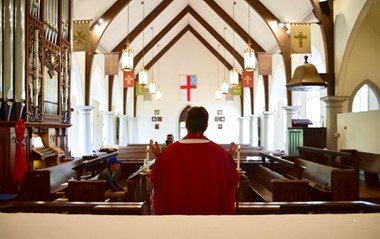
At the Episcopal Church of the Ascension, the eucharist isn’t just one piece of the service it’s the center. Everything points toward the table and everything flows from it. It is where the community remembers Jesus’s sacrifice, his shared grace, and where they are sent to live out their lives as Christians.
In a world where a lot of worship is shaped around performance and personality, Ascension offers something different It is slow, steady, and intentional. The focus is not on individual expression but shared action and sacred memory. People go to church here because they are shaped by it. Through repetition and beauty, the eucharist forms a community that’s ground, gracious, and held together as one.
Episcopal Church of the Ascension
Address: 1912 Canyon Road, Vestavia Hills, AL 35216
Website: https://www.ascensionepiscopal.org
Video Archive: https://www.youtube.com/@episcopalchurchoftheascension/streams
Services Observed: Sunday Worship on March 10, 2025, and Easter Vigil on April 19, 2025
Affiliation: The Episcopal Church
Congregaton established: 1953
References
Catechism of the Catholic Church. 2000. 2nd ed. Vatican City: Libreria Editrice Vaticana. https://www.usccb.org/sites/default/files/flipbooks/catechism
Phillips, L. Edward. 2020. The Purpose, Pattern, and Character of Worship. Abingdon Press.
Ruth, Lester. 2002. “A Rose by Any Other Name: Attempts at Classifying North American Protestant Worship.” In The Conviction of Things Not Seen: Worship and Ministry in the Twenty-First Century, edited by Todd E. Johnson, 33–51. Brazos Press.
White, James F. 2023. Introduction to Christian Worship. 4th ed. Edited by L. Edward Phillips. Abingdon Press.
Sydnie Ferrant ’28 was a student in Christian Worship: History & Theology in Samford University’s Department of Biblical and Religious Studies in spring 2025.
Published June 13, 2025.
 Magic City Religion
1 Comment