By Annie Heaton
If you have any interest in discovering more about the Catholic faith and immersing yourself in a high liturgical tradition and community, I cannot recommend the Cathedral of Saint Paul more! This spring, I researched, investigated, and attended the cathedral in downtown Birmingham, Alabama. Since this was my first time in any sort of Roman Catholic setting, you can imagine my experience has been quite unique and enhanced my knowledge of Catholicism in a tangible way.
The cornerstone of the cathedral was laid in 1890. Since soon after that it has soared above the intersection of Third Avenue North and 22nd Street. It replaced a small wooden frame church built in 1872, shortly after Birmingham began. The cathedral was renovated in 1955 and again in 2015. It is built in a neo-gothic style that pulls the eye heavenward, inspiring the spirit to thoughts above. The cathedral’s exterior, with its red brick and white limestone walls, showcase the gothic style as well. The main entrance has a statue of Christ above the doors. Upon entering, you observe that the church is built in basilica form, and has a half dome at one end, with a center aisle and two side aisles. Ten solid granite columns support the church’s arches.The baptismal font stands at the door of the church to remind those entering that baptism is the doorway to faith and the life of the church. (For more on the cathedral’s liturgical arrangement see this earlier essay.)
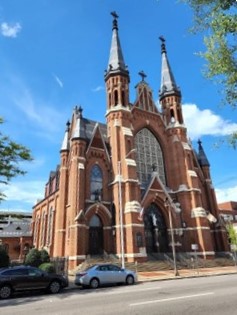
Focus and Character
The focus (or telos) of the Sunday liturgy in this community is, as I have witnessed, a response to God’s revelation to us. Much of the service is considered “responsorial,” meaning, upon hearing a certain reading, gospel message, or antiphon, the congregation is then led in some sort of responsorial reading/song where they are invited to process and acknowledge what has been presented to them. And, as I’ll expound upon later, the eucharist most definitely stands as a pillar of response in any given Catholic service. This sort of posture is quite common for Catholic churches, as it fosters a sense of solemnity.
The ethos, or character, of mass in this community is one marked as sacred, tradition-bound, and highly familar. Experiencing this kind of formalism was wholly powerful to observe, especially as it was completely out of my comfort-zone. Of course, the atmosphere of the cathedral itself aided this sort of ethos on a major level. The aesthetic was ornate and reverential. The incorporation of the dignified altar, surrounding stained glass-windows, and tall columns contributed greatly to the aesthetic, and therefore the ethos of the community.
Staying rooted in tradition allows for spiritual continuity and helps to connect worshippers with all of the generations that came before them. It was encouraging to see just how many families made up the church– the attendance and participation of children of all ages is of great value in the Catholic faith.
It is no surprise that the primary sacramental act in any typical Catholic gathering is the celebration of the eucharist. It felt as though everything in the service— the readings, the chanting, the antiphons, the responsorial songs– the entirety of the service was paving the way for the climax– the eucharist. It was clear to all attendees, members and visitors such as myself, that this was the culminating moment of our gathering together. The euchairst was indeed the primary sacramental act of the service, that is it was “the normal means by which a congregation assesses God’s presence in worship or believes that God is made present in worship” (Ruth 2002, 48). When Father Pastor Bryan Jerabek— rector of Saint Paul’s— presented the church with the elements there was a bell, chime-like ringing as he raised both the bread and the cup heavenward. I recalled that Catholics believe through an act of God they call transubstantiation the elements of bread and wine become the actual physical body and blood of Jesus Christ. This is a clear example of what Ruth is describing in the above quote.. as “God is being made present in worship.”
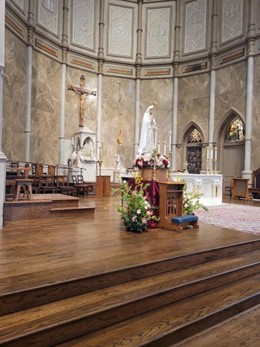
Experience of the Liturgy
The service itself was incredibly moving and a new concept to me, being raised in the Baptist faith. It began with a beautiful organ prelude, played by Bruce Ludwick. Then, there was an entrance antiphon based on Isaiah 66:10-11. It was presented to the congregation in Latin, but translated on the order of worship: “Rejoice, Jerusalem, and all who love her. Be joyful, all who were mourning; exult and be satisfied at her consoling breast.” What I noticed right away was that the majority of the congregation seemed to have these bits and pieces of music and text completely memorized. I enjoyed bearing witness to this, as it added a sense of unity among the gathering.
After this, there was an introduction and welcome, given by Father Bryan W. Jerabek, pastor and rector of the cathedral. I was surprised that the majority of the readings and prayers were chanted rather than spoken. I had expected some to be sung, but I was unprepared for so much of the liturgy to be chanted.
I noted that the order of worship I was handed encompassed of all of the masses for that weekend, rather than just for the eleven o’clock service. Additionally, the program had a note that suggested we follow the book in the pew back in front of us, to take part in recitations and hymns. When I opened the book, I was amazed . . .
This was quite possibly the most interesting part of the whole service for me. They had the antiphons, readings (I, II, and III), responsorial psalms, and the gospel for every single service for the rest of the year. This raised many questions in my mind. Firstly, who is charged with creating this book? Is the book the same for all Catholic churches in the area? What about the idea of spontaneous worship? Do they ever go off script? I was truly enthralled to see this.
The responsorial psalm was “The Lord is my Shepherd,” performed beautifully by the organ and choir. I was incredibly moved by this performance, as Psalm 23 is my most favorite psalm. It was truly a holy moment for me, and I couldn’t help but sing along. Soon after this came the Gospel Acclamation and Gospel reading followed by the homily, which as a Protestants I am used to calling a “sermon.” Father Jerabek spoke about John 9, and gave us practical application on how we can best love our neighbor. After reciting the gospel he offered his homily, or “mini-sermon” highlighting the parts of the text that should stand out to us, and reminding us of the beauty of the gospel message.
Following this, he led the congregation in prayer… not a written liturgical prayer in the congregation’s hands, but an “on-the-spot” prayer. In this prayer, he said “.. that she (Mother Mary) would help us see more clearly what Christ has done for us.” I, of course, took particular note of this, as the concept of Mary is vital for the Catholic faith. As I mentioned previously, the main focus of the liturgy at Saint Paul’s seemed to be the revelation of God through all elements of the service. Although I felt disconnected from some this, based on my unfamiliarity and having grown up in the Protestant, Baptist tradition, the members and attendees seemed to be deeply ingrained and at peace as I took note of my surroundings. In following traditional liturgies and devotions the Saint Paul community is most definitely contributing to its telos of providing church attendees with a liturgy that aids to connect them with the divine.
Reflection
Something, however, that I would’ve loved to see in the service is perhaps embedded moments of silence. As I mentioned, the service cultivated such peace and solemnity in an awe-inspiring way. I would’ve loved, then, to take a few moments throughout the service to reflect in silence, just to feel that “vertical relationship” with God on a more profound level. Although, I’m sure if this particular mass lacked the amount of music it had, there would’ve been some moments of silent reflection.
Of course, It would be naive to say “I wish there was contemporary music incorporated, or spontaneous worship moments.” This would be abnormal and more than atypical for a highly liturgical Catholic mass. However, added pockets of silence just between the worshiper and God is a practical, and yet valuable addition that would surely add to Saint Paul’s telos.
Even as I am still processing all that I witnessed at the Cathedral of Saint Paul, I would say there are both pros and cons to this community’s worship. What I have continued to ponder and consider is this idea of a highly-traditional, dignified, and majestic worship. I think immature Annie would’ve thought that the “flow” of worship– from sacraments, antiphons, to the Eucharist— came across as robotic and ritualistic in a negative connotation.
However, the more mature Annie, shaped by her growing in my knowledge of worship, no longer has this perspective. I now see the great, intrinsic value of upstanding customs and traditions. It truly does bond you to the worshippers and great leaders of the past— the ones that paved the way for us to continue in worship today. When you recite an antiphon that has been around since the fourteenth century, there is no doubt one will feel a beautiful, strong connectedness with one’s faith and, of course, with the divine.
To be honest, the one thing I feel could be potentially problematic about this community’s worship comes not from the church itself, but from my own personal convictions regarding the Christian faith. As I set this up, I don’t want to be misheard–-I recognize the importance of Mary and the virgin birth! I recognize and honor Mary as the chosen Mother of Christ, purveyor and bearer the Messiah, and what a miraculous gift we have received through her. However, my solid foundation is the finished work of Jesus– the gospel message. Lucky for me, my parents continuously worked to instill the truth in me that “Jesus loves me, and there is nowhere I can go to separate me from His love.” I was encouraged through my Protestant upbringing that I had access to direct communication with the divine at any time. This is something that it seems to me many Catholics are not completely “bought-in” on. In my view Catholics tend to regard Mary as of similar importance and value as her son Jesus.
This, to me, seems highly contradictory to the message of Christianity. I suppose I hold similar beliefs to those of Justin Martyr, who pointing to baptism, faith, and good works said, “there is no other [way} that this: to be acquainted with this Christ” (Justin Martyr, Dialogue with Trypho, 44). Highly revered saints, such as Mary, John the Baptist, and the disciples of Jesus deserving of our attention and appreciation, but not means of salvation.
The Cathedral of Saint Paul
Address: 2120 3rd Ave N, Birmingham, AL
Services Observed: March 16 and April 13 2025
Website: https://stpaulsbhm.org
Video Archives: https://www.youtube.com/@stpaulsbhm
Affiliation: Roman Catholic Church
Parish established: 1872
Annie Heaton ’26 was a student in Christian Worship: History & Theology in Samford University’s Department of Biblical and Religious Studies in spring 2025.
 Magic City Religion
1 Comment