A Samford Legacy
By Emma Stinton
Throughout the country and especially in Birmingham, Alabama, there are many memorials. Each memorial has its own important purpose and reason why it honors a historic person, figure, or time-frame. Each memorial has something that its creator wants to honor, whether that is what someone has done or a movement that was formed and the memorials have a future goal that they hope to desire. Ralph Waldo Beeson left a legacy to Samford University and it honored him with a statue that inspires philanthropy and service.
Ralph Waldo Beeson was born on October 24, 1900, in Mississippi. He attended Emory University and graduated in 1920. After college he worked in Atlanta where he sold insurance for Liberty National Life Insurance Company. After he sold insurance he went to work for Ford Motor Company. When he was 26, Beeson moved to Birmingham, Alabama and served as an assistant for Liberty National Life Insurance Company. Beeson didn’t get married until he was 40, because “He wanted to make certain he could appropriately provide for a wife” (Hartwell). Beeson did not become involved with Samford until the 1960s. He was inspired by his brother to become invested in the university. He is known for being one of Samford’s biggest donors. He died nine days before his 90th birthday.
He donated gifts to Samford University such as residential halls, the school of education, and some scholarships. After his death he was known as a “titanic figure in the history of samford university.” When he passed away he left Samford 56 million dollars. He said “”It’s the Lord’s money. He gave me the gift of making it. I am not smart enough to make that much money on my own. It’s His money, and I am going to give it back to Him” (“Founders” 2024). According to many different articles, people regarded Beeson as a humble person. Gerow Hodges, one of his good friends, gave him a pair of corduroys and when Hodges went to give him a second pair Beeson said he could not accept them because “he already had one pair, and he said that was enough” (Harwell). He showed the type of mindset that we should all have. Even though he was a multimillionaire he showed how important it was to be humble. Hoyt Harwell reported that even though Beeson was making millions he still spent his money sparingly. He decided to put his money towards a good cause and donated millions to Samford University. He was the main contributor to the university and is still recognized even to this day.
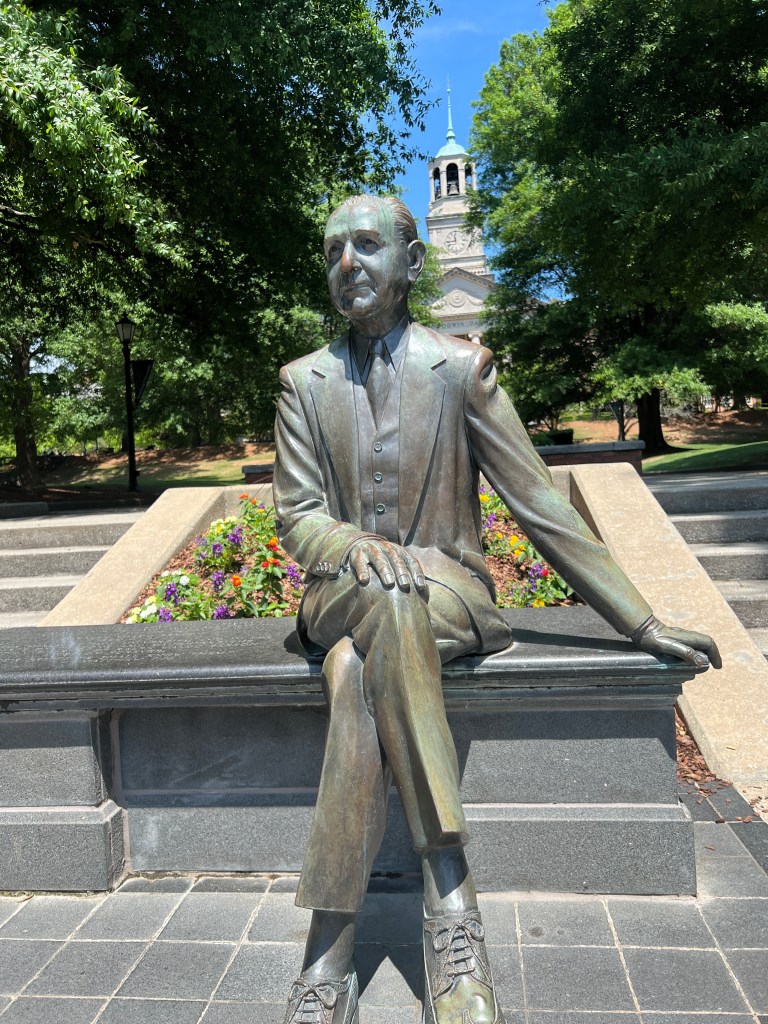
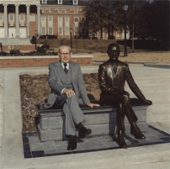
In order for Samford to honor him for all of his contributions to the university, the school decided to commission a statue of him and place it at the front of the foot of Centennial Walk, in the middle of campus. It was a way for Samford to honor all that he had done for the university. The audio walking tour of the campus explains,
Sculpted by Glynn Acree and installed in 1988, this life-size statue of Samford benefactor Ralph Waldo Beeson greets every visitor to Samford’s campus. With gifts totaling more than $100 million, the Beeson family helped shape both the physical and intellectual landscapes of Samford University. Mr. Beeson’s generosity continues to benefit and influence current and future generations of Samford students.
(Samford University Oral History Collection 2017).
An important outcome that the university and Beeson hoped to inspire a community of philanthropy. Philanthropic consultant, Tifany Boyles explains that the purpose of philanthropy is to serve others:
We must preserve the purpose of philanthropy – to create public good rather than personal gain. When personal gain is the donor’s motivation, that is when philanthropy loses its purpose and can cause harm. While the purpose of philanthropy is not to benefit one’s self, there is no question that giving has indirect and incredible benefits to the generous.
Boyles 2022
Her article mentions three key points on the importance of philanthropy. The first point mentioned is philanthropy is an expression of values. Philanthropy has proven to be a centuries-old method of transmitting values to generations and creating a lasting legacy beyond one’s lifetime. The second key idea is we become more educated when we invest in change.
Supporting causes or specific organizations inspire us to learn more about social issues and the approaches to resolving them. Most nonprofit organizations go beyond trying to achieve their mission and also invest significant dollars in communication efforts that educate their stakeholders and create awareness.
Boyles 2022
The final idea is philanthropy creates happier, healthier humans. The article says in an environment where people are more critical of power, exercising your voice and living your values reduces stress and increases well-being. Even though there are many positive outcomes and reason’s to serve and focus on philanthropy, people argue against it. Beeson showed the true goodness of philanthropy and service based on all he did for the university, but some people argue that there is no such thing as a selfless act. Different people will have different views on every type of service. People argue that people will always be selfish and do something good just to justify it to themself. Boyles compared this to throwing a rock in the river.
To them I say, when you throw a rock in the river, you may or may not hit your target, but you will always create ripples. While the ripples were not the intended target, are they not also beautiful? The same is true for philanthropy. Perhaps your target is to alleviate poverty, to feed a family, or to increase social justice. And, during your journey, you become more educated, you find a meaningful community, and you teach your children about your beliefs. While it wasn’t the target, it sure is noteworthy.
Boyles 2022
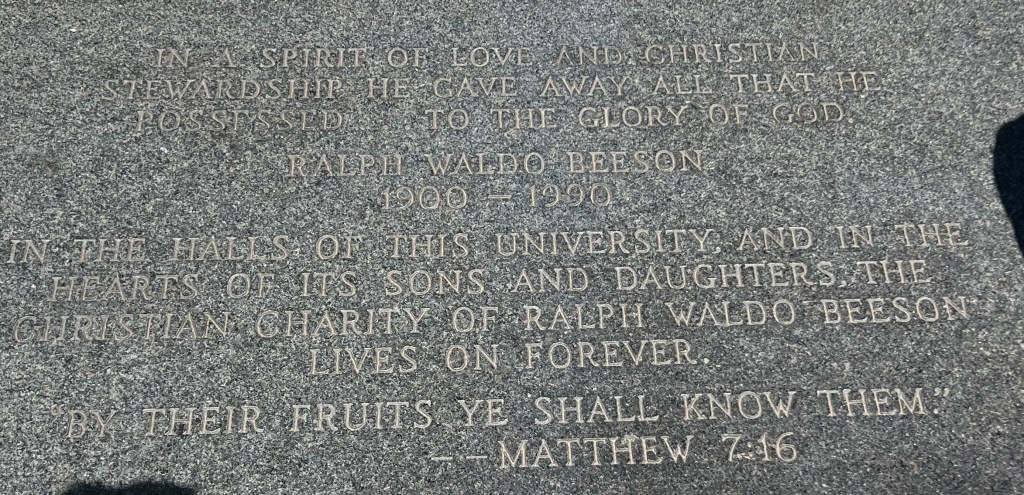
In conclusion Ralph Waldo Beeson shows the importance of philanthropy and giving back. He shows Samford students what they should do to live a life of service and philanthropy by showing how the lord calls us to do so. The university hopes to encourage students, faculty, and all those who come to the university and see his statue to be reminded of the importance of philanthropy.
Ralph Waldo Beeson
Medium: Bronze statue
Artist: Gylnn Acree
Commisioned by: Samford University
Installed: October 24, 1988 for Mr. Beeson’s Birthday
Bibliography
Boyles, Tifany. 2022. “The Power of Philanthropy: We Become Better Humans.” Lilly Family School of Philanthropy, February 10, 2022. https://blog.philanthropy.iupui.edu/2022/02/10/the-power-of-philanthropy-we-become-be tter-humans/
“Founders & Benefactors” 2024. Samford University. Accessed January 26, 2024. https://www.samford.edu/about/founders#ralph-waldo-beesonnders.
Harwell, Hoyt. 1990. “Philanthropist Saved his Millions a Dime at a Time”| Lewiston Tribune. November 24, 1990. http://mtribune.com/biography/philanthropist-saved-his-millions-a-dime-at-a-time/
“Mr. Beeson Statue: Ralph Waldo Beeson.” 2017. Samford University. November 8, 2017. https://www.samford.edu/departments/oral-history/projects/samford-walking-tour/Beeson-Statue-Ralph-Waldo-Beeson
Emma Stinton ‘27 was a student in UCS 102: Memorials & the Future in Samford University’s Howard College of Arts & Sciences in spring 2024.
 Magic City Religion
1 Comment