Faithful Orthodox Christian Behind Bars
By Gabe A. Adams
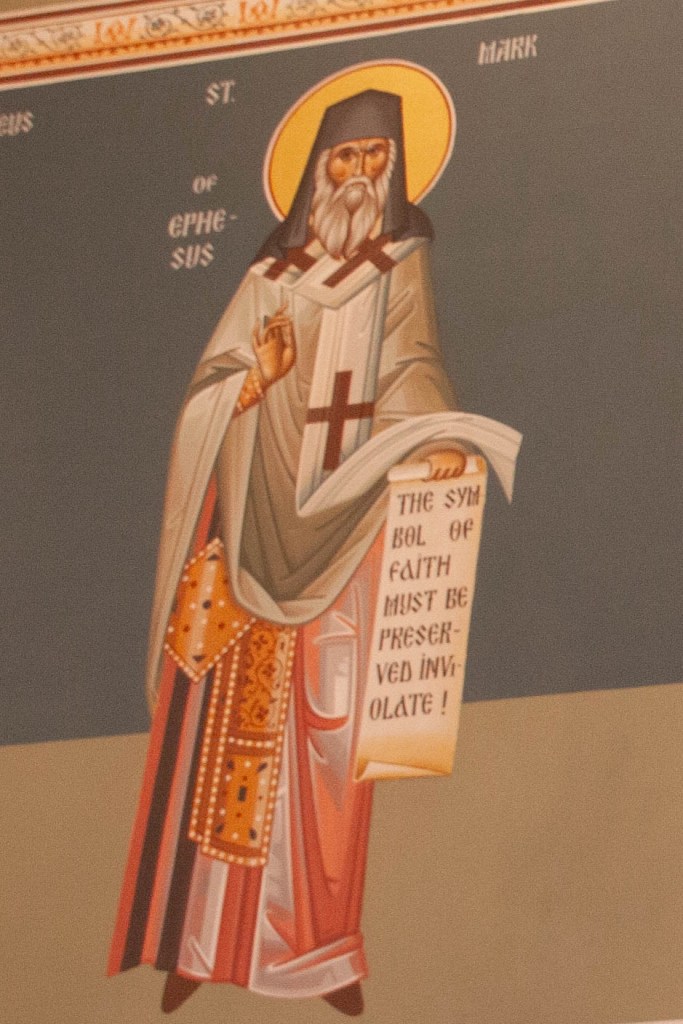
Mark of Ephesus, also known as Mark Eugenicus, was born in 1392. Saint Mark was a significant figure within the Orthodox Church during the fifteenth century. Mark of Ephesus stems from a lineage that was deeply devoted to religion. Manuel Eugenicus, Mark’s grandfather, distinguished himself as an iconographer, while his father, George, contributed to the ecclesiastical sphere by composing prayers and teaching children. Saint Mark learned from respected scholars of his era, such as John Chortasmenos and George Gemistos Plethon. He also talked about religion with essential people like Makarios Makres and Joseph Bryennius, who helped him understand ancient Greek writings and Latin theology. Before studying religion formally, Mark of Ephesus spent time in solitude and contemplation on the Isle of Antigone. Later, Mark of Ephesus became a monk at the Monastery of Mangana in Constantinople, where he read many books and immersed himself in extensive research within its library.
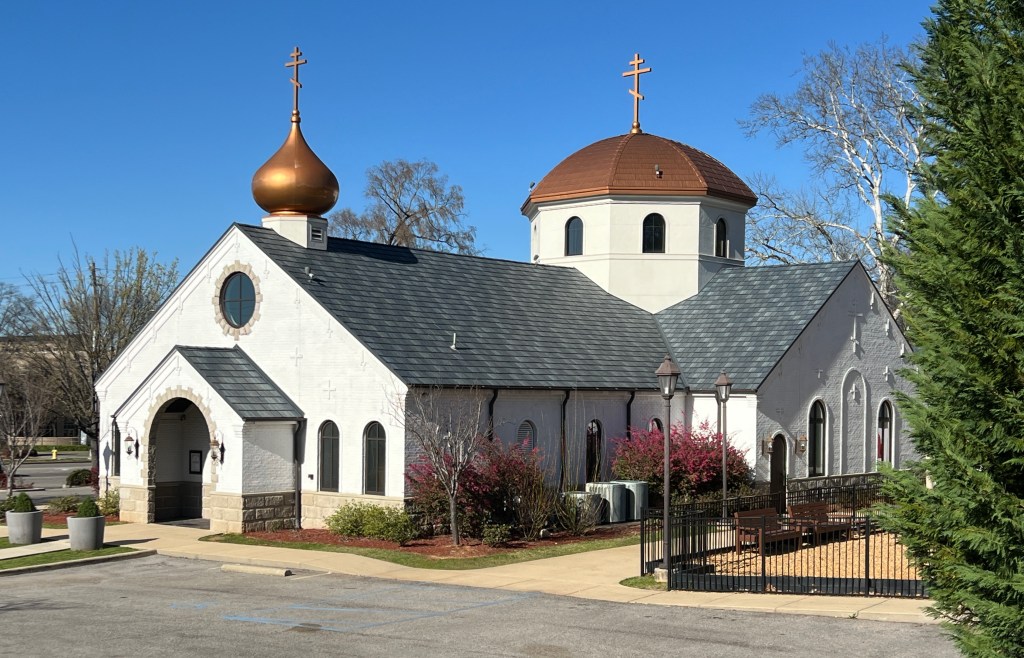
Saint Mark’s early writings showed that he preferred peaceful discussions, wanting unity among Christians without arguments. Even though he was interested in Latin theology, Mark of Ephesus stayed true to his Orthodox beliefs, as shown in a letter he wrote to Ecumenical Patriarch Joseph II about his stance on the filioque controversy. He is among the many saints honored in iconography of St. Symeon Orthodox Church in Birmingham. Overall, Mark of Ephesus became a brilliant theologian who stayed loyal to his Byzantine roots while discussing religion with Latin scholars.
The Differences between Roman Catholicism and Eastern Orthodoxy
Eastern Orthodox and Roman Catholic worship significantly differ in how they are organized and practiced. Orthodox worship focuses on decentralized leadership and mystical symbols, often using icons and chants extensively. While the Orthodox tradition embraced languages for worship it emphasized continuity through time. Roman Catholic liturgy remained in Latin until after the Second Vatican Council (1962-65). Since then it has incorporated a large variety of musical styles and songs blending traditional and modern elements to engage people effectively. However, what distinguishes Orthodox worship is its profound emphasis on liturgical practices. Scholar Nina Glibetić states that Orthodox Christianity is well known for prioritizing “the liturgy in the life and mission of the church” (Wolterstorff 2022, 85). According to theologians such as Georges Florovsky and Alexander Schmemann, within Orthodox Christianity, worshiping and praising God is seen as the ultimate goal of all human activity, going beyond mere rituals (Wolterstorff 2022, 90). Orthodox Christians see the church as an experience that serves as a communal gathering and a transformative path toward spiritual connection with the divine. Moreover, the focus on rituals in Orthodox worship highlights their crucial role in shaping the identity and purpose of the Orthodox Church, distinguishing it from other Christian denominations.
A key dispute between the Eastern Orthodox and Roman Catholic churches is “the filioque:” that is the inclusion of the words “and the son” in portion of the Nicene Creeds that states that the Holy Spirit “proceeds from the Father and the Son.” This became a central point of contention during the fifteenth-century Council of Florence. According to Edward Siecienski, the “debate on the orthodoxy of the filioque did not begin until March 2, 1438 (the second session at Florence), after the council had left Ferrara because of an outbreak of plague” (Siecienski 2010, 155). The Greek delegates, weary from prolonged debates and longing to return home, expressed frustration with the ongoing discussions surrounding doctrinal differences, particularly regarding the addition of the Filioque to the Nicene Creed. John of Montenegro, representing the Latin case, sought to clarify the debate’s terms by examining the Greek word “enópevous,” citing Jerome’s Vulgate and differentiating between the Spirit’s “going forth” and “enópevous,” a term exclusive to the hypostatic coming-to-be of the Spirit (Siecienski 2010, 155).
On the other hand, Mark of Ephesus referenced John of Damascus’s On the Orthodox Faith to support the view that the Spirit’s procession is solely from the Father. This theological debate escalated during subsequent sessions, with Montenegro arguing that the Spirit receives being from both the Father and the Son, while Mark of Ephesus emphasized the Byzantine belief in the Spirit’s procession solely from the Father. Despite efforts to reconcile differences, such as examining textual variations in Basil’s Adversus Eunomium, the council faced significant challenges in achieving unity between the Eastern Orthodox and Roman Catholic Church (Siecienski 2010, 157). After the Council of Florence, Mark of Ephesus, seen as a symbol of opposition to Latin theological changes, was imprisoned for his dissent. This punishment highlighted the Byzantine Empire’s deep divisions and the council’s intense debates. Mark’s imprisonment reminds us of the sacrifices made for one’s beliefs and the lasting impact of the Filioque controversy on Christian history.

Mark of Ephesus’s Influence Today
Mark of Ephesus’s teachings emphasize the significance of remaining true to one’s beliefs. Today, this principle translates to maintaining steadfast convictions in every situation encountered. The Bible states,
Submit yourselves for the Lord’s sake to every human authority: whether to the emperor, as the supreme authority, or to governors, who are sent by him to punish those who do wrong and to commend those who do right. For it is God’s will that by doing good, you should silence the ignorant talk of foolish people. Live as free people, but do not use your freedom as a cover-up for evil; live as God’s slaves. Show respect to everyone, love the family of believers, fear God, honor the emperor.
1 Peter 2:13-17 NIV
Believers are called to submit to human authority, but this obedience must also be balanced with the responsibility to uphold God’s will by promoting justice and protecting citizens.
Conclusion
Mark of Ephesus, a significant figure in Byzantine church history, was deeply devoted to his faith. His upbringing, education, and steadfast commitment to Orthodox principles, notably in his stance on the Filioque controversy, shaped his role at the Council of Florence. Despite attempts at reconciliation, Mark’s unwavering fidelity to Orthodox beliefs ultimately influenced the reception of the council by the Orthodox church. Though proclaimed by the emperor, the union between the Catholics and the Orthodox was broadly rejected and remains unimplemented.
Mark of Ephesus
Medium: Painted icon mural
Artists: Alin and Smaranda Trifa
Created and Installed: 2023
Location: St. Symeon Orthodox Church, 3101 Clairmont Ave South, Birmingham, AL 35205
Reference List
Faure, Emmanuel. 2020. “Memory, Knowledge, and Zeal in the Spiritual Combat According to the Letter to Nicholas Attributed to Mark the Monk.” Cistercian Studies Quarterly 55, no. 3 (July 1, 2020): 283–98.
Gill, Joseph. 1982. The Council of Florence with Corrigenda by the Author. New York: AMS Press, 1982.
Harpur, Alison Catherine. 2023 “Studies in Visual Culture and the Council of Ferrara-Florence (1438-1445).” Ph.D. dissertation, University College London.
“Hesychasm.” 2018. Funk & Wagnalls New World Encyclopedia,
Kappes, Christiaan. 2019. The Life and Times of Mark of Ephesus. Notre Dame, IN: University of Notre Dame Press.
Kappes, Christiaan. 2014. “A Latin Defense of Mark of Ephesus at the Council of Ferrara-Florence (1438-39).” Greek Orthodox Theological Review 59, no. 1–4 (March): 161–230.
Siecienski, A. Edward. 2010. The Filioque: History of a Doctrinal Controversy. New York: Oxford University Press.
Strezova, Anita. 2014. Hesychasm and Art: The Appearance of New Iconographic Trends in Byzantine and Slavic Lands in the 14th and 15th Centuries. Canberra, ACT: Australian National University Press.
Ross, Melanie C. and Mark A. Lambert. Historical Foundations of Worship: Catholic, Orthodox, and Protestant Perspectives. Grand Rapids, MI: Baker Publishing Group, 2022.
Gabe Adams ‘27 was a student in UCS 102: Memorials & the Future in Samford University’s Howard College of Arts & Sciences in spring 2024.
 Magic City Religion
2 Comments