The Great Impact that Vulcan and Mines Had on Birmingham
By Johanna VanPelt
Buried deep inside of foothills of the Appalachians in Birmingham, Alabama, lie the skeletons of the past. Many different mines rest peacefully in Red Mountain. These mines are the reason that Birmingham is the thriving city that it is today. The industrial era boosted the economy greatly, and the world’s largest cast iron statue was created to show off Brimingham’s hard work.
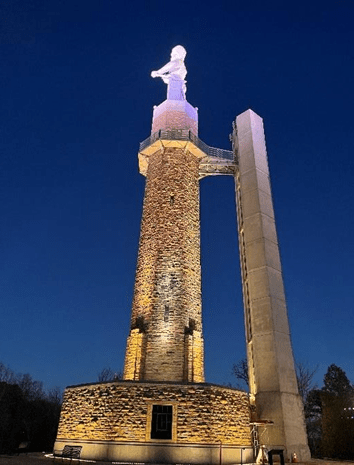
This statue of Vulcan, the Roman god of the forge, now reigns at the peak of Red Mountain overlooking Birmingham. He commands, a ten-acre plot, Vulcan Park & Museum, dedicated to the sharing and interpretation of Birmingham’s deep industrial history (“About | Vulcan Park & Museum: Birmingham, AL” n.d.). All around Birmingham are thirteen mini copies of Vulcan (Itson 2021). These smaller versions of Vulcan are Birmingham’s way of a tribute to Vulcan. The little versions were painted by multiple different artists and are vastly different in their looks, each one being original and unique to its area. These statues range greatly in size too, from a ten-foot-tall version to a little bobble head found in a gift shop. It is obvious that Birmingham loves and appreciates the Vulcan, even though there’s more behind Vulcan than only good things.
The Creation of Vulcan
Originally built in 1904, Vulcan was designed and sculpted for Saint Louis’s 1904 Louisiana Purchase Exposition. This world’s fair was very influential and contributed many valuable assets to South’s economy. The designer, Guiseppe Moretti had imagined Vulcan to be a grand statue that would highlight the iron from the mines of Birmingham. Moretti wanted people to be inspired every time that they looked at Vulcan and remember the legend behind it. He went on to build Vulcan to be 100,000 pounds and fifty-six feet tall (Sonderman and Truax 2008). Moretti designed Vulcan after the very skilled and slightly deformed Roman god of blacksmithing and fire (Dragnea 2009). Vulcan in Roman mythology was a very loved and respected god, especially because Rome tended to have many fires and volcanoes (Burris 1930). Just as Vulcan is important to Rome, Vulcan is important to Birmingham. Unfortunately, on opening day, it was only completed up to the knees, leaving more than half to be finished. It was dedicated on June 7, 1904 (Sonderman and Truax 2008). Vulcan ended up winning the grand prize in the minerals department.
When the fair was over, there was no plan for Vulcan’s future. The statue was been moved around multiple times for various reasons. It was moved to Alabama State Fairgrounds where he held a Coke bottle for advertisement and was dressed in spray-on overalls (Sonderman and Truax 2008). He remained there until 1939 when he was relocated to his tower atop Red Mountain. He remained there until 1999 when he was taken down for restoration, a process that was not completed until 2003 (Sonderman and Truax 2008). When people see Vulcan today, they can gather round and share stories of the grand statue and how it came to be. The sight of people joining together because of Moretti’s work of art must bring him joy in his place of rest.
Dark History of Vulcan and Birmingham
Even though there are many good aspects that Vulcan represents, its history has a dark side. Inside the museum are multiple accounts of mistreatment of its workers, one leading to death (Vulcan Museum 2024). Coal and iron from inside the mines in Birmingham have caused fthe local waters to become polluted with toxic metals and acidic water (“Drummond Ordered to Clean Old Mine Site, Pay $3.65 Million” 2022). The plants used to turn these raw materials into something useable caused air pollution in the Birmingham area, especially in African American communities (“The Tragedy of North Birmingham” 2022). Back in the 1970s, Birmingham was known as the “smoke city” to the truckers that drove through it. Another one of Birmingham’s nicknames was “the Pittsburgh of the South” due to the black smog around both Pittsburgh and Birmingham.
These names indicated that the air pollution was starting to get out of hand and become dangerous. Dr. Ben Branscomb, a world-renowned pulmonologist from the University of Alabama at Birmingham, was the first person to realize that there was something going on within the city limits of Birmingham (Byington 2017). The effect of the heavy industry and natural “bowl-like” landscape of Birmingham created and concentrated toxic smoke that caused a catastrophic long-term impact on the people of Birmingham. In April 1970, Branscomb told Birmingham News that, “emphysema is a disease we built for ourselves” and that a shocking 27% of patients in the Birmingham Veterans Administration Hospital had been diagnosed with emphysema (Byington 2017). The founder of Maynard Cooper & Gale, one of the many respected law firms in Birmingham, George Fleming Maynard, kept a “bowl of water in his office to wash his hands before handling documents” due to the amount of dirty air coming in through his open window (Byington 2017). In the 1950s and 60s, lawyers and businessman who walked back and forth from their offices to the courthouse had to occasionally change their clothes due to the amount of soot falling from the area’s steel mills (Byington 2017).

The air pollution was much worse back then, during the peak of the industrial era, than now, but now with in increase of automobiles and other sorts of air pollution, the air quality is still considered to be poor (“Birmingham Air Quality Index (AQI) and Alabama Air Pollution | IQAir” 2024). The City of Birmingham was rated by the American Lung Association (ALA) to be number fourteen on its list of U.S. cities with the highest levels of year around particle air pollution in 2019 (“Birmingham Air Quality Index (AQI) and Alabama Air Pollution | IQAir” 2024). The ALA also ranked Birmingham to be the forty-sixth worst city in the country when inozone pollution (“Birmingham Air Quality Index (AQI) and Alabama Air Pollution | IQAir” 2024). The pollution in Birmingham has been an issue of concern since the birth of the city.

Vulcan and the Future
While Birmingham values Vulcan and uses him as a representation for multiple different things, including but not excluding the history, economy, and pollution of Birmingham, things need to change. When people of Birmingham look onto the Vulcan, it should invoke feelings of pride in the city, while also invoking feelings of environmentalism and a wanting to change the effect of the mines inside of Red Mountain had on entire city of Birmingham. Cleaning the air and water of Birmingham would greatly increase the quality of life of citizens living in the Birmingham area. Vulcan is a great piece of public art that everyone should be encouraged to look at and experience once in their life.

Vulcan
Location: 1701 Valley View Dr, Birmingham, AL 35209
Form: Cast iron statue
Creator: Giuseppe Moretti
Completed: April 30, 1904
Installed: May 7, 1939.
References:
“About | Vulcan Park & Museum: Birmingham, AL.” n.d. Vulcan Park & Museum.
“Birmingham Air Quality Index (AQI) and Alabama Air Pollution | IQAir.” 2024.
Byington, Pat. 2017. “‘Smoke City’ – Birmingham Air Pollution Our Past and Future.” Bham Now. August 17, 2017. https://bhamnow.com/2017/08/17/smoke-city-birmingham/
Dragnea, Mihai. 2009. “Slavic and Greek-Roman Mythology, Comparative Mythology.”
“Drummond Ordered to Clean Old Mine Site, Pay $3.65 Million.” 2022. AP News. August 12, 2022.
Flynt, Sean. 2001. 160 Years of Samford University. Arcadia Publishing.
Itson, Patience . 2021. “13 Vulcan Statues Found. Here’s Where They Are and Where You Can See Them Too.” Bhamnow.com. March 2, 2021. https://bhamnow.com/2021/03/02/follow-this-magic-city-trail-to-find-all-of-birminghams-vulcan-statues/
Sonderman, Joe, and Mike Truax. 2008. St. Louis. Arcadia Publishing.
“The Tragedy of North Birmingham.” 2022. Grist. September 17, 2022.
“Vulcan Stands Tall as Symbol of City’s History.” 2019. The Birmingham Times. November 14, 2019.
Vulcan Museum. 2024. Permanent exhibit visited February 2024. Birmingham. AL: Vulcan Park and Museum.
“Vulcan Statue and Vulcan Park.” n.d. Encyclopedia of Alabama.
Johanna VanPelt ’26 was a student in UCS 102: Icons & Memorials in Samford University’s Howard College of Arts and Sciences in Spring 2024.
 Magic City Religion
2 Comments