How One Minister Changed Thousands of Lives
By Peyton Hull
The Reverend James Alexander Bryan, commonly known as Brother Bryan, is a prominent figure in the history of Birmingham, Alabama, From the the late 1880s to the early 1940s he was pastor of Third Presbyterian Church and a friend to many. Brought up by a devout Christian family, Bryan developed a love for God, people, and the church at an early age. Through his pastoral leadership and efforts of social reform, Bryan was able to transform and help to shape the city’s social foundation to make it grow and develop into what it is today.
Early Life and the Move to Birmingham
Bryan was born on March 20, 1863, in Kingree, South Carolina. At the time his father was away serving under General Robert E. Lee in the Civil War. For almost all of Bryan’s early life, America was filled with strife, especially in his community, as Federal authorities were working to reconstruct the South as a multi-racial democracy. His mother struggled to get dinner on the table and provide enough clothing to keep Bryan warm at night. According to his biographer, “in all of the United States, no section suffered more from the war than Bryans’ native state of South Carolina”, and even amid that, religion was not neglected in that Southern home, as his mother and father were adamant about keeping the Presbyterian faith and God at heart in their household (Blakely 1953, 18).
Surviving and making it out of the situation that he was born into, Bryan graduated from the University of North Carolina in 1885 and one year later matriculated at Princeton Theologicay Seminary in New Jersey. While living in New Jersey and finding a more stable life, his past experiences stayed with him and lingered in his mind and on his heart. “Suffering, hunger and want” were all things he had experienced and he felt a deeper calling to help others manage these things in their own lives (Blakely 1953, 19). He wanted to help anyone he could that was struggling to get by and make it through their days; especially those lacking Christ. Even while a student at Princton, he bagan serving as a visiting pastor at Third Presbyterian Church in Birmingham. The city was a young boom town, not even twenty years old.
Upon graduation Bryan had two options: he could be an assistant pastor at a wealthy parish in Philadelphia, or he could aid a small struggling church in Birmingham. After praying over it, he chose the Magic City, which had all the ingredients to be a great city except for Christ (Curlee 2011, 8).
Testimonies and Works
Upon arriving at the struggling church in Birmingham, Bryan came to discover a congregation made up of roughly thirty-one members (Curlee 2011, 17). In August of 1889, Third Presbyterian Church of Birmingham installed Bryan as its first permanent pastor. Within his first year at the church, the congregation had grown to five hundred members and was growing rapidly . This remained true until “tragedy” struck in 1901, when a fire spread from an adjoining barn to the church (completed in 1891) and gutted it. This did not discourage Bryan, however.

The church set up a tent on the corner of their burned down building, and continued to have services while construction for their new building started, never missing a Sunday. In his historical novel about Brother Bryan Bob Curlee states that he was known for having a life motto that he followed to a T which was made by his statement to a man he met on a journey to the Magic City, “You can take a little and turn it into a lot.” (Curlee 2011, 12). Just like the fire burning down his place of worship, he did not let that get him down, rather remembering that his motto helped carry him through life, specifically that situation, with optimism. In his novel, Curlee reports Bryan saying, “God can take us sinners, nothing but raw material, and he can turn us into saints” (Curlee 2011, 13).
One dramatic scene in Curlee’s novel is when a man holds up Bryan at gunpoint on a Thursday as he left Third Presbyterian Church for the night. Without hesitation after hearing the robber tell him to put his hands up while waving a gun in his face, Brother Bryan did just that and let him take the money from his pockets and watch from his wrist. Bryan had no doubt in his mind that all this man needed was a meeting with the Lord. He said, “Brother let us pray,” and began to pray. Then the criminal lowered his gun, returned Bryans’s belongings and went home (Curlee 2011, 90). Brother Bryan had a great influence in Birmingham, he succeeded above others in showing Christ to fellow men in need.
Remembrance and Actions
The marble statue of Brother Bryan that now sits in Five Points South was deisgned by William Grant and sculptor Georges Bridges. When Bryan went to the studio to sit for the portrait, he kept dropping from his chair to kneel and pray. This is what inspired the artists to depict him kneeling.
Initally placed in 1934 on a grassy spot in Five Points South, the statue was moved to Vulcan Park at the top of Red Mountain in 1966 in order to reflect Bryan’s concern for the whole city and so it would be seen by the many visitors to Vulcan. In 1983, it was moved back to Five Points South where it remains today.

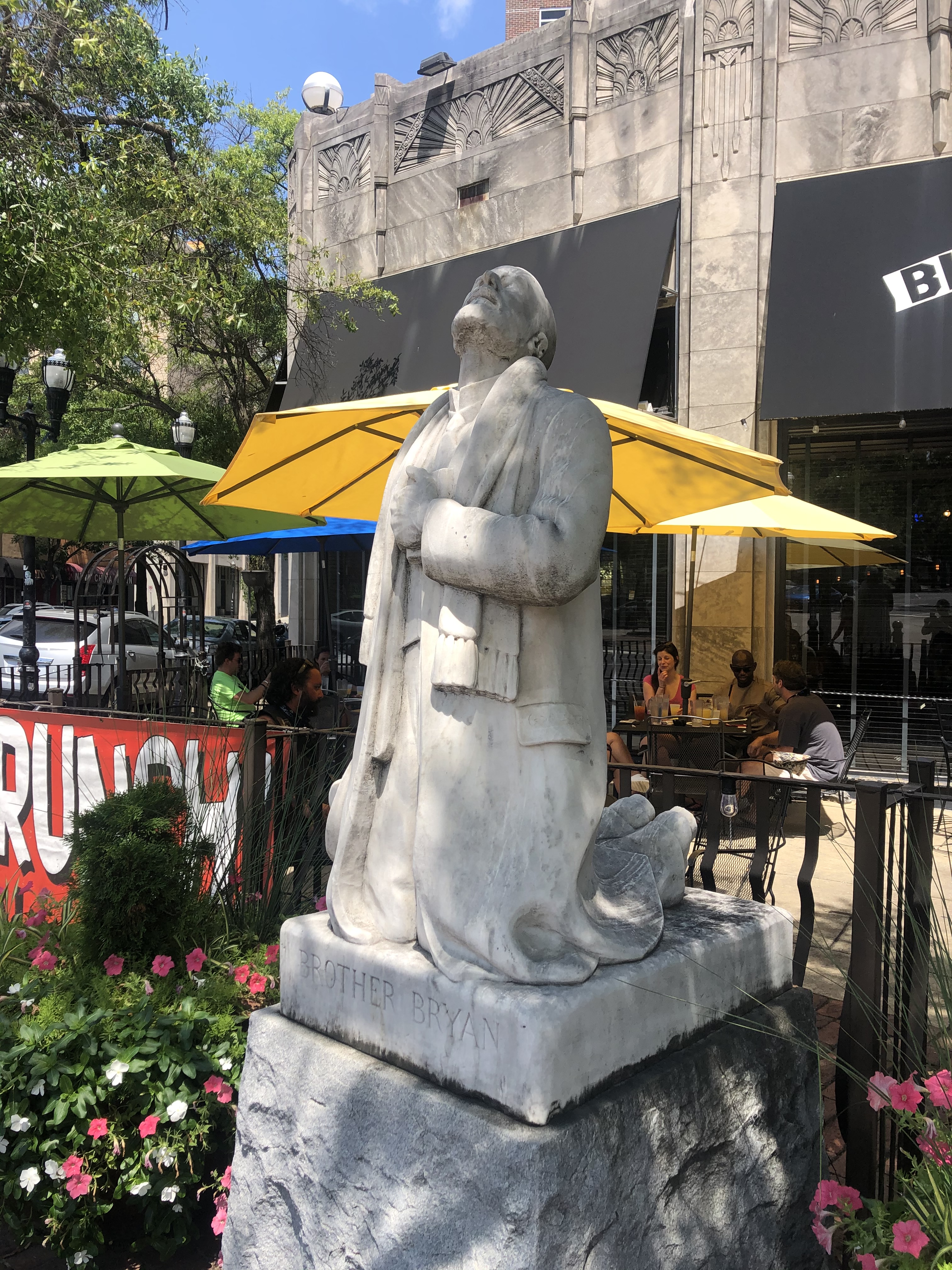

The memorial is a reminder of his heart for the homeless, the less fortunate, his endless work that went towards ministering and aiding as many groups in Birmingham as possible. Brother Bryan remains in the hearts of those changed by him in Birmingham.
His impression was so prominent that even a statue was seemingly not enough. There is also a park that was named after him located one block from the statue, and the Brother Bryan Mission. Founded in 1940, the mission’s goal is to “glorify the Lord Jesus Christ by providing for the physical, emotional and spiritual needs of economically, emotionally, and spiritually impoverished men of the Birmingham area.”
The Brother Bryan Mission continues to carry his legacy through their New Life Fellowship Program. This program is a nine-month Christian program, which enrolls homeless men, some in recovery, and seeks to address the cause of their homelessness. After that, they develop the men and start to break down the barriers that hinder them from returning to a productive life, helping them get stable jobs and housing (Brother Bryan Mission).
Why And How Should He Be Remembered?
Reverend James Alexander Bryan should be remembered for all of his time and energy that he put towards the misfortunate, specifically the impoverished. The long history of poverty in Birmingham remains true to this day. According to 2019 estimates by the U.S. Census, Alabama was the seventh poorest state, with 15.5 percent of its residents living in poverty, compared with the U.S. average of 11.1 percent (Flynt 2023). This long history of poverty really got a start post Civil War, during Byran’s time, when the economic disturbance caused by the Civil War caused Whites to become even poorer, and left Blacks just as poor as they already were. Everyone was struggling to make ends meet and get by. While many gave up and accepted death, sickness, spiritual death, and defeat, Brother Bryan was a light through the darkness, reintroducing many to the saving grace of God. During his time on earth, he married upward of ten thousand people, buried twelve thousand, and won over ten thousand people to faith in Jesus (Curlee 2011, 5).
Members of the Birmingham community should continue to honor and remember Brother Bryan through donations to the Brother Bryan Mission, attending and remembering Third Presbyterian Church, visiting his memorials and simply keeping his name alive. His legacy will forever hold significance in Alabama and so many people and descendants of those he impacted can give their gratitude to him.
Conclusion
Brother Bryan’s life and the work had a profound impact on Birmingham, Alabama, and beyond. Being a pastor, social reformer, and community leader, he dedicated his life to making Birmingham a better place–even if that meant risking his own life and reputation to do it. His legacy proves to be prominent in organizations striving for an end to homelessness, racial injustice, and love for all, ensuring his spirit lives on in the heart of the city that he once served faithfully.
Brother Bryan Statue
Location: 20th Street South and Magnolia Avenue, Birmingham, Alabama, 35203
Form: Marble statue
Artist: William Grant
Carver: Georges Bridges
Created: 1934
Installed: 1983
References
Blakely, Hunter B. 1934. Religion in Shoes; Brother Bryan of Birmingham. Richmond, VA: John Knox Press.
Brother Bryan Mission. Birmingham, Alabama. https://bbmission.com/
Curlee, Bob. 2011. Brother Bryan. Virginia Beach, VA: CreateSpace Independent Publishing Platform.
Flynt, J. Wayne. 2023. “Poverty in Alabama.” Encyclopedia of Alabama. https://encyclopediaofalabama.org/article/poverty-in-alabama/
Editors of Bhamwiki. 2024. Brother Bryan Statue. https://www.bhamwiki.com/w/Brother_Bryan_statue.
Marshall, James Williams. 1977. The Presbyterian Church in Alabama. Presbyterian Historical Society of Alabama.
Nunnelley, William. 2001. Brother Bryan, Samuel Ullman Elected to Men’s Hall of Fame. https://www.samford.edu/news/2001/Brother-Bryan-Samuel-Ullman-Elected-to-Mens-Hall-of-F ame
Peyton Hull ‘27 was a student in UCS 102: Memorials & the Future in Samford University’s Howard College of Arts & Sciences in spring 2024.
 Magic City Religion

2 Comments