An Early American Who Made Dreams of Religious Freedom Come True
By Caroline Oldham
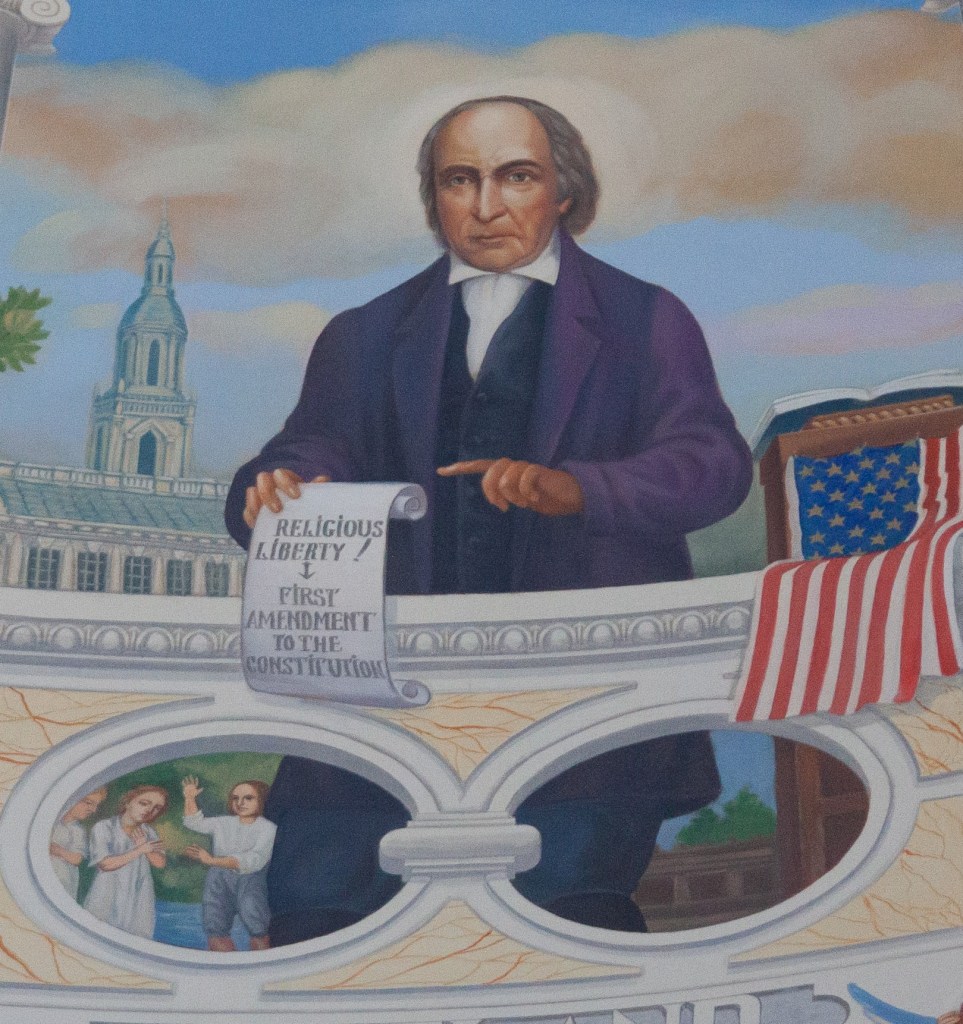
John Leland is depicted in the celling of Hodges Chapel at Samford University. He is one of two U.S. Baptists pictured on the celling and is shown with a patriotic frame, containing the United States flag. He is also shown with Independence Hall in the background, and a paper containing the words “Religious Liberty —> First Amendment to the Constitution.” Each of these images represents the contributions of Leland and his lasting influence on American religion and government.
John Leland was born in 1754 in Grafton, Massachusetts. As a child he was not well educated in school, nor religion. It was not until he was eighteen years old that he heard God speak to him. He heard God say, “You are not about the work you have got to do” (Beck 2012, 66). After hearing this, Leland started exploring Christianity and became a Baptist, due to Baptists’ belief that baptism should be for adult believers only. After perusing it for only two years, Leland gave his first sermon and a year later was ordained. Directly after, he went on a trip for eight months to preach in Virginia. When he returned, he married Sally Divine. Together, they would have eight children. While Leland was sometimes home, he was often away preaching. He traveled and “preached almost 8,000 sermons and baptized 1,278 people.” Leland’s popularity for his preaching stemmed from the “depth, wit, and a dynamic presentation.” He became well known for his ministries and served with the Virginia Baptists as a member of the Committee of Correspondence. He helped unify them into the United Baptists of Virginia, and aided Thomas Jefferson, James Madison, and George Mason ratify the US Constitution in Virginia. During this time, Leland was also continuing to spread the Baptist word through New England and Virginia.
Significance in America
Though Leland had no intentions of becoming a political figure, he turned out to be one of the most well-known advocates for religious freedom in the United States. He became passionate about religious liberty when he started traveling to preach. So much so that when Virginia was considering ratification of the Federal Constitution, Leland ran against James Madison to be Orange County’s representative. This was because the proposed Constitution did not include protection of religious liberty, and Leland wanted to ensure that it did. Leland and Madison decided to meet and agreed to compromise on this issue: Leland would withdraw from the campaign so Madison could support ratification of the Constitution. Once the Constitution was ratified, Madison would work tirelessly for ratification of a Bill of Rights that included religious freedom. Madison was elected. Virginia ratified the Federal Constitution, and soon the Bill of Rights was also ratified. This may not have happened if it were not for John Leland.
Significance in Hodges
Leland is painted on the celling in Hodges Chapel on the campus of Samford University. Samford was established as a Baptist school, and to this day, still holds some Baptist beliefs. Lottie Moon is the second of the two U.S. Baptists shown on the celling. She is most known for her generous mission work abroad and is also an inspiration the Baptists everywhere. It is only right that in the chapel of a Baptist university, there are prominent Baptist figures pictured. If not for Leland, freedom of religion in the United States may have been near impossible to gain. In the mural, Leland is depicted with an American flag flowing. This symbolizes his aid in making America free. He is also pictured hold a paper that says, “Religious Liberty –> First Amendment to the Constitution”, showing that the only route to freedom was through the ratification of the First Amendment. In light of this, Leland worked tirelessly to ensure the amendment was passed. In the bottom left corner of the painting, there is a baptism going on. This is most likely because of the great number of baptisms Leland preformed in his many years of preaching. It could also be an ode to the importance of baptism in the Baptist denomination and the emphasis it has. Lastly, behind Leland’s shoulder, there is a white building. This building is meant to represent a government building, or more specifically Independence Hall in Philadelphia, where the first amendment was ratified.
The Cheese
Leland became a staunch supporter of Thomas Jefferson and vision of American government, he called Jefferson, “the patriarch of liberty, the man of the people, the defender of the rights of conscience, and the greatest statesman that the world had produced.” The two men became friends and Leland strongly supported Jefferson in the election of 1800. At the time, Leland was living in Cheshire, Connecticut. Within the town, Leland swayed so many people to vote for Jefferson that when the voting happened, and there was only one ballot for a Federalist candidate. (Election officials rejected as being invalid!) In a close national race, Jefferson ended up winning the election. In order to give back to the city of Cheshire, Leland decided to put them on the map in the most creative way he could. Leland decided to take milk from every cow in Cheshire (excluding cows owned by Federalists) and make a mammoth cheese that weighed 1,235 pounds. He then delivered this cheese to President-elect Jefferson “on the next New Year’s Day as a token of appreciation and congratulation from the farmers and housewives of Cheshire.” While the Mammoth Cheese is not depicted in Hodges Chapel, it shows Leland’s passion and commitment to the United States and to what he believed in.
John Leland represented freedom in the United States, as does his painting on the celling of Hodges Chapel at Samford. He worked hard to ensure that the students, even now, who walk into the chapel, can worship God how they see fit, and not be limited to the government’s expectations of religion. Leland worked hard for what he was passionate about. He paved the way for more enlightened thinkers in the United States to speak their mind and make change. John Leland displayed what being a good Christian means, as does his memorial in Hodges Chapel.
John Leland
Medium: painting
Artist: Petru Botezatu
Created and Installed: c. 1995
Location: Andrew Gerow Hodges Chapel, Samford University, 800 Lakeshore Drive, Birmingham Alabama, 35229
Bibliography
Beck, Rosalie. 2012. “John Leland: The Consistent Separationist.” Baptist History and Heritage 47 (3): 65–75.
Browne, C. A. 1944. “Elder John Leland and the Mammoth Cheshire Cheese.” Agricultural History 18 (4): 145–53.
Creed, John Bradley. 1986.“John Leland: American Prophet of Religious Individualism.” Ph.D. diss. Southwestern Baptist Theological Seminary.
Dilbeck, D.H. 2012. “‘The Voice of Faithful Tradition’: The Madison-Leland Legend in Nineteenth-Century Print.” Nineteenth-Century Prose 39 (1–2): 303.
Gaustad, Edwin Scott. 1987. “Religious Liberty: Baptists and Some Fine Distinctions.” American Baptist Quarterly 6 (4): 215–25.
Leland, John. 1986. The Writings of the Late Elder John Leland. New York: G.W. Woods.
McConnell, Michael W. 2009. “Reclaiming the Secular and the Religious: The Primacy of Religious Autonomy.” Social Research 76 (4): 1333–44.
O’Brien, Brandon. 2008. “From Soul Liberty to Self-Reliance: John Leland and the Evangelical Origins of Radical Individualism.” American Baptist Quarterly 27 (2): 136–50.
Shurden, Walter B. 2006. “Famous Quotations by John Leland (1754-1841).” Baptist History & Heritage 41 (2): 6–7.
Wardin, Albert W., Jr. 1998. “Contrasting Views of Church and State: A Study of John Leland and Isaac Backus.” Baptist History & Heritage 33 (1): 12–20.
Caroline Oldham ‘27 was a student in UCS 102: Icons & Memorials in Samford University’s Howard College of Arts & Sciences in fall 2024.
 Magic City Religion
1 Comment