The Great Scottish Reformer
By Carson Lehn
John Knox was the most prominent figure in the Scottish Reformation. He is credited with ensuring that the Church of Scotland would be Reformed and Presbyterian. Although he is infamous for his pointed statements about female rulers, he was committed to the Word of God and the reformation of the church. After other major figures of the Reformation were honored in the dome of Hodges Chapel at Samford University, Knox was selected to join John Chrysostom, Jan Hus, and George Whitefield as preachers representing the four periods of church history on the chapel’s pulpit.
The Beliefs of John Knox
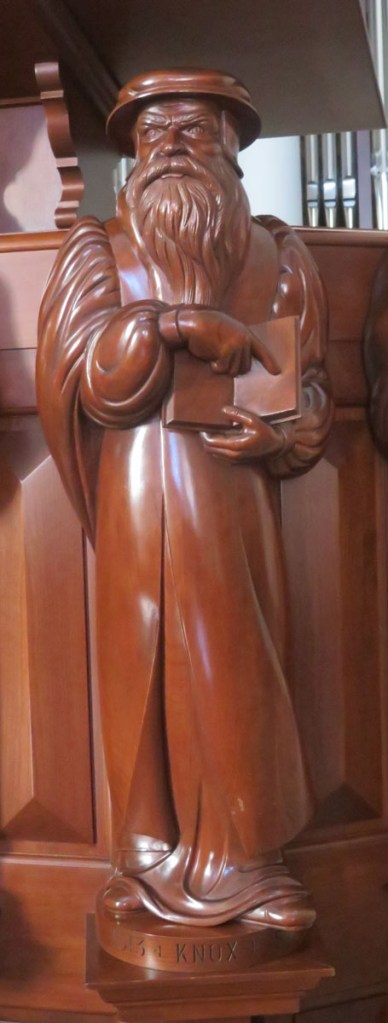
On the pulpit, Knox, is portrayed pointing to the middle of a page of the Bible. This is because of his unwavering devotion to the text. Although Knox was first introduced to the Reformed cause in Scotland, he studied under John Calvin in Geneva. Afterwards he would spread the doctrine of Presbyterianism throughout Scotland. Knox was a strong proponent of authenticity in worship and obedience to God. He was convinced that if an individual has truly accepted Jesus Christ as their lord and savior, then there ought to be identifiable fruits as the result of the work of the Holy Spirit in that person. The opposite also being true, that if an individual bears no fruit for the kingdom of God or others, then it can be assumed that the presence of God is not in that person. As the Scots Confession he helped compose in 1560 declared, “[W]e do not hesitate to affirm that . . . workers of iniquity have neither true faith nor anything of the Spirit of the Lord Jesus, so long as they obstinately continue in wickedness.” Much like Calvin, Knox emphasized the importance of works, but that they do not possess redemptive qualities in and of themselves. The Confession explained, “the cause of good works, we confess, is not our free will, but the Spirit of the Lord Jesus, who dwells in our hearts by true faith.”
Knox also taught that the whole truth has already been revealed through the Bible and that the Spirit is the interpreter that guides us. The Scots Confession stated that in the Bible, “all things necessary to be believed for the salvation of mankind are sufficiently expressed; the interpretation whereof” and that the Bible’s interpretation “does not belong to any private or public person . . . but pertains to the Spirit of God.” Like Martin Luther and John Calvin, Knox emphasized the supremance of scripture above tradition . He argued that members of the body of Christ must constantly look to scripture to knowhow to worship in the way that they do, all in the hope of growing closer to God. Knox stated that no interpretation of scripture should be admitted that is contrary “to any other plain text of Scripture or to the rule of love.”
Knox also had a strong conviction that his actions played a significant role in the struggle between good and evil, particularly, against the Catholic Church (Richard Kyle). It was these convictions that placed John Knox in controversy considering his comments on many prominent female rulers at the time. He insisted upon the preconceived notion of the time, that women were unfit to rule, as is seen in his: “The First Blast of the Trumpet Against the Monstrous Regiment of Women.” Knox was by no means what would be termed nowadays as a misogynist since there have been several letters preserved that he wrote to women that contain none of the rhetoric used in his First Blast (Susan M. Felch 1995). However, that does not exclude the fact that he occasionally let his passion get the better of him. Knox especially thought very unfavorably of Mary of Guise and Mary Tudor, the two most prominent female rulers of his time. Both of them were Catholic, and both attempted to wipe out Protestantism. Considering these circumstances, it is not hard to understand why Knox despised the women in power. Knox had the conviction that if a ruler was infringing upon the religious liberty of the populace, then the people had every right to ignore or overthrow that authority. This belief sounds remarkably similar to the rhetoric of the American colonists leading up to the American Revolution. However, despite this tint on Knox’s reputation, he is still remembered today in large because of his work as the leader of the Scottish Reformation and for heading the Church of Scotland.
The Life of John Knox
John Knox received his childhood education at Haddington and then went on to pursue his undergraduate studies at St. Andrews. While he was serving as a tutor for the sons of two noblemen, he met George Wishart, who was an early Scottish Reformation leader. Wishart is credited with convincing Knox to join the Reformed cause. George Wishart was martyred several years after by Cardinal David Beaton, archbishop of St. Andrews. Only three months later, Beaton was murdered by Protestant conspirators who took refuge in St. Andrews Castle (James Stevenson McEwen 2023). It was then that Knox first preached a sermon at the church at St. Andrews just down the road. This sermon in front of the town gave Knox substantial recognition and launched his career as a reformer.
He was soon taken into captivity by the French who were aiding the Scottish crown, and he remained in France for nineteen months. The English eventually secured his release. Knox ventured to Geneva soon after where he studied under John Calvin. He continued preaching while under Calvin by ministering to Protestant refugees. Knox eventually returned to Scotland in 1559, and thereby oversaw the establishment of the Reformed church. As conflict between England, France, and Scotland ended in 1560, with England emerging as the victor, the door was suddenly left open for religious freedom in Scotland. The formerly suppressed Scottish parliament rushed to seize authority over the nation and Knox and the other reformers insisted they depose of papal authority (James Stevenson McEwen 2023). In the final year of Knox’s life, the massacre of the French Huguenots took place, and this news took a toll on his physical health. Knox travelled down from St. Andrews to Edinburgh one final time and preached at St. Giles Cathedral. He would go on to deliver a few more sermons in front of smaller audiences because his voice had grown so weak (Jane Dawson 2015).
Knox’s Legacy
John Knox will forever be known as the great Scottish reformer who refused to abandon his cause in the face of capture and potential martyrdom. He adopted and proclaimed the doctrine of Calvin and many other reformers and raised the Reformed church from the ground, leading to the rise of Presbyterianism across the country. When one looks upon the face of John Knox in Hodges Chapel, one sees his long, flowing beard, symbolizing wisdom and integrity. His face is also carved with a stern look, suggesting his unrelenting devotion to the Scottish Reformation and the spread of the gospel. He passionately believed in the constant clash between good and evil, and the responsibility of individuals to stand firm in their convictions. This is why John Knox is honored in Hodges Chapel and depicted as the great Scottish reformer.
John Knox
Medium: Carved cherry wood
Artist: Artists of Létourneau Organ Company
Created and Installed: c. 2001
Location: Andrew Gerow Hodges Chapel, Samford University, 800 Lakeshore Drive, Birmingham Alabama, 35229
Bibliography
Cowan, Henry. 1905. John Knox: Hero of the Reformation. Reprinted 1970, New York: AMS Press.
Dawson, Jane. 2015. John Knox. New Haven, CT: Yale University Press.
Felch, Susan M. 1995. “The Rhetoric of Biblical Authority: John Knox and the Question of Women.” The Sixteenth Century Journal 26 (4): 805–22.
Gray, John R. 1939 “The Political Theory of John Knox.” Church History 8 (2): 132-147.
McEwen, J. Stevenson. (2023) “John Knox.” Encyclopedia Britannica. https://www.britannica.com/biography/John-Knox.
The Scottish Confession (1560). Accessed via A Puritan’s Mind. https://www.apuritansmind.com/creeds-and-confessions/the-scottish-confession-by-john-knox/.
Carson Lehn ‘27 was a student in UCS 102: Icons & Memorials in Samford University’s Howard College of Arts & Sciences in fall 2023.
Published: January 3, 2024
 Magic City Religion
Nice post ✍️
LikeLike