From Religious Critic to Christian Enthusiast
By Ivy Hogan
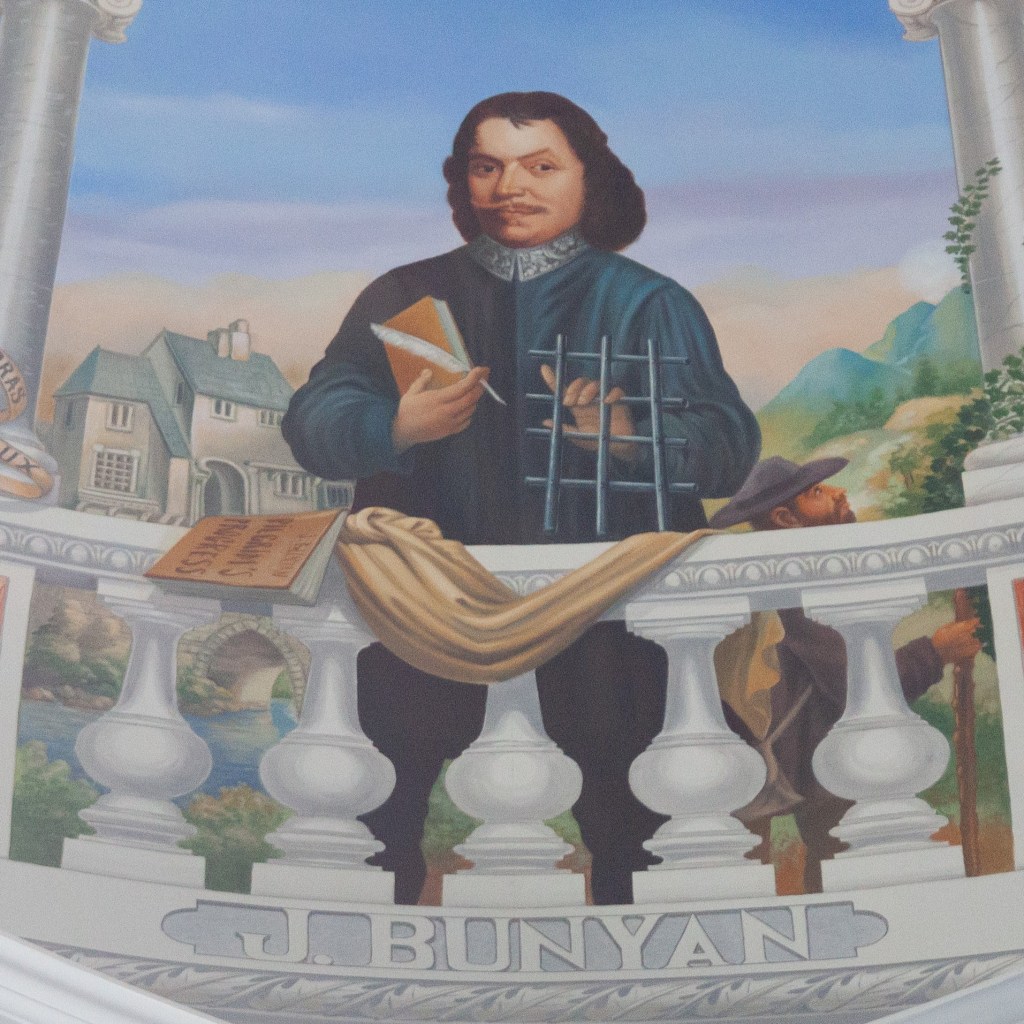
In the dome of Hodges Chapel, there is a painting of John Bunyan. While one may only recall him as the author of Pilgrim’s Progress, the objects that surround him suggest other aspects of his influential life. Being both an author and a preacher, Bunyan is shown wearing a long dark robe and holding a quill pen and notebook in his left hand. In his right hand, Bunyan holds prison bars, which could be interpreted as a representation of the over twelve years he spent in prison because of his faith. The painting’s background depicts images from Pilgrim’s Progress. A man walks along a path with hills and valleys. He looks up towards the sky, which is his acknowledgement of God. Additionally, there is a house in the background that allows the viewer to see Bunyan’s humble upbringing. His house embodies his true desire to let his actions reflect God rather than himself. Although this painting accurately exhibits John Bunyan’s life, one can only truly understand his reasoning and abilities if one knows his supreme dedication to God.
Transformation Change
John Bunyan’s occupations ranged from being in the army to being a preacher. His ability to preach came from his humble conversion to Christianity. Before converting, Bunyan had the tendency to curse and lash out at individuals. While in the army and newly married, he was exposed to the gospel. His wife introduced Bunyan to Christian theology books and accompanied him to church services. This continual exposure of Christianity caused John Bunyan’s conversion. Because of his change in character and comprehension of “the unconditional nature of the gospel,” he believed he gained spiritual freedom (De Vries 2010, 70). Thus, Bunyan’s convictions were the climax for his new beginning. He began pastoring a small church, St. John’s in Bedford.
As a changed individual, he sought to be personable in every interaction to the common man. According to historian Thomas Geoff, “No other great [influence] in the seventeenth and eighteenth centuries was so passionately and fiercely on the side of the common people as was Bunyan” (2014, 57). Due to his radical conversion and humble lifestyle, Bunyan felt called to relate to individuals in small communities. He showed commitment to the people of Bedford by refusing to reform his Baptist beliefs. Due to his faithfulness to God in his teachings, Bunyan was unafraid of the imprisonment threats in England. He was warned three times to refrain from teaching against the Church of England. Refusing to conform to the prominent religious leaders, imprisonment became his reality. Bunyan displayed his spiritual strength through “adherence to the whole counsel of God, avoidance of any hint of scandal, and a readiness to cooperate with any state authorities who would grant freedom and toleration to dissenters” (Thomas 2014, 60). Bunyan’s faithfulness in prison proves to be a blessing to others for generations. His ability to withstand the religious persecution was pivotal; he took advantage of the abundant time given to write down his thoughts and ideas. Thus, Pilgrim’s Progress and Great Abounding were brought into existence.
Bunyan authored Grace Abounding to recount his redemption story. He sought to encourage others that one’s past does not determine one’s future. Through God’s grace and mercy, one can achieve his or her aspirations. Bunyan was a firm believer in the sanctification process. As one is faithful to God’s plan and accepting of his love, one’s passions are aligned to those of God. His willingness to deliver both Pilgrim’s Progress and Grace Abounding for others’ well-being proves that his passions were vastly differing than before his conversion. In the latter years of imprisonment, Bunyan had successfully written fifty-eight books in total, which is a rarity.
Spiritual Leader & Legacy
The famous Pilgrim’s Progress is seen as a prominent object in John Bunyan’s painting. While it is certainly not Bunyan’s only written allegorical story, has proven to be the most notable of them all. Kevin Belmonte suggests, “The impression one gets when leafing through his handsome, carefully documented work is that of a man who has undertaken his own pilgrimage—seeking to recover, as much as can be done, all of the sights, sounds, and settings that shaped John Bunyan” (2010, 12). Bunyan creates this piece through his interpretation of the ideal Christian life. Recalling his own struggles, the trials and successes of the pilgrim reflects, at that time, the average individual. In the book, Hope and Christian’s interactions provide a glimpse of practical sanctification. Hope encourages Christian’s repentant heart after returning from his trap into the glorious Vanity Fair. Indeed, Bunyan’s work can still relate with the present-day person; for example, our challenges may be modified, but there are still valleys amongst the elated hills of accomplishment. The background of the painting illustrates a pilgrim walking along the path set before him. The pilgrim’s upward gaze reflects his reliance on God. The simple fixation portrayed gives insight into the strength of a dedicated Christian. Bunyan wanted to display in a tangible narrative that “the strength of a Christian does not lie in his faith or conversion, but in God to whom he has dedicated his life” (De Vries 2010, 73). Bunyan himself was an example of a Christian pilgrim. Professing his faith publicly in churches and being a Christian author were outward expressions of his continual commitment to Christ.
Therefore, because of his humble conversion and faithfulness to God, John Bunyan has encouraged many individuals for Christ. People have learned greatly about theological differences through Bunyan’s sermons. Pilgrim’s Progress has been translated into over two hundred languages, reaching thousands of people globally. It sold over one hundred thousand copies in its first fifteen years of publication. The global distribution of Pilgrim’s Progress has influenced how many people view the Christian life. Most importantly, John Bunyan’s personal conversion is a tangible example showing how one’s life can be used for the betterment of society. His life-long dedication is inspiring; one must be willing to reflect and strive to have the same selfless attitude for the gospel.
John Bunyan
Medium: painting
Artist: Petru Botezatu
Created and Installed: 1995
Location: Andrew Gerow Hodges Chapel, Samford University, 800 Lakeshore Drive, Birmingham Alabama, 35229
Bibliography
Banks, John S. 2019. “The Trinitarian Thinking of John Bunyan in The Pilgrim’s Progress.” Evangelical Quarterly 90 (3): 231–45. http://www.doi.org/10.1163/27725472-09003003.
Belmonte, Kevin. 2010. John Bunyan. Nashville, TN: Thomas Nelson.
De Vries, Pieter. 2010. “John Bunyan and His Relevance for Today.” Puritan Reformed Journal 2 (1): 67–74.
Harrison, G.B. 1967. John Bunyan: A Study in Personality. University of Michigan: Archon Books.
Thomas, Geoff. 2014. “John Bunyan: His Life, Writing, and Influence.” Puritan Reformed Journal 6 (2): 53–64.
Ivy Hogan ‘27 was a student in UCS 102: Icons & Memorials in Samford University’s Howard College of Arts & Sciences in fall 2024.
 Magic City Religion
1 Comment