Egyptian Defender of Christ’s Divinity
By John P. Galloway
When you first think of Christianity, an Egyptian priest and scholar is not usually who you would think of immediately, and you especially would not expect to see his portrait hanging among the likes of the Paul the Apostle and Martin Luther. However, Saint Athanasius, the patriarch of Alexandria, famous for his works at the Council of Nicea, and a long-time exile for his faith, appears in Hodges Chapel among his fellow saints. Born to a Christian family in Egypt, Athanasius became a major religious figure in the fourth century. He would even be exiled by the emperor of the eastern half of the Roman Empire, Constantine. However, he continued his glorious work, fighting to stop the spread and beliefs of Arianism, which stated that Jesus was not equal to God the Father in terms of importance and divinity. He served as a priest and a bishop in the church of Alexandria for many years, and was a faithful servant of the Lord.
Life and Legacy
Athanasius was born in the 290s in Alexandria. While little to nothing is known about this family and his early life, the first concrete works we have of his life start when he entered the service of the priesthood in Alexandria. He learned much under the previous head bishop, a man named Alexander, who had spent most of his career fighting the ideology of Arianism. Athanasius continued on Alexander’s opposition to the theory, and fought other Arian priests and bishops for years. In the year 336, he was exiled for the first time from the Eastern Roman Empire for disagreeing with a group of bishops about the treatment of certain Arian prisoners. The two opposing parties met in Constantinople, and then Emperor Constantine exiled the bishop without even a trial.
He continued his work in the faith, however, and brought the word of God to the Rhineland, where he had been exiled. Many lobbied for his return, including Pope Julius I, who wrote on his behalf after the renewal of his exile by Constantine’s son, Constantius. After fleeing to Rome, he was given protection by Constantius’ brother, Constans. In 346, Constans’s influence secured his return to Egypt, where he was welcomed as a popular hero (Hardy 2023). However, after two more renewals of his banishment, he ended out his life with publishing apologetics letters, which he affirmed his faith and much more (Athanasius 1946). He championed the orthodox faith by holding fast to his belief that Christ was and is truly the same as God, both in flesh and in spirit.
The Artwork
The artwork presented in the chapel shows Athanasius holding a scroll that reads (in Greek) “The Word became flesh.” This phrase from was the slogan of the orthodox in Alexandria, representing their belief that Christ was fully God, and therefore just as important as God the Father. Athanasius appears in the chapel dome holding a symbol of the Holy Trinity, which he staunchly defended against the Arian believers all throughout his storied life. Athanasius stands before typical Roman architecture, telling us about his past and where his faith was founded. He is dressed in the simple robes a clergyman would wear, showing his natural humility and willingness to put others before himself.
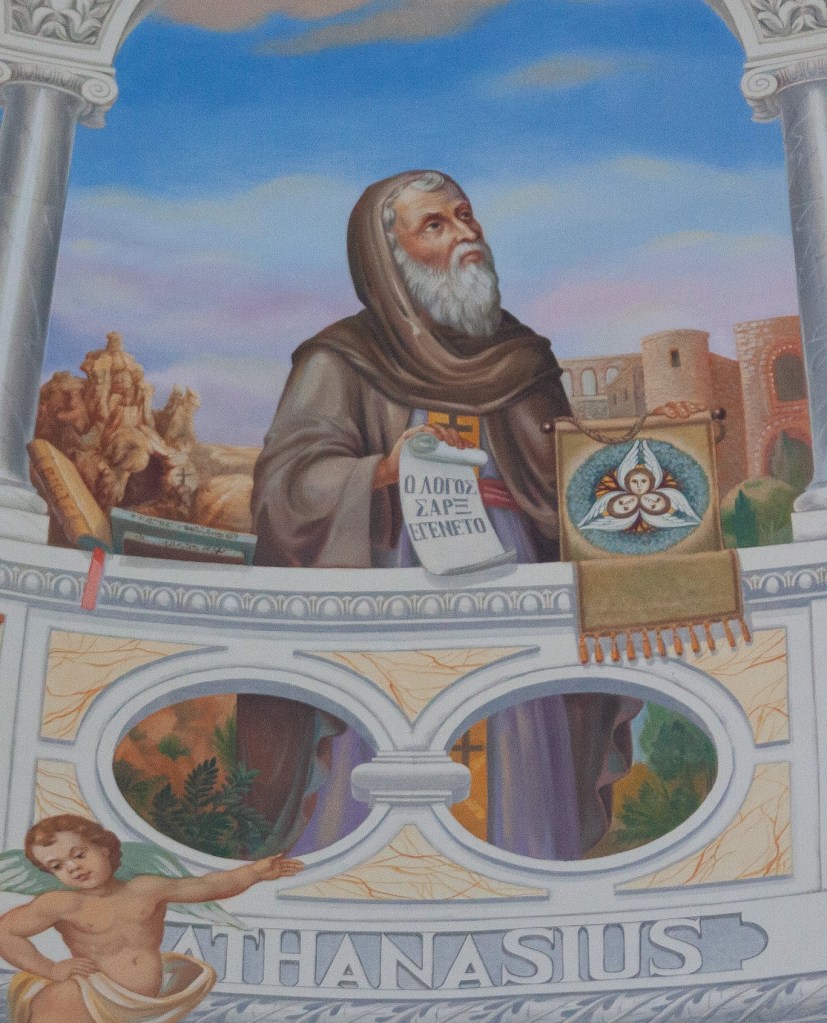
Finally, in the background, a cave is shown, which I believe represents several things. Athanasius was known best for his literary works, the most famous of which was the biography of Anthony, a famous Christian prophet. It also symbolizes his multiple exiles, and how his faith shielded him from the desolate world, just like the cave he used for shelter. The imagery in this painting captures the story and ideals of Athanasius well, and it serves as a fitting reminder of the early church’s true nature and beliefs, and how it was shaped by great men like Athanasius.
Conclusion
Without Saint Athanasius, we would not have some of the same beliefs that we hold today, and perhaps Christ would not be seen as wholly God and wholly man. Saint Athanasius is depicted as one of the many witnesses and Christian figures on the walls of Hodges Chapel, a man immortalized among fellow believers like Martin Luther and Thomas Aquinas. He certainly earned his spot among them for his important work, and will forever be revered as a man dedicated to God’s work.
Athanasius
Medium: painting
Artist: Petru Botezatu
Created and Installed: c. 1995
Location: Andrew Gerow Hodges Chapel, Samford University, 800 Lakeshore Drive, Birmingham Alabama, 35229
Bibliography
Anonymous. August 19, 2023. “Athanasius of Alexandria.” New World Encyclopedia. https://www.newworldencyclopedia.org/entry/Athanasius_of_Alexandria.
Athanasius. 1946. The Incarnation of the Word of God: Being the Treatise of St. Athanasius, De Incarnatione Verbi Dei. New York: The Macmillan Company.
Clifford, C. 1907. St. Athanasius. In The Catholic Encyclopedia. New York: Robert Appleton Company. http://www.newadvent.org/cathen/02035a.htm
Cross, F. L. 1945. The Study of St. Athanasius: An Inaugural Lecture Delivered before the University of Oxford on 1 December 1944. Oxford: Clarendon Press.
Hardy, Edward R. 2023. “St. Athanasius.” Encyclopædia Britannica. https://www.britannica.com/biography/Saint-Athanasius.
Reeves, Ryan. 2016. “Who Was Athanasius and Why Was He Important?” The Gospel Coalition. May 9, 2016 https://www.thegospelcoalition.org/article/who-was-athanasius-and-why-was-he-importa nt/.
Parker Galloway ‘27 was a student in UCS 102: Icons & Memorials in Samford University’s Howard College of Arts & Sciences in fall 2023.
 Magic City Religion
1 Comment