An Icon of An Iconoclast
By Leah Watson
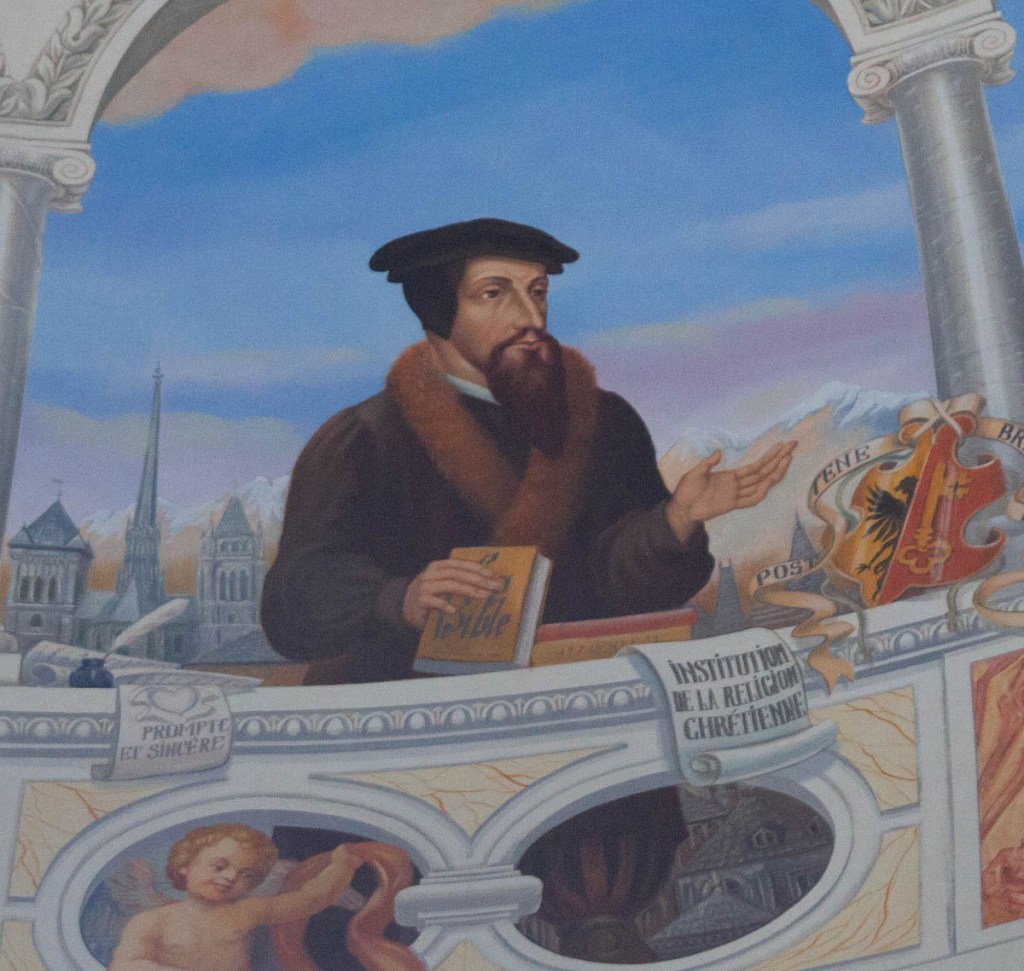
Universities often memorialize outstanding historical or religious figures that reflect the institution’s values and beliefs. John Calvin of Geneva is one such figure painted for presentation in Samford University’s Hodges Chapel. Calvin’s influential life as a Christian theologian who shaped education and the modern church inspired Samford to represent him among fifteen other saints in the dome.
Biography
John Calvin was a French Protestant theologian during the 1500s. At his father’s urging, he earned his license as a young man to practice law in France. Calvin joined the Reformed
tradition after he broke from the Roman Catholic Church in 1530. He learned Greek to study the New Testament while promoting Luther’s reformation of the church. He published his first apologetic, or defense, in 1536, called Institutes of the Christian Religion. Calvin married Idelette de Bure, who supported his theology, and while none of their children survived into adulthood, it did not cause a strain on their otherwise happy relationship. Though Calvin was originally inspired by Martin Luther, by the end of his life he was internationally recognized for his own view of the Christian faith, known as Calvinism.
Calvin’s theology and doctrines are best summarized by the acronym TULIP. The acronym stands for total depravity, unconditional election, limited atonement, irresistible grace, and the perseverance of the saints. As “the first reformer to develop a complete doctrine of the Christian faith from a Protestant point of view,” he believed in the original sin inherited by everyone since the fall of man (Bauer 2017, 1). Life to Calvin was, though a curse, to be lived for God’s glory. Humans could know God, but “because of humankind’s fallen nature and sinful choices, Calvin maintained that we fight with and struggle with this awareness of the divine” (McGee 2022, 216). His fundamental belief in predestination argues against free will, with God knowing all that is to come. Calvin’s seminal apologetic, Institutes of the Christian Religion, is his most recognizable work and is displayed alongside him in the image in Samford’s Hodges Chapel. The defense’s popularity during his lifetime encouraged Calvin to publish five total editions, yet his main points never deviated, and ultimately brought him to Geneva, Switzerland.
Calvin spent most of his adult life in Geneva, and for a few years served as the city’s preacher. There he brought significant encouragement to the already established Reformed in the city as he continued his writing. Yet, some citizens were opposed to his harsh lectures, creating controversy around Calvin. Politically, he called for separation between church and state. Calvin was also known as an iconoclast for his destruction of traditional Catholic imagery. He thought some art to be too worldly and selfish. His disputed teachings led him to be expelled from Geneva for three years, but he was able to return.
Before his untimely death due to his poor lifestyle, Calvin requested to be buried in an unmarked grave. As an iconoclast, he had hoped not to become an idol to the followers he gained during his lifetime of preaching. Calvin thought of himself as a humanist, and ultimately brought movement to the Protestant Reformation after Martin Luther’s initial production.
Influence on Modern Society
The scope of modern culture today influenced by John Calvin is broad. Education, church denominations, and even hymns contain some aspect of Calvinism. Tributes can be recognized in Presbyterian, Baptist, Anglican, Independent, and even Catholic churches. Many institutions in America can be traced back to the Puritans, and their heavy focus on Calvinism. Though he faced critics, calling him a heretic, miser, and short-tempered, both during and after his death, his work can still be appreciated for what it has contributed to society overall (Bèza 1997, 127). As part of the Reformation, Calvin helped build the beliefs that Western Christianity is based on today.
One of the most prominent results of Calvin’s life is the secondary school, Collége
Calvin, founded in 1559. It was the first accessible public school in Geneva, built on Calvin’s doctrines on education. The academy boasted independence from outside forces and insider control, unlike many Catholic and government schools during the time (Hall 2008, 15). Calvin’s priorities towards education also differed because of their Protestant perspective, “rather than a crusty and stale intellectualism, the aim of his pedagogy is to affect the will” (Sosler 2023, 1).
He argued that “the will is foundational for the task of education and for authentic knowledge” (Sosler 2023, 88). In Catholic and Protestant churches, the desire to pursue biblical knowledge over science and intellect was common. This was not always the case in schools, but Samford University is one of few modern schools that prioritizes it, reflecting Calvin’s example of a Christian school.
Ancient philosophy reconsidered from a Protestant standpoint was another new field for Calvin. With his classical training prior to his law degree, Calvin was arguably on a level similar to the late Romans (Steinmets 2009, 1). There is an overlap between the two cultures where certain philosophies still align with biblical values: “Calvin employs the same critique of the Stoics while contrasting the Christian virtues of hope and patience” (Sytsma 2020, 8). He viewed philosophy as an ongoing conversation with the dead that contributed to his own theological writing (Steinmets 2009, 3). Calvin’s studies of the soul and life after death through a classical and philosophical lens have become a template for Christian liberal arts programs.

Hodges Chapel
Near the center of the Samford University campus lies Andrew Gerow Hodges Chapel, named after a friend of Ralph Beeson, the building’s donor. Opened recently in 1995, it is known as “A Sermon in Stone” because of its artistic representation of the Gospel message as a part of its architecture. The dozens of images in the chapel represent the beliefs of Samford’s Beeson Divinity School and its commitment to “the theological principles characterized in the Protestant Reformation” (Samford 2023). Samford’s partiality to the Reformation is seen in its teachings of the Reformation and celebration of its 500th anniversary.
Before the chapel was completed, the faculty selected sixteen saints to be represented in the chapel’s dome. John Calvin, like several others also painted, was chosen for his contribution to the Reformation, as Samford is a Baptist-affiliated university. Calvin is drawn near two other Reformation leaders, Martin Luther and Thomas Cranmer, and together the three represent the three major branches of the magisterial Reformation.
In the image, Calvin is depicted holding a Bible, while a couple more of his best works are displayed around him, as well as the coat of arms of Geneva. The Bible represents Calvin’s “accurate and clearly expressed understanding of Biblical truth”, meaning he simply interpreted the Bible how he saw fit (Hall 2008). To the right of Calvin is a parchment with the title “Institutes of the Christian Religion”’ written in French, referencing his first major theological work from 1536. Beside this is the coat of arms of Geneva memorializing Calvin’s devotion to the city, as well as honoring the work he contributed as a pastor to the Reformation in Switzerland and across Europe. Behind Calvin’s other side is the Saint-Pierre Cathedral in
Geneva, which he embraced as his home church while preaching in the city. The Cathedral also happens to be adjacent to Calvin’s school (Hall 2008). In front is another paper with Collége Calvin’s motto, “Prompte et sincère” or “promptly and sincerely”. With the heart above it, it encapsulates Calvin’s offering of his heart as a dedication to the Lord, though the symbol of a heart related to Calvin did not appear until after his death. It is unknown what Calvin, as an iconoclast, would have thought of his image in the Hodges Chapel dome. Perhaps he might have appreciated the efforts and thought taken to accurately represent his life’s work, but more likely he would have thought it too materialistic.

A Samford education and degree promises to instill values that also resemble Calvin’s take on education. He was aware that humankind cannot obtain all knowledge, however he believed in pursuing an education founded on the Word of God. One program at Samford, the University Fellows, acts as the campus’s honors program, giving the selected students a classical and liberal arts education. The curriculum contains a heavy focus on the same philosophers that Calvin himself studied, such as Aristotle and Plato. Those who know Calvin’s history can see his theology represented in the program and image. From it, the viewer can interpret his legacy as a part of the Reformation and Samford University.
Conclusion
Calvin’s theology is still present and discussed throughout campus in lectures, debates, and worship. It is important to Samford to have his memorial in Hodges Chapel as a reminder of the foundation Christianity is built upon. Samford University encourages visitors to explore Hodges Chapel themselves once renovation is complete in late 2023.
John Calvin
Medium: painting
Artist: Petru Botezatu
Created and Installed: c. 1995
Location: Andrew Gerow Hodges Chapel, Samford University, 800 Lakeshore Drive, Birmingham Alabama, 35229
Bibliography
Bauer, Caroline. 2017. “The Necessity to Work, According to John Calvin’s Duty of Stewardship.” European Journal of the History of Economic Thought 24 (4): 689–707. doi:10.1080/09672567.2017.1332663.
Bèza, Théodore de. 1997. The Life of John Calvin. Webster, NY: Evangelical Press.
Hall, David W. 2008. The Legacy of John Calvin: His Influence on the Modern World. of Calvin 500 Series. Phillipsburg, NJ: P & R Publishing.
McGee, Iain. 2022. “Reconsidering the Sensus Divinitatis in the Light of the Semen Religionis: John Calvin and Non-Christian Religion.” European Journal of Theology 31 (2): 215–39. doi:10.5117/EJT2022.2.003.MCGE.
Samford University. 2023. “Hodges Chapel.” Andrew Gerow Hodges Chapel, Beeson Divinity School. https://www.samford.edu/beeson-divinity/hodges-chapel.
Samford University. 2023. “About Beeson.” About Beeson Divinity School. https://www.samford.edu/beeson-divinity/about.
Sosler, Alex. 2023. “With No Will, There Is No Way: John Calvin on Education.” Christian Education Journal 20 (1): 87–103. doi:10.1177/07398913231178842.
Steinmets, David C. 2009. “Calvin as Biblical Interpreter Among the Ancient Philosophers.” Interpretation: A Journal of Bible & Theology 63 (2): 142–53. doi:10.1177/002096430906300204.
Sytsma, David S. 2020. “John Calvin and Virtue Ethics: Augustinian and Aristotelian Themes.” Journal of Religious Ethics 48 (3): 519–56. doi:10.1111/jore.12324.
Leah Watson ‘27 was a student in UCS 102: Icons & Memorials in Samford University’s Howard College of Arts & Sciences in fall 2023.
Published: January 2, 2024
 Magic City Religion
2 Comments