The Greatest Father of Africa
By Holt Cole
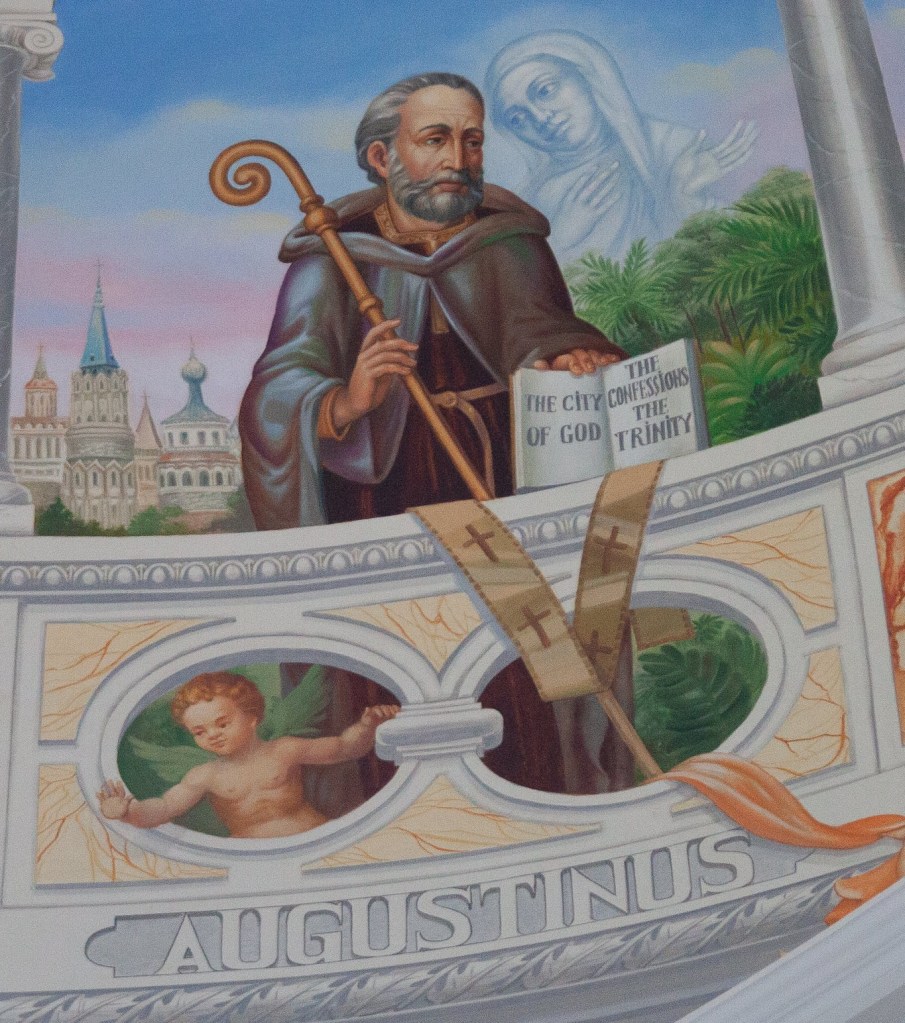
It should surprise no one, that when Beeson Divinity School decided to depict sixteen key figures from through Christian history in its dome one of them was Augustine of Hippo. Augustine had a tremendous influence on both the medieval church and the Protestant Reformation. Indeed, the official guidebook to Hodges Chapel describes Augustine as simply “the greatest of the Fathers of the Church” (Beeson Divinity School). What is interesting, however, is how Augustine is depicted, particularly the prominent role of his mother Monica in the Hodges Chapel painting. Before diving into the iconography of Augustine in Hodges, it is important to understand who exactly the saint of Hippo was.
Augustine is a key figure in the Christian world as both a theologian and writer. He was born in 354 in the city of Thagaste to parents Patricius and Monica, the latter would be extremely influential in his life. Augustine began his education in Thagaste and would later go to the college town of Madauros and finish his studies in the greatest city in Africa, Carthage. He then taught for a brief period in Thagaste before moving elsewhere. During this time Augustine was a rhetorician, and a very good one at that. He traveled to teach both in Rome and Milan before eventually returning home. He then unexpectedly became a clergyman in Hippo and spent the rest of his life there. In 396 he became the bishop of Hippo and retained that position until he died in 430. In his later life, Augustine began to write his most famous works such as Confessions, The City of God, and The Trinity. These works, along with some theological arguments expressed in other sources are what earned Saint Augustine of Hippo the status as one of greatest church fathers. Perhaps he is the greatest of them all. Augustine was an extremely influential figure in the early church, and he still is today
Major Writings
In his depiction in Hodges Chapel, Augustine stands beside a book with the titles of some of his most famous works. These include Confessions, The City of God, and The Trinity. Each of these books is extremely important. For example, Augustine’s Confessions, written between 397 and 400, is an autobiography that not only tells the story of his life but also of the theological struggles he faced as a young man. This book is full of theological arguments about subjects ranging from sin and evil to love and desire. Desire is a central theme for Augustine. He argued that even sin is motivated by a desire for something God created. In sin, a good impulse has become perverted.
Augustine’s next major work, The City of God, took around a decade to write. The focus of this book is the two cities: the city of God and the earthly city. Augustine has two main arguments in this work. The first is against those who blamed Christians and their god for failing to protect Rome during the invasion by the Vandals. Augustine states that if it were not for Christians the carnage and destruction would have been much worse, as Christians took in and cared for others. The second is that Rome, being an earthly empire, was always doomed to fade and fall away as all things of this world do. The city of God is a place of place where people have left their earthly desires to solely pursue Christ, whereas the earthly city is a place of sin, darkness, and pleasure. As can be seen through his two arguments, the Roman Empire and the Vandals can be seen representing the earthly city. Meanwhile, Christians, who aided their neighors after the attacks, represented the idea of the city of God.
The last of the major works of Augustine represented is The Trinity. This work is Augustine’s attempt to explain the Trinity and show how it can be seen in nature so that we may understand the idea of God being three in one. His attempts to define the Trinity can be seen earlier in Confessions where he tries to but is unsuccessful in expression the exact teaching of the doctrine.
An intriguing story that emerges from Augustine’s work on the Trinity is that of the child on the seashore. The story goes that as Augustine was attempting to articulate the Trinity to better understand it, he ran into a child digging a hole by the ocean. The child claimed that it was going to soak up all the water of the ocean into the tiny hole it had dug with a spoon. Augustine replied by saying that was simply impossible. In return, the child said, “Indeed, but I will sooner draw all the water from the sea and empty it into this hole than you will succeed in penetrating the mystery of the Holy Trinity with your limited understanding.”
Augustine turned around in astonishment, but when returning his gaze to the child, it was gone. While acknowledging the idea that the triune God far surpasses human understanding, Augustine strived to find examples so that we might scratch the surface of comprehending the idea of the Trinity. One of the first ways Augustine identified a triune object in human nature is love. There is the lover, the loved, and then love itself. However, there was not enough in that argument, so Augustine continued to search for a better image. Augustine eventually concludes that his perfect image is within the mind. The process of memory, knowledge/understanding, and will/love is what Augustine defined as the most succinct image of a triune object in human nature.
The Importance of Monica
What makes the painting of Augustine in Hodges Chapel stand out from the usual depictions of Augustine is the ghostly figure watching over him. This is his mother, Monica. There are a few potential reasons why she is depicted as looking over Augustine in Hodges. One of the potential reasons is the attempt to include another faithful female character in the dome of Hodges, as only two of the sixteen named figures are women. However, I think, the real reason why she makes the cut is because of her influence on Augustine’s life.
Monica was, as most Christian mothers are, very concerned about the salvation of her child. This can be seen throughout the Confessions, when she is reported to be urging Augustine to be baptized and turn from the evil ways of his youth. Augustine was eventually baptized and converted into one of the most prolific and influential church fathers. However, during his sinful youth, Monica repeatedly prayed for Augustine’s soul and pleaded with him to turn to God. In book 3 of Confessions, Monica pleads to a priest that her son would be saved and the priest responded, “Do not worry. It is not possible that the son of so many tears should be lost forever.” This shows the intensity with which Monica prayed that her son would not be lost to God. Augustine’s later conversion clearly shows that all his mother’s prayers were not in vain and very well could have been a major factor in his salvation. Because of the impact of his mother and her constant prayers for Augustine’s salvation, Monica was depicted looking over Augustine in the painting in Hodges Chapel.
Other Iconographic Details
While Saint Augustine’s mother and his three major works are the more prominent objects of the painting, there are many smaller details to be noted. For instance, in the background of the painting are many churches of many different designs, these suggest the wide reach of Augustine’s writings and teachings. Another small detail is the palm branches on the opposite side of the churches. These represent the Mediterranean coast where Augustine lived for most of his life. One other notable object in the painting is the staff he is holding. This staff by Augustine is known as a crozier, and is carried by bishops, like him, to represent their office.
Interestingly, the painting in Hodges omits one of the most common symbols of Augustine: a flaming heart. Such a heart can be seen in virtually every other image of Augustine. It represents his ideas of desire and being on fire for God. However, in his painting in Hodges Chapel, Petru Botezatu deemed it more important to depict the significance that Monica had in Augustine’s life.
Conclusion
Saint Augustine of Hippo was an extremely influential figure in both the early and modern church. Without him, there truly is no telling what the present-day church would look like. Although Augustine’s unbridled youthful desires carried him wherever his heart desired, through his mother’s prayers and God’s overarching plans, he became much more than a rhetorician. He became the greatest theologian of the Western Church. To this day. his works have stood the test of time and influenced millions around the world. Thus it is natural that he would be among the sixteen Christian witnesses depicted in the dome of Hodges Chapel.
Saint Augustine of Hippo
Medium: painting
Artist: Petru Botezatu
Created and Installed: c. 1995
Location: Andrew Gerow Hodges Chapel, Samford University, 800 Lakeshore Drive, Birmingham Alabama, 35229
Bibliography
Beeson Divinity School, n.d.. Andrew Gerow Hodges Chapel. Birmingham, AL: Samford University, https://www.samford.edu/beeson-divinity/files/hodges-chapel-guidebook.pdf
Brown, Peter Robert Lamont. 2000. Augustine of Hippo : A Biography / Peter Brown. University of California Press.
Drilling, Peter. 2006. “The Psychological Analogy of the Trinity: Augustine, Aquinas, and Lonergan.” Irish Theological Quarterly 71 (3/4): 320–37. http://www.doi.org/10.1177/0021140006075751.
Medievalists.net. 2019. “The Child by the Seaside: A Medieval Story about Saint Augustine.” Medievalists.Net, February 2019. https://www.medievalists.net/2019/02/the-child-by-the-seaside-a-medieval-story-about-saint-augustine/.
O’Donnell, J. 2023.”St. Augustine.” Encyclopedia Britannica. https://www.britannica.com/biography/Saint-Augustine.
Holt Cole ‘27 was a student in UCS 102: Icons & Memorials in Samford University’s Howard College of Arts & Sciences in fall 2023.
 Magic City Religion
1 Comment